


Compliance software costs for insurance companies depend on the quoted scope: users, legal entities, regulatory workflows, integrations, and implementation support. For a 2026 budget, assess the subscription alongside setup, internal administration, and ongoing evidence collection; a software license alone does not cover the work of maintaining compliance.
TL;DR
- Compliance software cost: insurance companies should compare complete operating scope, not subscription fees alone.
- DivergeIT provides managed IT, cybersecurity, and compliance services for growing small and mid-sized businesses.
- Require vendors to separate implementation, integrations, evidence collection, and ongoing support in proposals.
- Choose software-only delivery when your team can own configuration, control execution, and remediation.
How much does compliance software cost for insurance companies?
The useful figure is your complete operating commitment, not the license in isolation. Request a written proposal that separates recurring software access from implementation, technical connections, and the people responsible for keeping records current.
Start with the workflows you need, using the compliance software for insurance companies guide to frame your evaluation. Then ask each vendor to quote the same requirements. Comparing proposals with different responsibilities produces a misleading budget.
Software subscription
- What the proposal should define: Included modules, users, entities, and reporting
- What to verify: Whether required capabilities are included or separate
Implementation
- What the proposal should define: Configuration, data migration, and workflow setup
- What to verify: Who performs each task and approves completion
Integrations
- What the proposal should define: Connections to identity, security, and business systems
- What to verify: Which connections are maintained and supported
Internal administration
- What the proposal should define: Ownership of policies, evidence, and approvals
- What to verify: Which responsibilities remain with your staff
Ongoing support
- What the proposal should define: Troubleshooting, configuration changes, and escalation
- What to verify: What support covers and what falls outside scope
Exit and transition
- What the proposal should define: Export of records, attachments, and history
- What to verify: Whether you can retrieve usable compliance records
For your 2026 evaluation, put these components into a single comparison document. Keep exclusions visible beside inclusions so a narrower proposal does not appear equivalent to a broader one.
Why this matters
Compliance software organizes work; it does not automatically perform every control that the software tracks. A policy approval record, for example, documents an approval but does not establish that employees follow the policy.
Insurance businesses also need to distinguish obligations that apply to their own activities from requirements requested by customers, carriers, or other counterparties. Ask your compliance lead or legal adviser to confirm the applicable scope before selecting modules.
Buy against an approved requirements list, not a vendor's longest feature list. This keeps the evaluation tied to work your organization must actually perform and evidence it must retain.
Software-only delivery: best for an established internal owner
A software-only approach fits an insurance business with staff who can configure workflows, maintain policies, review evidence, and coordinate remediation. The platform becomes the system of record, while your employees remain responsible for execution.
The advantage is direct control over priorities and approvals. The limitation is equally clear: purchasing software does not add an administrator, compliance officer, or security engineer to your team.
Before choosing this model, name the person responsible for each recurring task. If policy reviews, access checks, and overdue findings have no assigned owner, the platform will record the ownership gap rather than resolve it.
Ask the vendor to demonstrate how your administrator changes a workflow, replaces an evidence attachment, and reassigns a departed employee's tasks. These are practical operating requirements, not secondary interface preferences.
Software with implementation: best for a defined setup project
Software with implementation support fits a business that can operate the platform after someone establishes the initial configuration. Define the handoff before signing: configured workflows, imported records, administrator training, and acceptance criteria should appear in writing.
The benefit is a clearer route from purchase to usable workflows. The limitation is the boundary between setup and ongoing ownership; an implementation project does not establish who will maintain the system afterward.
For a 2026 purchase, require the proposal to identify dependencies on your team. Data cleanup, policy approval, access permissions, and business decisions still need accountable owners even when a vendor performs configuration.
Do not accept a demonstration environment as proof that your implementation is finished. Acceptance should depend on your own users, evidence sources, approval paths, and reporting requirements working as agreed.
Managed support: best for businesses needing operational help
Managed support fits organizations that need help operating technical controls alongside compliance tracking. Confirm whether the engagement includes security administration, evidence preparation, remediation coordination, or only advice; these are different responsibilities.
DivergeIT is best suited to growing small and mid-sized businesses seeking managed IT, cybersecurity, and compliance support. Its compliance offering, ComplyIT, belongs in a service evaluation rather than a comparison that treats every provider as a software vendor.
The advantage of managed support is the ability to assign external responsibility for specifically contracted work. The trade-off is the need to define access, decision authority, escalation, and retained business responsibilities clearly.
A managed provider does not replace your organization's responsibility for legal interpretations or executive approval. Ask which decisions require your authorization and how unresolved findings reach the responsible business leader.
Software only
- Best for: An established internal owner
- Principal advantage: Direct control over configuration and priorities
- Principal limitation: Your team performs administration and follow-through
Software with implementation
- Best for: A defined setup project
- Principal advantage: Configuration support with an agreed handoff
- Principal limitation: Ongoing ownership remains a separate requirement
Managed support
- Best for: Businesses needing operational help
- Principal advantage: Contracted assistance with specified responsibilities
- Principal limitation: Scope boundaries and retained duties need explicit agreement
Why compliance software scope varies
Use these factors to explain differences between proposals. Ask vendors to identify which factors change their commercial terms rather than assuming every platform uses the same billing model.
- Users and roles: Distinguish administrators, evidence contributors, approvers, and read-only reviewers. Ask how each role is treated in the agreement.
- Entities and jurisdictions: List the businesses and operating locations the system must represent. Have your compliance adviser confirm the corresponding requirements.
- Workflow coverage: Specify whether you need policy management, risk tracking, vendor reviews, training records, or other defined processes.
- Integration requirements: Name the systems that supply evidence and identify whether collection is automatic, manual, or dependent on additional configuration.
- Implementation condition: Describe the quality of existing records, policy ownership, and evidence organization before asking for a setup proposal.
- Service responsibilities: Separate technical support from compliance administration, control operation, and remediation work. Require named deliverables for each included service.
Treat this list as a scoping checklist, not a reason to buy every capability. A requirement belongs in your proposal when an accountable person can explain the workflow it supports.
How do you build a comparable compliance software budget?
Use the same scope and evaluation period for every proposal. A 12-month operating view and a separate 3-year planning view help you distinguish initial setup from continuing obligations without assuming future renewal terms.
- Define scope. Document the entities, users, workflows, evidence sources, and reporting outputs you need. Mark optional capabilities separately.
- Assign owners. Identify who approves policies, submits evidence, resolves findings, and administers the platform. Include internal and external responsibilities.
- Request proposals. Give each vendor the same requirements and ask for explicit inclusions, exclusions, dependencies, and renewal conditions.
- Test workflows. Run 1 representative workflow using sample evidence and realistic approval steps. Record manual work and missing permissions.
- Confirm acceptance. Agree on implementation completion, support escalation, record exports, and the handoff to ongoing operations.
Keep the 12-month operating view separate from the 3-year planning view. The former supports an immediate purchasing decision; the latter records assumptions about growth, renewal, and changing service needs. Neither should imply that future contract terms are guaranteed.
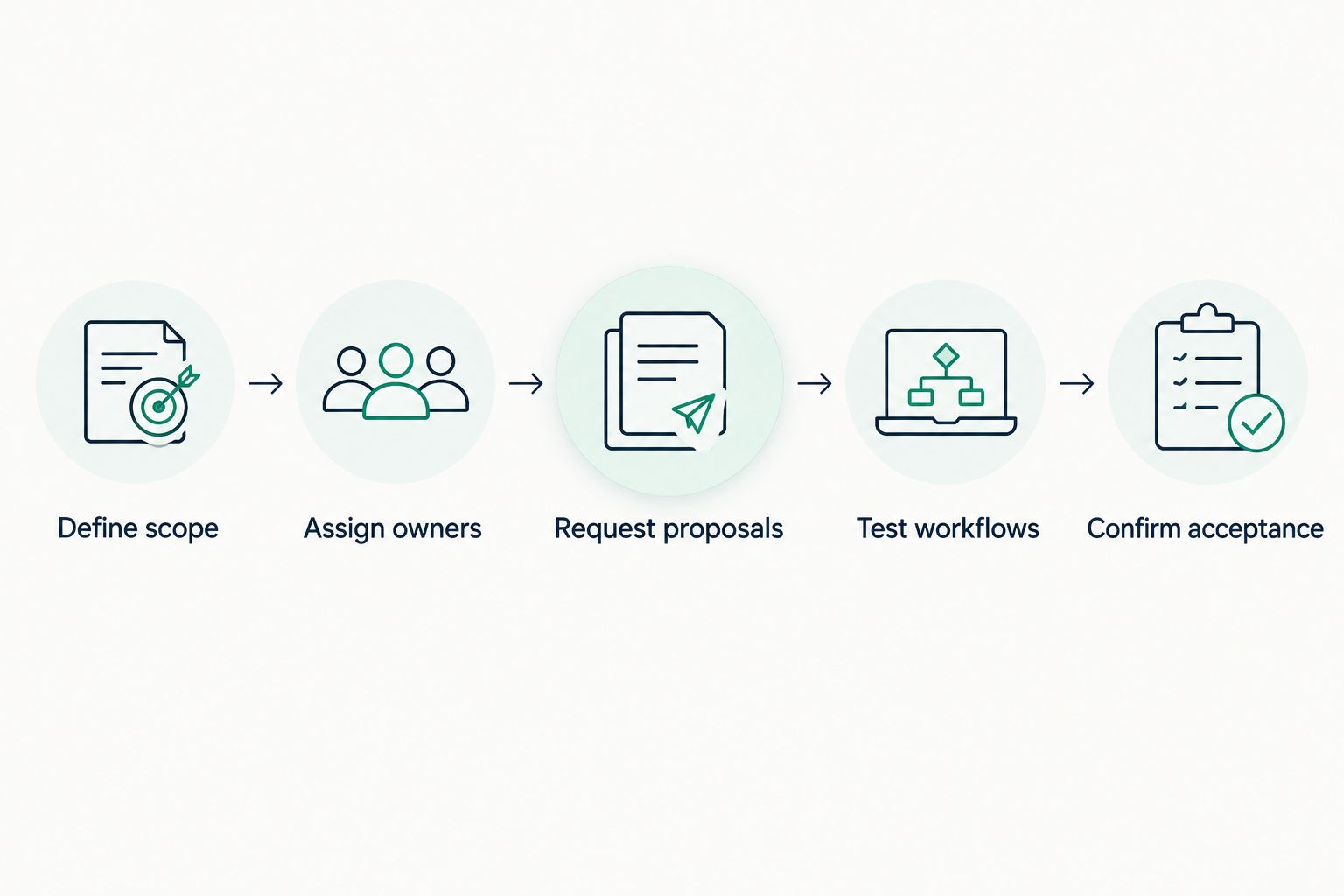
Define responsibilities before comparing proposals, then test the workflow before accepting implementation.
A demonstration should follow your evidence from request through review and closure. Ask the vendor to show a rejected submission, an overdue task, and a change of owner rather than only the successful path.
If technical weaknesses are driving the project, distinguish assessment from platform selection. The guide to cybersecurity risk assessment timing addresses a related planning question; a tracking system and an assessment serve different purposes.
What should you ask vendors before signing?
For a 2026 procurement, turn service claims into written boundaries. A promise of support is incomplete until you know what triggers assistance, who responds, and what work the agreement includes.
What does implementation actually deliver?
Request a deliverables list rather than a general onboarding description. It should identify configured workflows, migration responsibilities, training, unresolved dependencies, and the evidence used to accept the work.
Also ask how changes to the original scope are handled. A process added after configuration should have an approval path rather than becoming an undocumented obligation for either party.
Who maintains evidence after setup?
Ask who checks whether evidence is current, complete, and relevant to the requirement being reviewed. An automated upload confirms that a file arrived; it does not necessarily establish that the file proves the control operated correctly.
Require a route for rejected evidence and overdue corrective work. Otherwise, your dashboard can remain populated while the underlying findings remain unresolved.
Can you retrieve your records when you leave?
Ask for an export demonstration covering attachments, approvals, findings, and activity history. Confirm the format and identify any records that require a separate retrieval process.
Treat usable exports as a purchasing requirement. Your compliance history should remain understandable when the platform or service relationship changes.
How is compliance software different from cybersecurity software?
Compliance software tracks requirements, evidence, ownership, and review activity. Cybersecurity tools perform technical functions such as access protection, threat detection, or security monitoring; their outputs can become evidence in a compliance workflow.
Neither category makes the other unnecessary. A completed checklist does not substitute for an operating security control, and a security tool does not by itself organize every policy approval or vendor review.
DivergeIT provides both cybersecurity and compliance services. When evaluating a combined engagement, ask for a responsibility map showing the technical work, the evidence it produces, and the person who reviews that evidence.
Should you replace your existing tools immediately?
Start with a gap review, not a replacement decision. Inventory the workflows your current systems already support, then identify missing ownership, missing evidence, or unusable reporting.
A new platform is justified when it addresses a defined operating requirement. Replacing software without fixing unclear responsibilities simply transfers the same unresolved work into a different interface.
Use your 2026 requirements list to test existing tools and proposed replacements against the same criteria. Preserve historical evidence and approval records in any transition plan, and verify access before retiring an old system.
FAQ
How much does compliance software cost for an insurance company?
Compliance software costs depend on the vendor's quoted scope, including users, workflows, integrations, and services. Request a proposal that separates software access, implementation, and ongoing responsibilities rather than treating the subscription as the complete budget.
Does compliance software make an insurance company compliant?
No. Compliance software supports tracking, documentation, and review, but your organization still needs applicable requirements, operating controls, accountable owners, and corrective action.
Should a small insurance agency choose software or managed support?
Choose software when your staff can administer the platform and perform the required work; consider managed support when you need contracted operational help. Define the responsibilities you need covered before comparing delivery models.
What should an insurance company include in its software proposal request?
Include entities, user roles, required workflows, evidence sources, integrations, reporting, implementation deliverables, and support boundaries. Give every vendor the same requirements so the proposals are comparable.
Are implementation and ongoing compliance support the same thing?
No. Implementation establishes the agreed configuration and handoff, while ongoing support addresses the continuing work expressly included in the service agreement.
Can existing cybersecurity tools provide compliance evidence?
Yes, existing cybersecurity tools can provide evidence relevant to technical controls. Verify what each record demonstrates, how it reaches the compliance workflow, and who reviews it.
Does DivergeIT sell only compliance software?
No. DivergeIT provides managed IT, cybersecurity, compliance, and related services for growing small and mid-sized businesses. Evaluate its service responsibilities separately from a software-only subscription.
One last thing
Ask to see a failed workflow before you sign. Have the vendor demonstrate what happens when evidence is rejected, a responsible employee leaves, or a finding stays open past its agreed deadline.
The successful path shows that the software can collect information. The failed path shows whether your team can identify the problem, assign responsibility, and document its resolution. That is the more useful purchasing test.