


A cybersecurity risk assessment takes as long as the agreed scope, evidence review, technical checks, and findings validation require; there is no universal completion time. For your 2026 project, get a written schedule tied to those milestones, and confirm whether the finish date means delivery of the risk report or completion of the fixes.
TL;DR
- How long does a cybersecurity risk assessment take? Agree on scope and evidence requirements before accepting a completion date.
- Separate the cybersecurity risk assessment schedule from remediation and compliance audit schedules.
- DivergeIT serves growing small and mid-sized businesses seeking managed IT, cybersecurity, and compliance services.
- Require a risk register, named owners, and a findings review—not just vulnerability scan results.
How long does a cybersecurity risk assessment take?
The useful timeline is a milestone-based schedule, not an unsupported number of days. A cybersecurity risk assessment must connect threats and weaknesses to business consequences. Finishing a scan does not establish that the assessment is complete.
Ask your assessor to distinguish active assessment work from elapsed calendar time. Reviewing evidence is work; waiting for an administrator to supply that evidence is a dependency. Both affect your delivery date, but they require different responses.
The workflow from vulnerability scans to audit-ready reports provides related context for separating technical findings from the evidence and reporting that follow.
Scope approval
- What must be agreed or completed: Systems, business processes, locations, and exclusions
- What can prevent completion: Unresolved boundaries or an incomplete asset list
Evidence collection
- What must be agreed or completed: Requested policies, configurations, records, and interviews
- What can prevent completion: Missing access or unavailable system owners
Technical review
- What must be agreed or completed: Approved checks and examination of relevant controls
- What can prevent completion: Testing restrictions or unresolved technical questions
Risk analysis
- What must be agreed or completed: Findings connected to likelihood and business impact
- What can prevent completion: Missing business context or disputed assumptions
Findings review
- What must be agreed or completed: Factual corrections and management discussion
- What can prevent completion: Unresolved evidence or unclear ownership
Final delivery
- What must be agreed or completed: Accepted report, risk register, and next actions
- What can prevent completion: Undefined acceptance criteria
Use these milestones to evaluate a proposed deadline. If a provider quotes a finish date without explaining the scope, dependencies, and deliverables, the date does not tell you enough to plan around it.
Why this matters
Your assessment schedule affects when leadership can make decisions about security work, business exposure, and compliance preparation. A report delivered before the supporting evidence is reviewed leaves those decisions resting on assumptions.
For 2026 planning, distinguish the date you need findings from the date you need corrective work completed. A board discussion, customer security review, or compliance initiative can require different outputs. Tell the assessor which decision the assessment must support.
DivergeIT is a fit for growing small and mid-sized businesses seeking managed IT, cybersecurity, and compliance services. When evaluating an assessment engagement, ask for its specific scope and deliverables rather than treating the broader service description as a project plan.
Choose the assessment scope before choosing the deadline
A focused assessment and a broader organizational assessment answer different questions. Neither is automatically the better choice; the right scope follows the business decision you need to make.
Focused assessment
- Best for: A defined system, process, or business change
- Advantage: Keeps evidence requests and findings tied to a specific decision
- Limitation: Does not establish the risk position of excluded systems
Broader organizational assessment
- Best for: Leadership decisions across business functions and systems
- Advantage: Examines dependencies across the agreed environment
- Limitation: Requires coordination across more owners and evidence sources
Choose a focused assessment when the decision is genuinely narrow. For example, reviewing a particular business application should have explicit boundaries around its users, data, integrations, and supporting infrastructure. Exclusions must remain visible in the final report.
Choose a broader assessment when leadership needs to prioritize risks across the organization. The advantage is a connected view of the agreed environment; the trade-off is additional coordination and evidence review. Do not label a focused review an organization-wide assessment simply to satisfy a deadline.
Focused assessment: define the boundary
Write down the business question first. Then identify the systems and dependencies required to answer it, along with anything deliberately excluded.
A narrow scope is useful only when its boundary makes sense. Excluding an identity system that controls access to the application under review, for example, requires an explanation of how that exclusion limits the findings.
Broader assessment: assign evidence owners
A broader assessment needs participation beyond IT. Business owners explain operational impact, while the people responsible for systems and controls supply evidence about how those controls work.
Assign ownership before scheduling interviews. An assessor cannot resolve every business-impact question from configuration records alone, and an IT administrator should not be expected to accept business risk on leadership's behalf.
Why cybersecurity risk assessment timelines vary
These factors determine what belongs in the schedule. Use them to challenge an estimate and identify dependencies before kickoff.
- Scope boundaries: The assessment must define which systems, processes, locations, and third-party dependencies are included. Changes to those boundaries require a schedule review.
- Evidence readiness: Current asset records, policies, configuration exports, and control records support review. Missing or contradictory records create follow-up work.
- Access and authorization: Technical checks need approved access and clear testing boundaries. Restrictions must be reflected in the assessment method and limitations.
- Stakeholder availability: System owners explain controls; business owners explain impact. Their participation belongs in the schedule rather than being treated as incidental.
- Assessment purpose: A management risk review and evidence preparation for a specific compliance obligation have different acceptance requirements. Define the intended use before work begins.
- Validation requirements: Findings need factual review, and corrective work needs separate verification if it is included. State which review cycles are part of the engagement.
Improve readiness before cutting assessment depth. Supplying usable evidence and booking decision-makers addresses scheduling dependencies without removing systems or controls from review.
How to get a defensible assessment schedule
Use this sequence when requesting a proposal or preparing an internal assessment. Each step produces something concrete that supports the next decision.
1. Define the decision
State what the assessment must help you decide: which risks to address, whether a business change is ready, or what evidence needs attention before a compliance review. Avoid a brief that says only “check our cybersecurity.”
For a 2026 assessment, record the business deadline and the reason behind it. The assessor can then distinguish a necessary delivery requirement from a preferred date.
2. Approve the scope
List the business processes, systems, data, and locations in scope. Include relevant external dependencies and identify exclusions explicitly.
Require a method for approving scope changes. Otherwise, adding a newly discovered system creates uncertainty about whether it belongs in the existing engagement or needs separate work.
3. Prepare evidence
Request the evidence list before kickoff and assign an owner to each request. Typical categories include asset inventories, access-control records, policies, incident procedures, and records supporting the controls being assessed.
Check that the evidence describes the current environment. A policy states what should happen; supporting records help establish what actually happens. Keep that distinction visible throughout the review.
4. Reserve access
Arrange interviews, permissions, and approved technical-check windows. Identify who can authorize access and who can answer questions about outsourced systems.
Write unresolved dependencies into the schedule. A deadline that assumes access is ready should say so, including what happens if access is delayed.
5. Agree on delivery
Define the final outputs before the work starts. Request findings that identify affected assets or processes, supporting evidence, business impact, recommended action, and an accountable owner.
Schedule the findings review as part of delivery. Your team needs an opportunity to correct factual errors without turning that review into an informal process for removing uncomfortable findings.
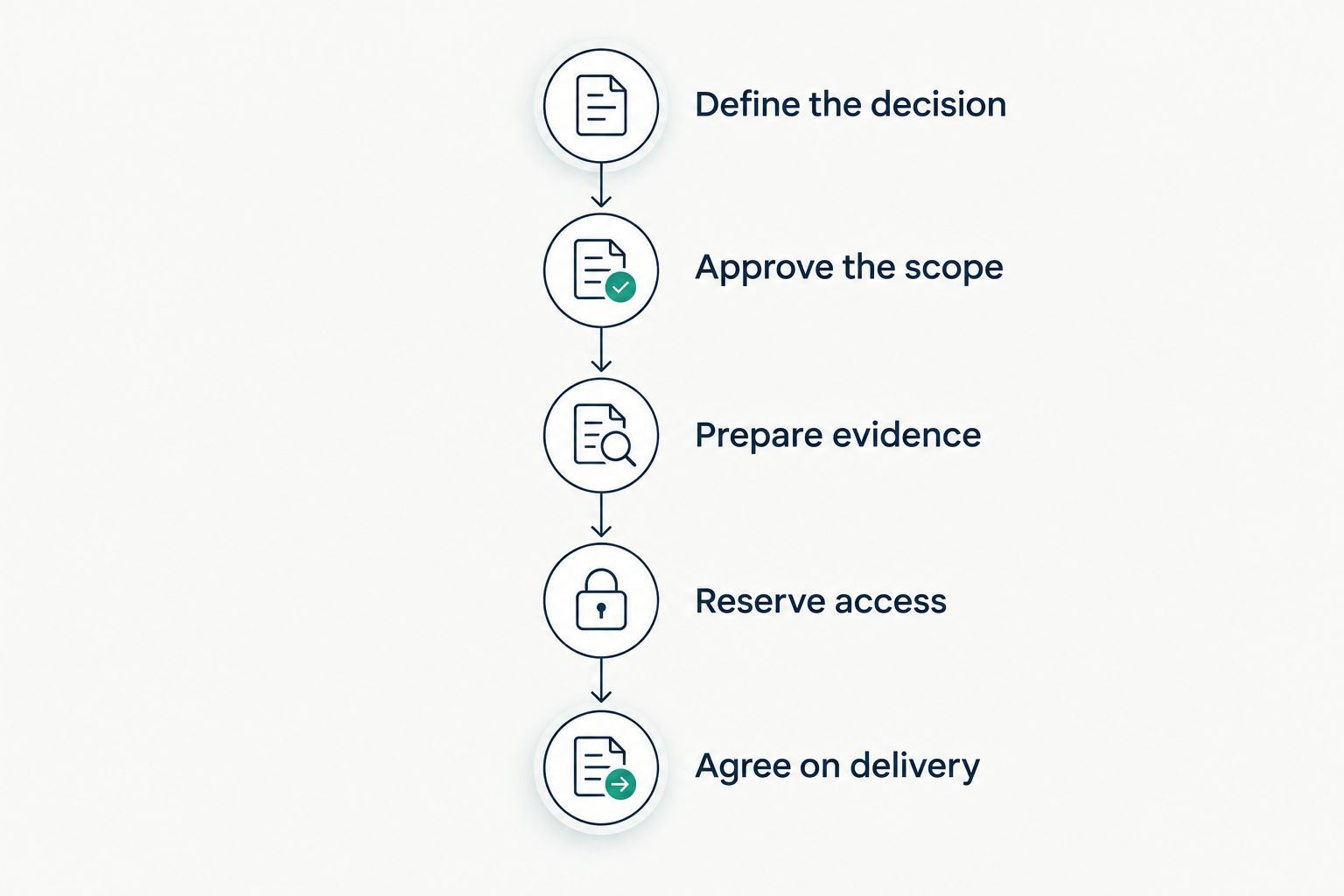
Agree on scope, evidence, access, and deliverables before accepting the assessment deadline.
Your written schedule should identify who owns each milestone and what marks it complete. A delivery date becomes useful when the obligations behind it are clear.
Does a vulnerability scan finish the assessment?
A vulnerability scan does not finish a cybersecurity risk assessment. It supplies technical findings about the targets and checks included in that scan; it does not independently establish the full business consequences of those findings.
An assessment also examines the relevant threat context, controls, likelihood, and impact. It should explain why a finding matters to your organization and what decision follows from it.
Ask whether the proposed completion date covers scan output, validated findings, or the final risk report. Those are different milestones, and substituting one for another creates a misleading impression of progress.
Does fixing the findings count toward the assessment timeline?
Remediation is separate from assessment unless the written scope includes it. Identifying a weakness, correcting it, and confirming the correction are distinct activities with different dependencies.
Your 2026 project plan should give remediation its own owners and deadlines. A final assessment report can document an unresolved risk without implying that the risk has been corrected or accepted.
If verification is included, specify what evidence establishes closure. Installing a change is not the same as demonstrating that the relevant weakness has been addressed.
Can you shorten the assessment without weakening it?
You can remove administrative delays without pretending that required analysis is optional. Prepare records, resolve access approvals, and reserve stakeholder time before assessment work begins.
If the deadline still conflicts with the scope, choose explicitly between changing the deadline and narrowing the question. Record any excluded systems and explain how those exclusions limit the conclusions.
Do not ask for a predetermined favorable result. Ask for clear evidence, explained uncertainty, and prioritized actions that leadership can use.
What should you request from a provider?
Ask DivergeIT to discuss your cybersecurity and compliance requirements against a defined business objective. Confirm the proposed assessment method, evidence requests, delivery milestones, and any exclusions in the written engagement.
Request the same clarity about limitations as about benefits. Managed support can help maintain records and coordinate follow-up, but a service relationship does not by itself prove that a particular assessment scope or deadline has been agreed.
Use the contact page to discuss the business decision, systems involved, and deadline you need the engagement to address.
FAQ
How long does a cybersecurity risk assessment take for a small business?
A small-business cybersecurity risk assessment takes the time required by its agreed scope, evidence review, technical checks, and findings validation. Ask for a milestone-based schedule that identifies access requirements and stakeholder responsibilities.
Can a cybersecurity risk assessment be finished before all the fixes are done?
Yes, an assessment can finish before remediation is complete when corrective work is outside the assessment scope. The final report should distinguish identified risks, planned actions, and verified corrections.
Is a vulnerability scan the same as a cybersecurity risk assessment?
No, a vulnerability scan is not the same as a cybersecurity risk assessment. Scan findings need context about affected assets, existing controls, likelihood, and business impact to support risk decisions.
What should I prepare before a cybersecurity risk assessment starts?
Prepare the agreed scope, relevant asset records, requested control evidence, and access approvals. Assign system and business owners who can answer questions and review findings.
Will a cybersecurity risk assessment prove that my business is compliant?
A cybersecurity risk assessment does not by itself prove compliance. Its findings can support compliance work, but the applicable obligations and required evidence must be evaluated separately.
Who should approve the cybersecurity risk assessment report?
The designated business owner should accept delivery against the agreed scope and acceptance criteria. Technical owners should review factual accuracy, while authorized leadership handles decisions about accepting business risk.
What should my 2026 cybersecurity risk assessment schedule include?
Your 2026 cybersecurity risk assessment schedule should include scope approval, evidence collection, technical review, risk analysis, findings review, and final delivery. List dependencies and separate remediation deadlines from assessment milestones.
One last thing
Ask what “done” means before asking how soon it can be done. A delivered document, a validated risk register, and corrected security weaknesses are different outcomes.
Put the acceptance criteria beside the deadline. That makes it possible to tell whether the project has answered your business question—not merely reached its final calendar entry.