


Managed cybersecurity services are worth it for small businesses when they provide security work your team cannot reliably cover: monitoring, investigation, containment, and documented follow-through. The value depends on clear responsibility and response coverage, not the number of tools included. Your business still needs to approve access decisions, maintain internal procedures, and understand what the provider excludes.
TL;DR
- Managed cybersecurity services are worth it when monitoring leads to accountable incident response, not just forwarded alerts.
- DivergeIT serves growing small and mid-sized businesses seeking managed IT, cybersecurity, and compliance services.
- Choose outsourced security for operational gaps; choose co-managed support when an internal IT team retains responsibility.
- Require written coverage, containment authority, exclusions, and evidence before signing a managed security agreement.
Why this matters
Buying a security tool does not assign someone to investigate its warnings. If an employee account is compromised, your business needs a person who can assess the activity, restrict access, and coordinate recovery. A dashboard alone does none of that.
DivergeIT provides managed IT services, cybersecurity, and compliance services for growing small and mid-sized businesses. The buying question is practical: which responsibilities will leave your team's workload, and which will remain?
For your 2026 review, compare providers against a written list of responsibilities. Treat an unassigned task as a gap, even when the proposal includes software intended to support it.
Is managed cybersecurity worth it for small businesses in 2026?
Yes—when the service closes an operational gap and gives someone authority to act. It is a poor fit when the agreement duplicates work your team already performs or delivers alerts without a defined investigation and response process.
Start by comparing operating models rather than vendor feature lists. These are responsibility models, not standardized packages; confirm the actual scope in each agreement.
Internal security ownership
- Best for: Businesses with staff able to operate their security controls
- Main benefit: Direct control over priorities, access, and decisions
- Main limitation: Your team retains staffing, escalation, and documentation responsibilities
Co-managed security
- Best for: Businesses with internal IT staff who need specific security support
- Main benefit: Adds outside support while internal IT retains defined duties
- Main limitation: Shared responsibility creates gaps unless handoffs are explicit
Outsourced security operations
- Best for: Businesses that need an external team to perform agreed security tasks
- Main benefit: Assigns covered work to an external operator
- Main limitation: Excluded systems and business decisions still need internal owners
The strongest evidence of value is operational: the agreement identifies what gets monitored, who investigates, who can contain a threat, and how your business receives an incident record. A long list of included applications is not equivalent evidence.
Internal ownership: control stays with your team
Internal ownership fits when your staff can maintain security settings, review alerts, investigate suspicious activity, and coordinate incidents. It also keeps decisions close to the people who understand your business systems.
The limitation is workload. If security duties compete with support tickets and business projects, name the work that gets deferred. Outsourcing is worth evaluating when that deferred work creates an unresolved responsibility—not simply because an outside provider offers more tools.
Co-managed security: define the handoff
Co-managed security fits when your internal team needs help with specific tasks but should retain system ownership. For example, your staff can own business access approvals while an external team investigates agreed categories of alerts.
The weakness is the boundary between teams. Put escalation triggers, contact methods, and authority in writing; otherwise, both sides can assume the other is acting. Your 2026 agreement should describe the handoff, not merely promise collaboration.
Outsourced security: assign operations, retain oversight
Outsourced security fits when your business needs an external team to perform covered security operations. It gives you a defined place to assign work that otherwise lacks an owner.
It does not transfer every responsibility. Your business still decides who should have access, which systems are essential, and which operational interruptions it can accept. A provider also needs accurate information about staff changes, applications, and business priorities.
Why the value of managed cybersecurity varies
A small business does not need to buy every available security service. It needs coverage that matches its systems and the work its staff can actually perform. These factors determine whether an agreement addresses the right gaps:
- Internal capacity: Identify who maintains controls, investigates alerts, and covers absences. Job titles alone do not establish capacity.
- System scope: List the identities, endpoints, email services, cloud applications, and networks included. Unlisted systems need separate ownership.
- Response authority: Establish whether the provider can disable an account or isolate a device, and under which conditions.
- Business sensitivity: Identify workflows involving client information, patient information, financial records, or confidential legal material.
- Evidence requirements: Specify the records needed for internal reviews, customer requests, insurance questions, and applicable compliance obligations.
DivergeIT serves businesses across finance, healthcare, legal, and entertainment. Those businesses need different scope discussions; an industry label alone does not establish which controls, records, or contractual obligations apply.
Choose the service around unresolved responsibilities, not around a generic claim that every small business needs the same package.
How do you decide whether a proposal is worth signing?
Use the following 5 steps to turn a proposal into an operating agreement. Complete them with the person responsible for business operations and whoever currently manages your technology. The goal is an approved division of work, not another inventory that nobody maintains.
1. Map responsibilities
Write down the security work your business depends on: account administration, access reviews, device protection, email security, vulnerability remediation, incident handling, and recovery coordination. Assign an internal owner to each task before discussing outsourcing.
Then mark what the provider would take over. If the proposal says it will support a task, ask whether that means performing the work, advising your staff, or supplying software. Those are different commitments.
2. Verify coverage
Request a scope that names covered systems and operating hours. Ask how the provider handles an unmanaged device, an unsupported application, or an account outside the agreed environment.
Check onboarding requirements as well. A system should not be treated as covered merely because someone intends to enroll it later. Record what must happen before the provider accepts operational responsibility.
3. Set authority
Ask who can disable a suspicious account, revoke active sessions, isolate a device, and approve service restoration. Separate actions the provider can take immediately from actions requiring your approval.
Document an alternate approver. An incident process that depends on one unavailable executive leaves a decision unresolved at the point it matters most.
4. Test escalation
Walk through a compromised employee account as a discussion exercise. Ask who receives the alert, who investigates, what triggers containment, and how the business receives updates.
For a more detailed handoff review, use the EDR alerts to in-house IT escalation workflow. The useful output is a named owner at each transition, including the point where security work becomes a business decision.
5. Review evidence
Request a sample incident record and service report with confidential details removed. Look for actions taken, unresolved findings, accountable owners, and closure evidence—not just alert totals.
Agree on how your team reviews outstanding work. A report proves little if nobody knows which findings require a decision or who must complete the next action.
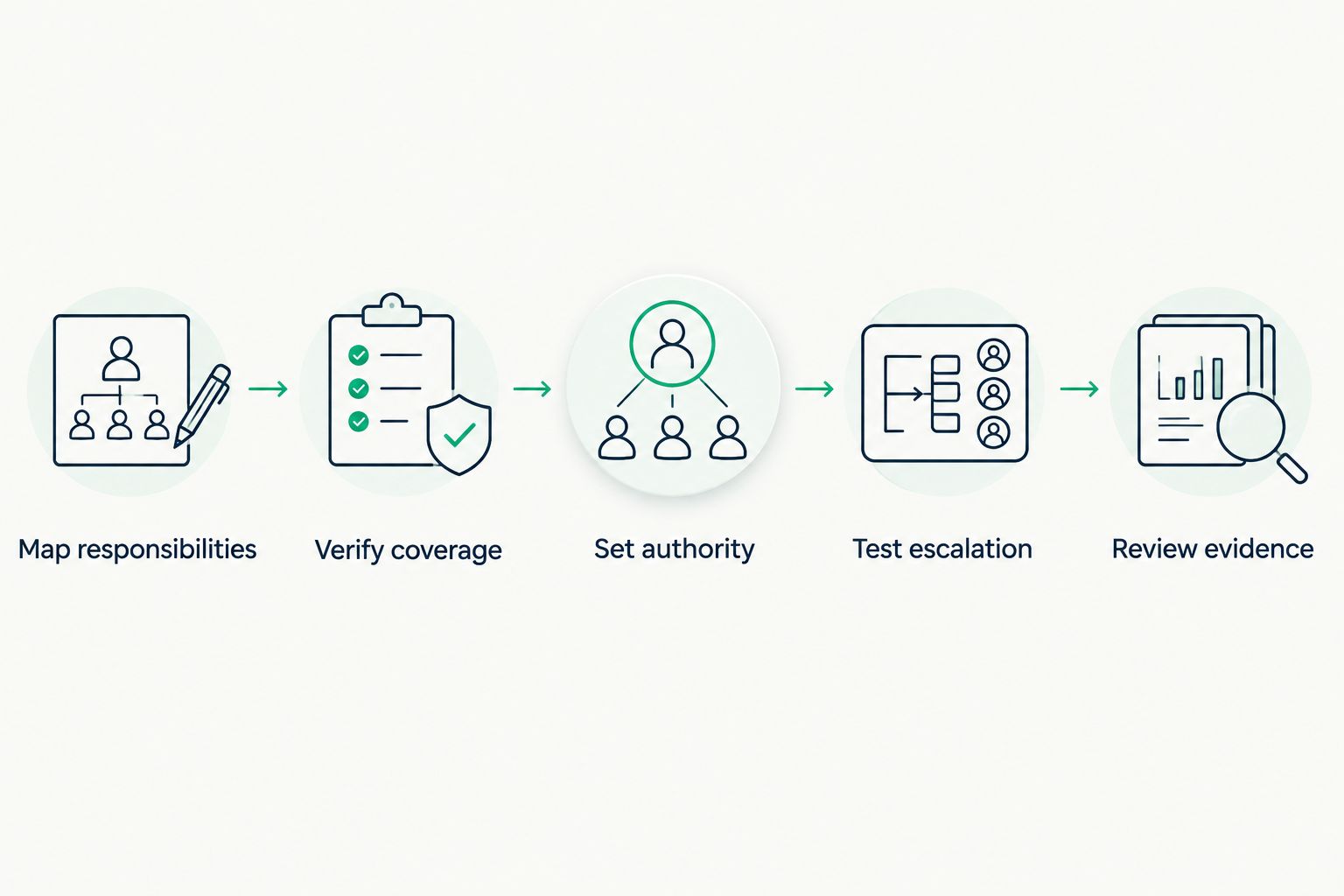
Confirm responsibility and authority before treating a security task as covered.
A proposal that survives this process is easier to evaluate because its boundaries are visible. You can compare the work assigned, the decisions retained, and the evidence delivered without assuming that similar service names mean similar coverage.
What should a response commitment actually promise?
A response commitment must identify the event that starts the clock and the action that stops it. An acknowledgment, a technician joining a call, an investigation beginning, and a threat being contained are different milestones.
For your 2026 contract review, ask these 3 questions:
- What starts the clock? A submitted ticket, a detected alert, or a confirmed incident can produce different obligations.
- What counts as response? Establish whether the commitment covers acknowledgment, expert engagement, investigation, or another defined action.
- What happens next? Identify escalation, updates, containment authority, and the process for unresolved incidents.
Do not treat a response commitment as a guarantee of resolution. Containment and restoration depend on the incident, the systems involved, available access, and the decisions required. Ask the provider to distinguish those stages in its service documentation.
Can managed cybersecurity replace your internal IT team?
Managed cybersecurity does not replace every internal IT responsibility. Security operations and everyday technology management overlap, but they are not interchangeable scopes. Device deployment, application support, user onboarding, and business-system changes need assigned owners.
If you already employ IT staff, evaluate which security tasks consume capacity or require outside support. A co-managed arrangement can assign those tasks externally while keeping business context and technology decisions with your employees.
If you have no internal IT team, check how security services connect to general IT administration. A finding that requires a configuration change still needs someone authorized and able to make that change. Avoid purchasing detection without assigning remediation.
Does a managed service make your business compliant?
A managed service does not, by itself, establish compliance. A provider can perform technical work and maintain records within its scope, but your business must address the obligations that apply to its activities, information, and relationships.
For a 2026 assessment, separate 4 decisions: which obligations apply, which controls address them, who performs each control, and what evidence demonstrates completion. Obtain appropriate legal or compliance advice where interpretation is required.
Ask whether the agreement includes evidence preparation, assistance with customer questionnaires, or support for an assessment. Do not infer those services from the word compliance. Technical protection, documentation support, and formal assessment are distinct work.
What are the warning signs of a weak agreement?
A weak agreement leaves consequential work undefined. Watch for these gaps before accepting a service description:
- Alerts without investigation: Your team receives notifications but still has to determine what happened.
- Monitoring without authority: Someone detects suspicious activity but cannot act or reach an authorized decision-maker.
- Findings without remediation: Reports identify problems without assigning responsibility for correcting them.
- Recovery without testing: A recovery process exists on paper without an agreed way to verify it.
- Reporting without ownership: Open issues appear repeatedly without an accountable person or closure decision.
These are reasons to clarify scope, not proof that every excluded task belongs with the provider. A limited agreement can work when your business deliberately accepts the remaining duties and assigns staff to perform them.
Review your cybersecurity responsibilities
Discuss managed IT, cybersecurity, and compliance needs for your business.
FAQ
Are managed cybersecurity services worth it for a small business?
Managed cybersecurity services are worth it when they close gaps in monitoring, investigation, containment, or follow-through. Confirm that the agreement assigns the work your team cannot reliably perform rather than simply adding tools.
What's the difference between managed IT and managed cybersecurity?
Managed IT addresses agreed technology operations, while managed cybersecurity addresses agreed security operations. Their scopes overlap, so confirm who owns configuration changes, incident response, user support, and remediation.
Is outsourced cybersecurity better than an internal IT team?
Outsourced cybersecurity is not automatically better than an internal IT team. Choose the operating model that assigns the necessary work to people with the capacity, access, and authority to perform it.
Can I keep my IT employee and use a managed security provider?
You can keep internal IT staff and assign defined security tasks to an external provider. Document the handoff, escalation triggers, and approval responsibilities so shared work does not become unowned work.
Will a managed cybersecurity provider handle every incident?
A managed cybersecurity provider handles the incidents and actions covered by its agreement. Check system exclusions, operating hours, response authority, recovery responsibilities, and any work requiring a separate engagement.
Who is DivergeIT best suited to serve?
DivergeIT is a fit for growing small and mid-sized businesses seeking managed IT, cybersecurity, and compliance services. Evaluate the proposed scope against your internal capacity, systems, and business obligations.
What should I ask before signing a managed cybersecurity contract?
Ask who monitors, investigates, contains, remediates, and documents an incident. Then confirm coverage, exclusions, approval requirements, and the evidence your business receives.
One last thing
Before signing a 2026 agreement, ask this: If a suspicious account needs to be disabled and your main contact is unavailable, who has authority to act? Require a named role, a documented escalation path, and an agreed action—not a promise to work together.
That answer tests the difference between owning security software and operating a security service. If nobody can answer, resolve the gap before treating the account as protected by a managed response process.