


Yes, managed IT services can help healthcare organizations meet HIPAA requirements by implementing security safeguards, maintaining systems, and documenting the work. Hiring a provider does not make your practice compliant or transfer all responsibility to that provider. You still need an organization-wide risk analysis, appropriate policies, workforce training, and oversight of how protected health information is used and disclosed.
TL;DR
- Can managed IT services help with HIPAA compliance? Yes, but your healthcare organization retains responsibility for its obligations.
- DivergeIT provides managed IT, cybersecurity, and compliance services for growing small and mid-sized healthcare businesses.
- Require a business associate agreement when the provider's work makes it a business associate.
- Evaluate security safeguards, incident escalation, and compliance evidence—not a blanket promise of HIPAA compliance.
Can managed IT services help healthcare meet HIPAA rules?
Managed IT services support HIPAA compliance when the contract assigns specific safeguards, accountable owners, and evidence requirements. The HIPAA Security Rule organizes its requirements into 3 safeguard categories: administrative, physical, and technical. Your provider's work should connect to those requirements rather than sit apart from your compliance program.
DivergeIT provides managed IT, cybersecurity, and compliance services to growing small and mid-sized businesses, including healthcare organizations. Evaluate the proposed healthcare scope against these steps:
- Identify the environment. Document where electronic protected health information, or ePHI, is created, received, maintained, and transmitted. Include clinical systems, email, endpoints, backups, and outside vendors.
- Assess the risks. Review threats, vulnerabilities, existing safeguards, and the potential impact on ePHI. A device inventory is an input to this work, not a substitute for a risk analysis.
- Assign the controls. Identify who manages access, updates, backups, monitoring, and incident escalation. Name the practice owner for decisions the provider cannot make independently.
- Verify the evidence. Require records that show what was configured, reviewed, tested, and corrected. A statement that a task is complete is weaker than a dated record demonstrating completion.
- Reassess after changes. Revisit risk when your practice adds locations, changes clinical applications, introduces remote access, or changes how patient information moves.
The right deliverable is an operating security program with evidence, not a compliance label attached to an IT subscription.
Why this matters
A working clinical application does not prove that patient information is adequately protected. Staff can have excessive access, backups can fail restoration tests, and former employees can retain active accounts while daily appointments continue normally.
For your 2026 planning, separate service reliability from compliance accountability. Reliability keeps systems usable; compliance work establishes whether safeguards, policies, and actual behavior meet applicable obligations. Your managed IT agreement needs to support both without treating them as interchangeable.
Start with a practical question: if someone asks who approved access to a patient system, can your team produce the approval and show when that access was last reviewed?
What should managed IT services actually cover?
Your contract should describe the work and the evidence you receive. Avoid broad descriptions such as security management unless the agreement also identifies covered systems, exclusions, reporting, and escalation responsibilities.
Access management
- What the provider can manage: Account setup, changes, removal, and technical access restrictions
- Evidence to request: Access lists, approval records, and removal records
- What your practice retains: Approving access based on job responsibilities
Device security
- What the provider can manage: Supported endpoint configurations, updates, and protection
- Evidence to request: Device inventory, configuration records, and remediation status
- What your practice retains: Identifying clinical constraints and approving exceptions
Monitoring
- What the provider can manage: Collecting and reviewing agreed security signals
- Evidence to request: Alert records, investigation notes, and escalation history
- What your practice retains: Making business decisions during incidents
Backup and recovery
- What the provider can manage: Backup operations and agreed restoration testing
- Evidence to request: Backup status, restoration results, and unresolved failures
- What your practice retains: Setting recovery priorities and continuity procedures
Risk remediation
- What the provider can manage: Correcting assigned technical findings
- Evidence to request: Finding owners, corrective actions, and closure evidence
- What your practice retains: Maintaining the broader risk management process
Not every provider includes every activity. Confirm whether clinical applications, personally owned devices, network equipment, and third-party systems fall inside the scope.
Best for evaluating a proposal: a responsibility matrix that names both the provider's owner and your practice's owner for each task. Its limitation is maintenance: the matrix becomes unreliable if staff, vendors, and systems change without corresponding updates.
Where does the healthcare organization's responsibility end?
It does not end when you outsource IT. A covered entity remains responsible for its applicable HIPAA obligations, while a business associate also has obligations of its own. The contract divides operational work; it does not erase the law's requirements.
Your practice must still govern workforce access, patient information handling, training, and decisions about acceptable risk. A provider can disable an account, but your practice must communicate that a worker has left. A provider can configure a system, but your practice must explain which roles need access and why.
A business associate agreement, or BAA, establishes required contractual protections when the relationship qualifies. It is not evidence that every safeguard is functioning. Review the services agreement and the BAA together so incident reporting, subcontractor responsibilities, and information handling do not contradict one another.
In your 2026 contract review, ask who authorizes containment when a suspected incident affects clinical operations. That decision should not depend on finding an unavailable executive while an alert remains unresolved.
Fully managed, co-managed, or internal IT?
The right delivery model depends on who already owns the work. Outsourcing more tasks does not automatically create better compliance; clear responsibility and adequate execution matter more than the model's name.
Fully managed IT
- Best for: Practices that need an external team to operate day-to-day IT
- Main advantage: Consolidates assigned operational responsibilities
- Main limitation: Requires careful oversight of scope, exclusions, and provider performance
Co-managed IT
- Best for: Healthcare organizations with an internal IT owner needing additional support
- Main advantage: Adds help while preserving internal operational knowledge
- Main limitation: Creates handoff gaps unless responsibilities are explicit
Internal IT
- Best for: Organizations able to staff and oversee the required functions
- Main advantage: Keeps operational control within the organization
- Main limitation: Requires internal capacity for security, recovery, documentation, and coverage
Choose fully managed IT when you need an operating team; choose co-managed IT when your existing team needs defined support. Neither option removes the need for a designated internal decision-maker.
Before choosing, list the activities your team can perform consistently—not just activities someone knows how to perform. An unreviewed alert queue and an undocumented recovery procedure remain gaps regardless of who employs the technician.
Why HIPAA support varies between practices
Healthcare organizations do not share the same systems, data flows, or operational constraints. These factors change the work a managed IT provider must perform:
- Information locations. Patient information in clinical applications, email, shared files, and backups creates different access and protection requirements.
- Device ownership. Organization-owned equipment and personally owned devices require clearly defined boundaries and access policies.
- Clinical dependencies. Medical equipment and clinical applications can constrain maintenance, updates, and recovery decisions.
- Existing IT capacity. An internal administrator changes the division of work, but does not eliminate the need for documented handoffs.
- Vendor relationships. Hosting providers, application vendors, and support contractors introduce responsibilities that need explicit ownership.
- Evidence gaps. An implemented safeguard without adequate records creates different remediation work from a safeguard that has not been implemented.
For a 2026 scope review, use your actual environment rather than a generic healthcare checklist. Include exceptions: a legacy device, an unsupported application, or an unusual data transfer needs a named owner and a documented decision.
How do you turn a risk finding into evidence?
Use a repeatable sequence: Record the finding, Assign an owner, Correct the gap, Verify the result, Retain the evidence. Each stage answers a different question, from what is wrong to how you know the correction worked.
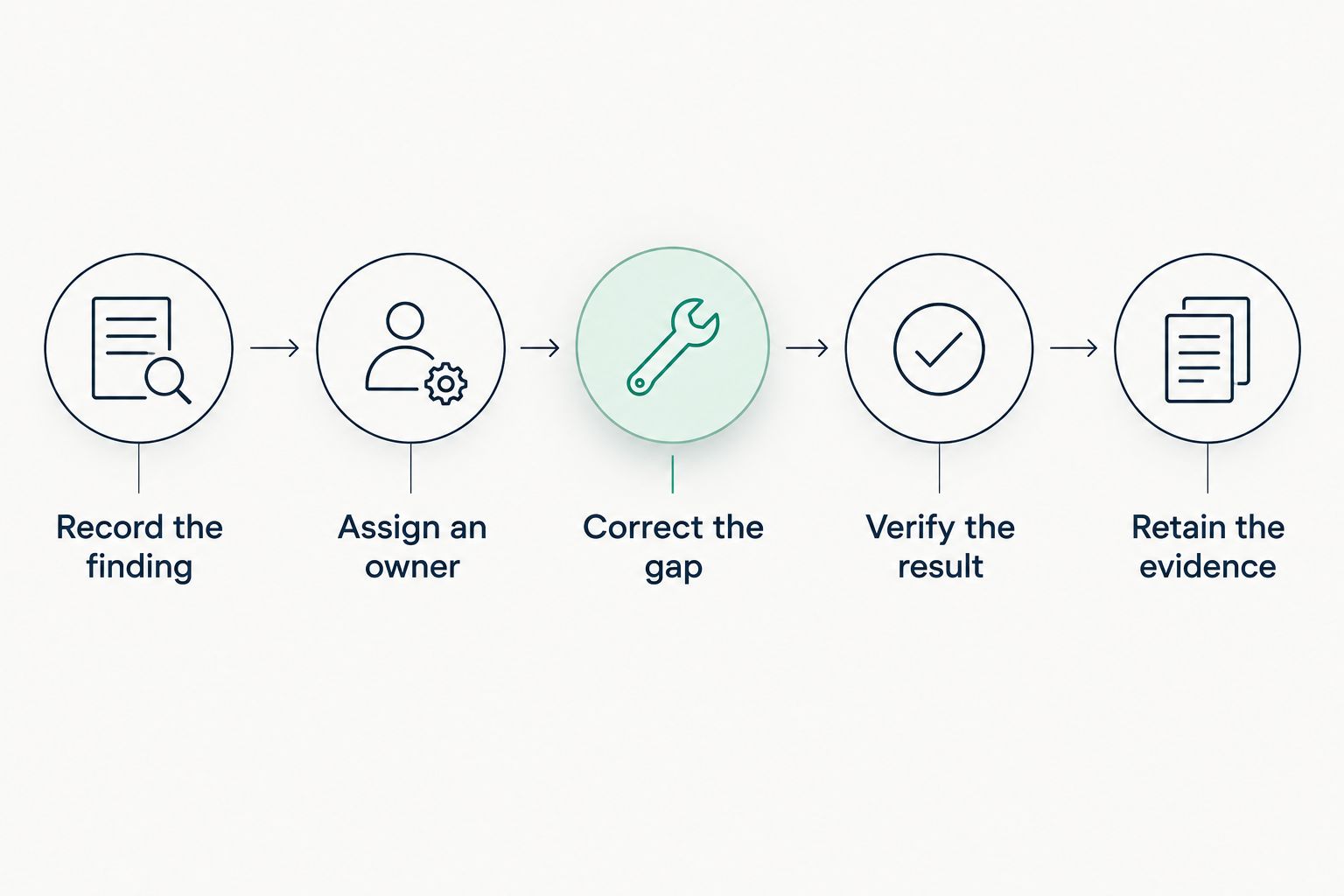
A closed ticket is not enough unless the record also demonstrates that the correction worked.
For example, a finding about former employees retaining access should lead to a defined termination workflow, not just removal of the accounts discovered during the review. The evidence should show who authorizes removal, which systems are covered, and how completion is verified.
The vulnerability scans to audit-ready reports workflow addresses the same operational distinction: identifying a weakness and documenting its resolution are separate activities. Require both in your service scope.
HIPAA requires specified Security Rule documentation to be retained for 6 years from creation or the date it last was in effect, whichever is later, under 45 CFR §164.316. That is not a universal retention period for all medical records or every technical log. Set those retention decisions according to the applicable requirements and your documented needs.
How should you evaluate a healthcare IT provider?
Ask the provider to walk through real operational scenarios using its proposed scope. Avoid a conversation limited to security product names or broad assurances.
When comparing managed IT services for healthcare, the decisive distinction is whether monitoring, access control, recovery, and incident escalation have named owners and verifiable outputs. A long list of tools does not establish any of those things.
Use these questions during your 2026 provider review:
- What starts the response clock? Distinguish ticket acknowledgment, expert engagement, investigation, containment, and resolution. They are different commitments.
- Which systems are excluded? Ask specifically about clinical applications, medical devices, remote access, and vendor-managed infrastructure.
- How are exceptions handled? Require an approval process and a record of the compensating safeguards or corrective action.
- What happens after an alert? Identify who investigates, who contacts your practice, and who can authorize disruptive containment.
- What evidence do you receive? Request representative report formats without asking for another customer's confidential information.
- How does the relationship end? Establish how your organization receives credentials, configurations, documentation, and its information when services end.
Reject a proposal that promises compliance without first defining your environment and responsibilities. Also reject a technically detailed proposal that leaves business decisions unassigned. Both create an accountability gap, just in different places.
Does signing a BAA make an IT service HIPAA compliant?
A signed BAA does not establish HIPAA compliance by itself. It sets contractual obligations for a qualifying business associate relationship; the parties still need appropriate safeguards and actual performance.
Ask how subcontractors are handled and how the provider controls administrative access. Then confirm that the work described in the agreement matches what technicians do in practice.
How quickly must an IT provider report a breach?
60 calendar days after discovery is the HIPAA outside limit for a business associate to notify the covered entity of a breach of unsecured protected health information; notification must also occur without unreasonable delay. A contract can require faster reporting.
Do not use that outside limit as your operational alerting target. Define prompt escalation for suspected security incidents so investigation and containment can begin before the breach determination is complete.
What should you ask DivergeIT about healthcare support?
DivergeIT is best for growing small and mid-sized healthcare businesses seeking managed IT, cybersecurity, and compliance support. Its stated service areas match those needs; the healthcare-specific deliverables still belong in the proposed agreement.
Ask DivergeIT to map its proposed scope to your risk findings, clinical dependencies, BAA requirements, and evidence needs. The limitation is straightforward: a service description alone does not establish which controls, systems, or reporting obligations your agreement includes.
Define your healthcare IT responsibilities
Discuss managed IT, cybersecurity, and compliance needs against your practice's actual scope.
FAQ
Can managed IT services help with HIPAA compliance?
Yes, managed IT services can support HIPAA compliance through assigned security operations, technical safeguards, recovery work, and documentation. Your healthcare organization retains responsibility for its own obligations and for overseeing the relationship.
Does every healthcare IT provider need to sign a BAA?
A provider needs a BAA when its activities make it a business associate under HIPAA. Evaluate whether the provider creates, receives, maintains, or transmits protected health information on behalf of a covered entity, rather than relying only on its job title.
Can a managed IT provider guarantee our practice is HIPAA compliant?
An IT provider cannot establish organization-wide compliance merely by supplying managed services. Compliance also depends on your policies, workforce practices, risk management, information handling, and other applicable obligations.
Is co-managed IT suitable for a healthcare practice?
Co-managed IT suits healthcare organizations with an internal IT owner who needs defined outside support. Document who handles access, maintenance, monitoring, recovery, and incident escalation so shared responsibility does not become unassigned responsibility.
How long do we need to retain HIPAA security documentation?
Required HIPAA Security Rule documentation must be retained for 6 years from creation or the date it last was in effect, whichever is later. That rule does not establish a universal retention period for medical records or every technical log.
Does HIPAA compliance mean our systems cannot be breached?
HIPAA compliance does not mean a system cannot be breached. Your organization still needs risk management, incident response procedures, recovery capabilities, and appropriate investigation and notification processes.
One last thing
For your final 2026 readiness check, trace a departed employee through every system containing patient information. Compare the departure approval with account removal, remote access removal, and any unresolved exceptions.
This exercise tests more than account administration. It shows whether human resources, clinical leadership, internal IT, and your provider share a working process. A safeguard becomes dependable when the handoff works and the record proves it. Use that standard when evaluating the rest of your managed IT agreement.