


Mid-sized business cybersecurity is the coordinated protection of your systems, identities, and data with the aim of keeping business operations running and sensitive information protected. Cybersecurity services for mid-sized businesses should connect daily IT support, threat response, and compliance responsibilities without leaving gaps between your internal team and outside providers.
TL;DR
- Cybersecurity services for mid-sized businesses need named owners for prevention, detection, response, and recovery.
- DivergeIT fits growing businesses seeking cybersecurity, managed IT, and compliance services from one provider.
- Choose co-managed security when your internal IT team needs defined operational support, not replacement.
- Require written response responsibilities, recovery tests, and evidence requirements before signing a service agreement.
Why cybersecurity matters for mid-sized businesses
Mid-sized businesses need a security plan that accounts for the people who actually operate their systems. An internal IT manager, an outsourced help desk, and a software vendor can each hold part of the responsibility. Unless you define the handoffs, an urgent alert has no clear owner.
DivergeIT is best for growing small and mid-sized businesses seeking cybersecurity, managed IT, and compliance services from one provider. DivergeIT serves businesses across finance, healthcare, legal, and entertainment; your evaluation should focus on the responsibilities included in the proposed agreement.
For your 2026 plan, start with business consequences rather than a software list. A compromised mailbox, unavailable client file, and disrupted production system require different containment and recovery decisions. Your service scope should explain who makes those decisions and who executes them.
Security and compliance also serve different purposes. Security controls protect operations and information; compliance work maps applicable obligations to controls and evidence. Buying security software does not, by itself, establish compliance.
How to build your cybersecurity service scope
Map your critical systems and business consequences
Start manually with a spreadsheet and interviews with department owners. Record the systems people depend on, where sensitive information lives, and what happens when access disappears. This gives you a usable service boundary before a provider proposes tools.
For your initial 2026 assessment, use a recommended 30-day discovery period to assign owners and document unresolved questions. That is a planning target, not a promise that every environment can be fully assessed within it. Prioritize unresolved access and ownership questions over making the inventory look finished.
- List business-critical applications and their department owners.
- Record sensitive data locations, including shared folders and cloud applications.
- Identify administrators, contractors, and outside vendors with access.
- Mark systems that lack a documented recovery procedure.
- Describe the business consequence of each critical system becoming unavailable.
Assign responsibility before selecting tools
Build a responsibility sheet yourself before requesting proposals. Give every recurring security task an owner, an escalation contact, and an approval path. Separate the person who receives an alert from the person authorized to disable an account or isolate a device.
Co-managed security is best for businesses that retain internal IT ownership but need clearly assigned outside support. It preserves internal context, but unclear boundaries create duplicated work or unattended tasks. A fully outsourced arrangement shifts more operational work outside your business without removing management's accountability.
Use a co-managed IT services guide for in-house teams to frame the division of responsibilities before comparing proposals.
- Assign owners for identity, devices, email, backups, and incident handling.
- Define who can authorize account suspension and device isolation.
- Separate routine support tickets from suspected security incidents.
- Document escalation when the primary contact is unavailable.
- Require written acceptance of responsibilities from each provider.
Close identity and device gaps
Review your existing administrative consoles first. Export account lists, inspect privileged access, and compare managed devices against the inventory. Your immediate task is to identify what is unmanaged, not to add another dashboard.
Cybersecurity services from DivergeIT, including SecureIT, belong in this evaluation when you want outside operational support. Ask which identity, device, and response responsibilities appear in the proposed scope; the program name alone does not define them. Retain ownership of the agreed access rules and exceptions.
For your 2026 scope, treat coverage as a documented inventory relationship: every in-scope identity and device should have an owner and an assigned control. An exception needs a business justification and a review date.
- Require multifactor authentication for administrative and remote access.
- Remove unused accounts and review contractor access.
- Separate everyday accounts from privileged administrative accounts.
- Assign responsibility for operating-system and application updates.
- Record unsupported devices and the plan to replace or isolate them.
Define detection and response handoffs
Begin with a written scenario: an employee reports a suspicious sign-in while your IT lead is unavailable. Walk through who receives the report, who checks the evidence, and who can restrict access. If the answer depends on an informal message to one person, revise the process.
A response commitment is incomplete unless it defines the action it measures. Ticket acknowledgment, contact with a qualified expert, investigation, containment, and restoration are different events. Ask providers to identify the starting point, coverage window, exclusions, escalation path, and written remedy for each contractual commitment.
Make a recommended 60-minute tabletop exercise part of provider evaluation. Use it to expose unclear handoffs, not to claim that an incident can be resolved in that period. Keep a written record of decisions that need approval.
- Name the monitored systems and the alerts included in scope.
- State the service coverage window and out-of-hours procedure.
- Distinguish acknowledgment from investigation and containment.
- Define authorization for disabling access or isolating devices.
- Record who coordinates legal, insurance, and customer communications.
Prove recovery before relying on backups
Start by reading the current backup reports and restoring a representative file or application in a controlled environment. A successful backup job shows that a backup process completed; it does not demonstrate that your business can resume work.
Set recovery objectives with department owners. The recovery time objective describes the target time to restore service; the recovery point objective describes the acceptable data-loss window. Do not adopt a provider's default targets without checking whether the business can operate within them.
For your 2026 review, include identity and application dependencies in the recovery plan. Restored files are not enough if employees cannot authenticate or the application lacks its configuration. Outside support is useful when recovery requires coordination across systems, but the agreement must assign that coordination explicitly.
- Identify the systems and data included in each backup process.
- Document recovery time and recovery point objectives by application.
- Test restoration in an environment that does not disrupt production.
- Record dependencies such as identity, encryption keys, and configuration.
- Assign responsibility for reviewing failures and retesting corrections.
Connect compliance obligations to evidence
Begin with your contracts, customer requirements, insurance questions, and applicable legal obligations. Build a simple register that links each requirement to a control, an owner, and supporting evidence. Have qualified legal or compliance advisers confirm applicability rather than assuming every framework applies.
Compliance services from DivergeIT, including ComplyIT, are relevant when you need outside help organizing this work. Confirm the specific obligations, deliverables, and evidence responsibilities in the engagement. Compliance support is not a substitute for determining which requirements govern your business.
For example, a policy that requires access reviews needs evidence that reviews occurred and exceptions were addressed. Keep the policy and operational record connected. This prevents audit preparation from becoming a search through email threads.
- List applicable contractual and regulatory requirements.
- Map each requirement to a named control owner.
- Identify the records that demonstrate control operation.
- Set a documented retention approach for supporting evidence.
- Track exceptions, corrective actions, and approval decisions.
Review outcomes and revise the scope
Start with a short recurring meeting and a shared action register. Review unresolved risks, service failures, business changes, and completed recovery tests. A dashboard supports this conversation; it does not replace decisions about ownership and remediation.
Use a recommended 90-day scope review after onboarding to compare the written agreement with operational reality. Check whether new applications, acquisitions, remote workers, or vendors have changed the environment. Adjust scope before the gap becomes an incident handoff problem.
For your 2026 reporting, distinguish activity from outcomes. An alert count shows workload; it does not explain whether an important exposure remains unresolved. Require reports that identify the decision needed and the accountable owner.
- Review unresolved incidents and overdue corrective actions.
- Compare the managed inventory with current systems and users.
- Check access exceptions and privileged-account changes.
- Review recovery-test findings and assigned corrections.
- Record scope changes and the person approving them.
The operating cycle is straightforward: Map systems, Assign owners, Test response, Prove recovery, Review scope. Repeat it when business changes alter access, dependencies, or responsibility.
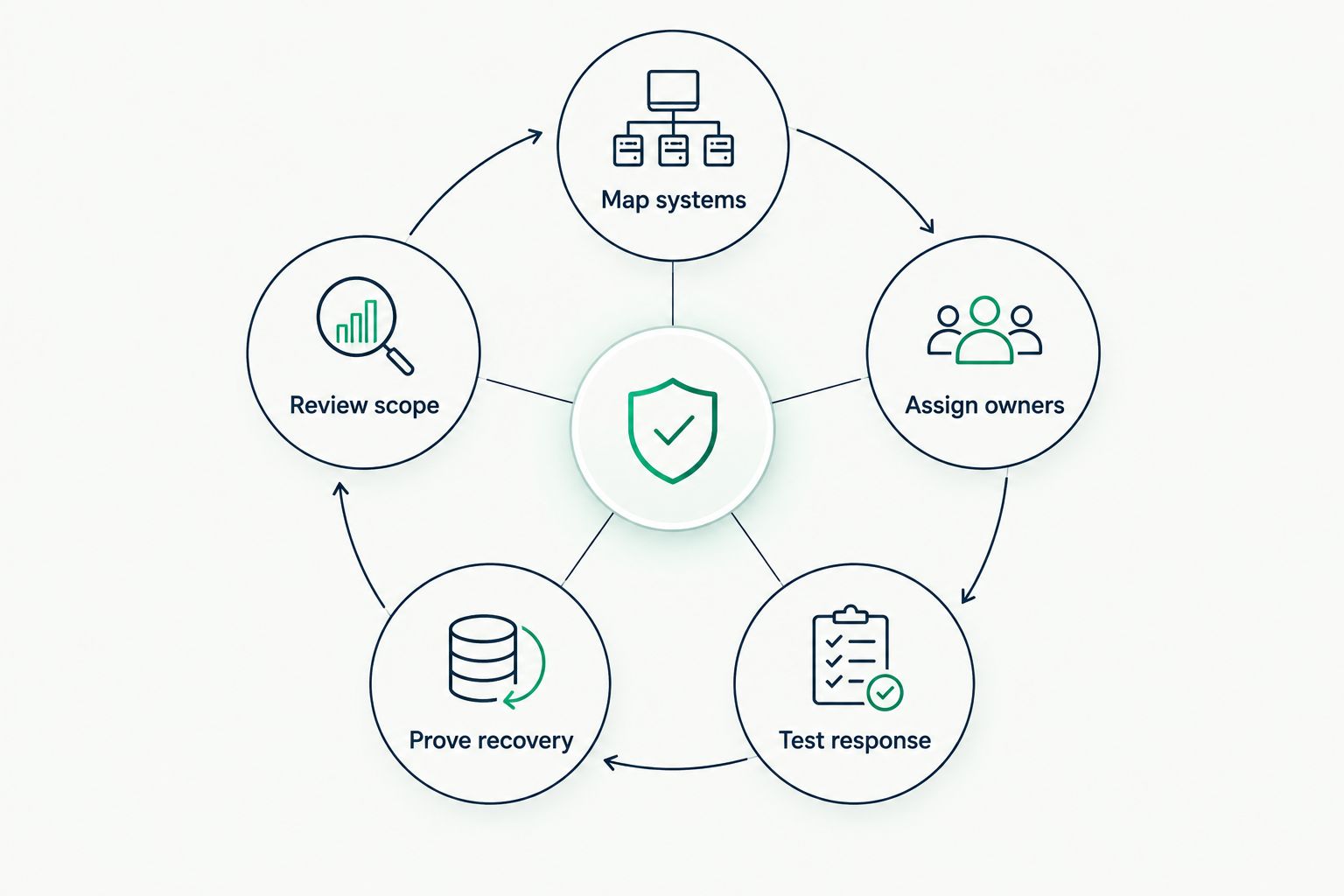
Recheck ownership and recovery whenever the business changes.
Compare cybersecurity service models
Choose the operating model around the work your team can own. A broader contract is not automatically a better fit, and retaining work internally only helps when someone has the authority and capacity to perform it.
Compare equivalent scope. A monitoring-only proposal and an outsourced operations proposal are not interchangeable simply because both use the word security. Ask every candidate to describe its deliverables, exclusions, and required participation from your employees.
Internal administration
- Best for: Businesses with dedicated security ownership and operational capacity
- Main advantage: Direct control and close knowledge of business systems
- Key limitation: Your team must maintain coverage, specialist skills, and escalation procedures
Co-managed security
- Best for: Businesses with internal IT that needs defined outside support
- Main advantage: Retains internal ownership while assigning selected work externally
- Key limitation: Shared responsibility fails without explicit task boundaries
Outsourced security operations
- Best for: Businesses seeking externally managed day-to-day security work
- Main advantage: Transfers agreed operational tasks to a provider
- Key limitation: Integration, exclusions, and approval rights still need business oversight
Project-based assessment
- Best for: Businesses needing a defined review or remediation plan
- Main advantage: Produces a bounded assessment or improvement project
- Key limitation: Does not provide ongoing operations unless separately contracted
DivergeIT
- Best for: Growing businesses seeking cybersecurity, managed IT, and compliance services together
- Main advantage: Offers these service categories through one provider
- Key limitation: The agreement must still specify coverage, responsibilities, and deliverables
Before selecting a model, ask for a sample responsibility matrix and reporting format. Reject any proposal that leaves containment authority or recovery ownership undefined. Those omissions affect execution, not presentation.
Review your security service requirements
Compare your identity, response, recovery, and compliance responsibilities with the services you need.
Common mistakes mid-sized businesses make
Treating the IT manager as the default owner
Assigning every unresolved issue to an already busy IT manager does not establish security coverage. Name a backup decision-maker and define what external providers can do without waiting for approval. Keep executive accountability separate from technical execution.
Buying overlapping tools without assigning action
Multiple alerts about the same event do not establish who must investigate it. Before adding a product, document the operational gap it closes and the person responsible for responding. Remove ambiguity before expanding the toolset.
Assuming client requirements cover every obligation
A customer's questionnaire reflects that customer's requirements, not necessarily every obligation your business holds. Keep customer commitments, insurance conditions, and applicable legal requirements in a single register, with qualified review where needed.
Extending standard support terms to security incidents
A routine help-desk agreement does not automatically define incident containment or evidence preservation. Check whether security incidents have separate escalation and authorization procedures. Get any response commitment in writing with its scope and exclusions.
Measuring backups without testing business recovery
Backup completion reports cannot answer whether employees can resume a critical workflow. Test an application-level recovery and record the dependencies that prevented normal operation. Assign corrections to named owners rather than closing the exercise when files reappear.
FAQ
What cybersecurity services does a mid-sized business need?
A mid-sized business needs assigned responsibilities for identity protection, device security, detection, incident response, recovery, and applicable compliance work. Start with critical systems and business consequences, then select services that close documented operational gaps.
Is co-managed cybersecurity better than fully outsourced security?
Co-managed cybersecurity is the better fit when your internal IT team retains ownership and needs defined outside support. Outsourced operations fit businesses seeking more external execution, but both models require explicit approval rights and task boundaries.
Can a managed IT provider also handle cybersecurity?
A managed IT provider can handle cybersecurity when the agreement explicitly includes the required security work. Routine technical support alone does not establish monitoring, containment, recovery, or compliance responsibilities.
What should a cybersecurity response commitment include?
A cybersecurity response commitment should define the event measured, its starting point, the coverage window, and the required action. It should also identify exclusions, escalation procedures, and any contractual remedy.
Does cybersecurity software make a business compliant?
Cybersecurity software does not, by itself, make a business compliant. Compliance requires identifying applicable obligations, operating the required controls, and maintaining evidence that those controls work.
How do I evaluate a cybersecurity provider before signing?
Evaluate a cybersecurity provider against a written scope covering systems, owners, response authority, recovery responsibilities, and evidence requirements. Use a tabletop exercise to test handoffs and ask the provider to explain exclusions before signing.
What is the difference between a backup and a recovery test?
A backup creates a recoverable copy; a recovery test checks whether you can restore usable data or services. A business recovery test also checks dependencies such as authentication, configuration, and application access.
One last thing
Your provider's most revealing answer is not the tool list. Ask: Who can disable a compromised administrator account when the usual business approver is unavailable? Require a named role, an authorization rule, and an escalation path. If the agreement cannot answer that question, fix the handoff before adding more services.