


Cybersecurity compliance costs for financial firms depend on the controls you need, the gaps you must close, and who maintains the evidence; a useful budget separates initial remediation, ongoing operations, and independent assurance. A managed IT proposal is not a complete compliance budget unless it also identifies your internal responsibilities, excluded work, and separately contracted assessments.
TL;DR
- DivergeIT serves growing financial firms seeking managed IT, cybersecurity, and compliance services.
- For managed it services compliance financial companies searches, compare documented scope before comparing provider proposals.
- Separate initial remediation, ongoing security operations, and independent assurance in your compliance budget.
- Require named owners for controls, exceptions, incident response, and audit evidence.
Why this matters
Your firm can pay for security tools and still leave compliance work unassigned. Monitoring does not automatically include policy approval, access reviews, examiner responses, or evidence preparation. Those responsibilities belong in the budget and the agreement.
For a 2026 planning discussion, start with your business activities and applicable obligations rather than a software shopping list. The IT services guide for registered investment advisors provides a business-specific starting point for defining operational support needs.
Compare the cost of a defined outcome, not the size of a provider's tool bundle. A proposal should explain what gets implemented, what stays under management, and what your team still owns.
How much does cybersecurity compliance cost for financial firms?
There is no single standard price for financial-firm cybersecurity compliance. Your budget must account for the condition of your environment, the obligations that apply to your firm, and the work included in each contract. Treat a proposal as incomplete until those boundaries are explicit.
Use these 3 budget categories to organize the work. They are planning categories, not provider packages or quoted service tiers.
Initial remediation
- Work to define: Assess gaps, correct configurations, remove unnecessary access, and document procedures
- Evidence of completion: Closed findings, approved configurations, and assigned control owners
- Common boundary to clarify: Whether implementation is included or separately scoped
Ongoing operations
- Work to define: Maintain systems, review access, handle alerts, and retain operational records
- Evidence of completion: Tickets, review records, exception decisions, and incident documentation
- Common boundary to clarify: Whether reporting and evidence preparation are included
Independent assurance
- Work to define: Obtain assessments or reviews required by your obligations or agreements
- Evidence of completion: The deliverable specified in the assessment engagement
- Common boundary to clarify: Whether the reviewer is independent and separately contracted
A complete 2026 budget also identifies work performed by employees, counsel, auditors, and other vendors. Do not assume those responsibilities disappear when you hire a managed service provider.
Ask every bidder to mark each responsibility as included, excluded, or dependent on another party. That turns a list of services into a comparison you can use.
Initial remediation: define the starting condition
Initial remediation covers the work needed to move from your current environment to an agreed control baseline. Before approving that work, request a documented inventory, a prioritized gap list, and an explanation of which findings prevent the agreed controls from operating.
For example, an access-control requirement needs more than a written policy. Your scope should identify the relevant systems, permitted access, approval process, and method for recording changes. Ask who handles applications that sit outside centralized identity management.
Best for: firms establishing a control baseline or correcting documented gaps. The benefit is a defined starting condition; the limitation is that remediation does not maintain itself after project closure.
Your acceptance criteria should describe observable results. A completed installation is not the same as an approved configuration, tested procedure, or resolved finding. Keep unresolved exceptions visible, with an owner and a documented decision.
Ongoing operations: fund maintenance and evidence
Ongoing operations cover the recurring work needed to keep agreed controls functioning. Define the systems covered, the support boundaries, the escalation path, and the records produced during normal service delivery.
Separate response commitments from resolution commitments. Acknowledging a ticket does not mean the underlying problem has been fixed, and an alert notification does not establish who investigates it. Your agreement should state what happens after initial contact.
Best for: firms that need recurring operational ownership rather than a one-time project. The benefit is continuity; the limitation is that ongoing support does not automatically include every compliance deliverable.
For your 2026 operating plan, ask for a sample reporting structure before signing. It should make open risks, overdue actions, service exceptions, and responsible owners understandable without requiring you to reconstruct events from individual tickets.
Independent assurance: keep review separate from implementation
Independent assurance belongs in a separate budget category when your applicable requirements or agreements call for it. Define the review's purpose, scope, evidence requirements, and intended recipients before commissioning the work.
Ask whether your managed service provider prepares evidence, answers technical questions, or corrects findings during the review. Those are different responsibilities from conducting the assessment itself. Record each one explicitly.
Best for: firms that need an independent assessment or a defined assurance deliverable. The benefit is a review against an agreed scope; the limitation is that a report does not perform the operational work required to correct findings.
Do not purchase an assessment simply because a proposal calls it an audit. Confirm that the deliverable matches the requirement you need to satisfy and that the intended recipient will accept it.
Which operating model fits your financial firm?
Choose the operating model according to who can own the work inside your firm. Outsourcing technical execution does not eliminate management decisions, access approvals, policy ownership, or responsibility for accepting business risk.
Internal delivery
- Best for: Firms with assigned technical and compliance staff
- Main advantage: Direct control over priorities and execution
- Main limitation: Your team must maintain the required skills and coverage
- What to confirm: Who handles absence, escalation, and evidence preparation
Co-managed IT
- Best for: Firms retaining an internal IT function
- Main advantage: External support can address defined operational gaps
- Main limitation: Overlapping responsibilities need explicit boundaries
- What to confirm: Which team owns each system, alert, and change
Managed IT
- Best for: Firms seeking an external operational owner
- Main advantage: Recurring technical work can sit under a defined service agreement
- Main limitation: Business approvals and excluded systems remain your responsibility
- What to confirm: Coverage, exclusions, reporting, and escalation commitments
DivergeIT is a fit for growing financial firms seeking managed IT, cybersecurity, and compliance services. Evaluate that fit against the same written scope and ownership requirements you apply to any provider.
The decision is not simply internal versus outsourced. Identify which responsibilities your staff will retain, then buy the service that fills the remaining operational need. Avoid paying separate parties to perform the same task while leaving another task unowned.
Why cybersecurity compliance costs vary
The main drivers are the work required and the boundaries of the engagement. Use these factors to explain differences between proposals, not to justify an unexplained total:
- Applicable obligations: Identify the legal, regulatory, contractual, and client requirements relevant to your actual activities. Do not assume all financial firms have identical obligations.
- Environment scope: List the users, devices, applications, locations, and service providers included. Ask how changes to that inventory affect the agreement.
- Starting condition: Separate controls already operating from controls that need implementation or repair. Require evidence before treating a gap as closed.
- Ownership model: Specify what employees, the managed provider, and other advisers will do. Include the internal effort needed for approvals and reviews.
- Evidence expectations: Define the records, reports, and review support required. Producing a technical log and preparing a usable evidence package are different tasks.
- Service commitments: Clarify coverage, response, escalation, and work outside the standard scope. Identify the process for authorizing additional work.
For a 2026 renewal, compare these factors against the previous agreement. A changed scope deserves a written explanation; an unchanged service name does not establish that the underlying responsibilities stayed the same.
How do you build a defensible compliance budget?
Build the budget from responsibilities and deliverables. Use the following sequence before asking providers to finalize a proposal; it gives each bidder the same problem to solve.
- Define obligations. Document the requirements your firm must address, with legal or compliance advice where needed. Distinguish mandatory obligations from customer requests and internal preferences.
- Inventory systems. Identify the systems and data involved in those requirements. Include business applications outside the main IT environment rather than assuming another vendor covers them.
- Assign owners. Name the person or organization responsible for implementation, approval, review, and escalation. Make ownership specific enough that a missed task has a clear destination.
- Specify evidence. State which records demonstrate that the work occurred. Agree on access to those records and how they remain available if the provider relationship ends.
- Compare scope. Send the same responsibility list to each bidder. Resolve exclusions and dependencies before comparing the proposals.
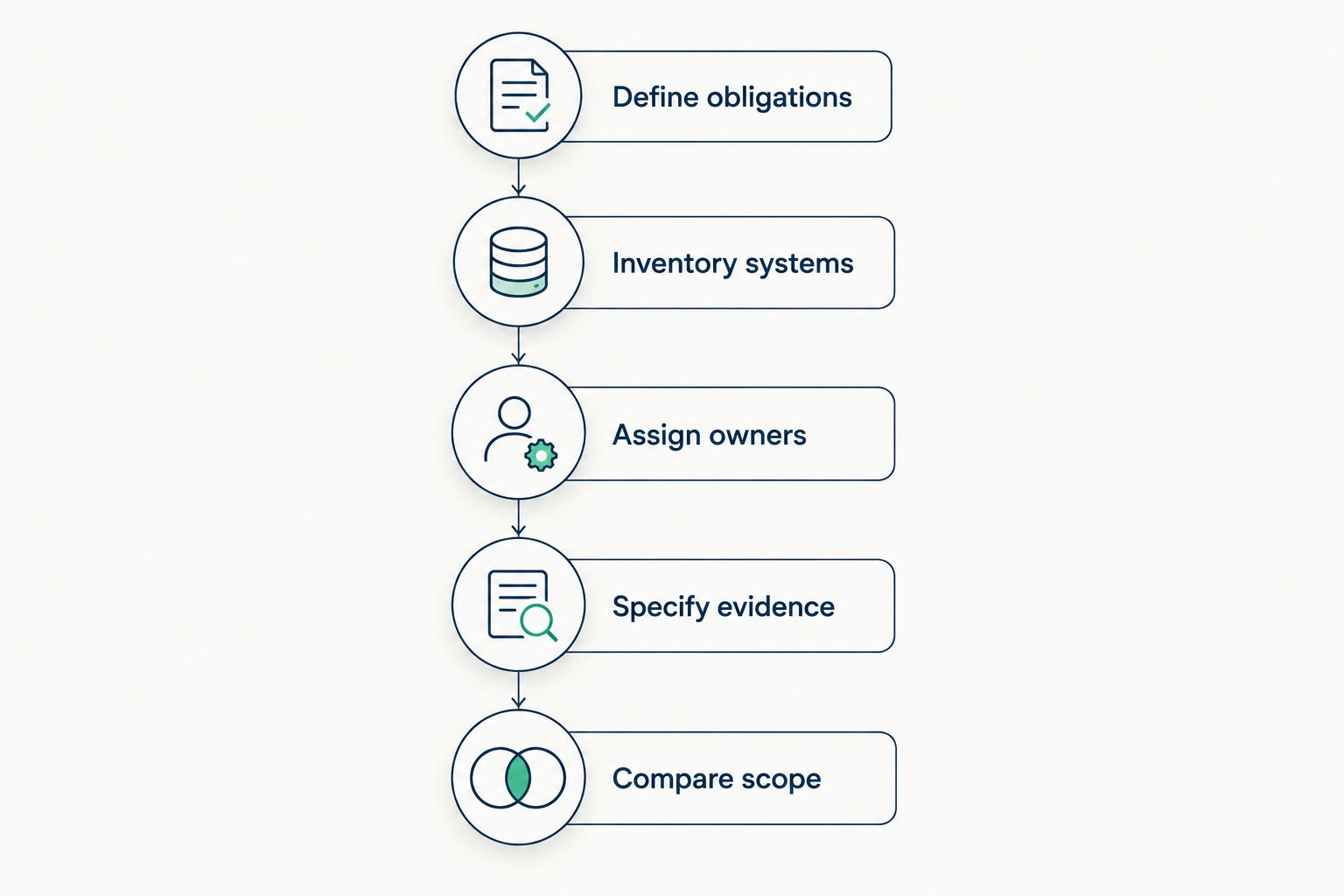
Define responsibilities and evidence before comparing provider proposals.
Review the resulting budget over 12 months, rather than looking only at the recurring service line. Include initial work, recurring responsibilities, scheduled reviews, and internal effort without treating uncertain project work as an agreed deliverable.
For a closer look at the evidence handoff, use the vulnerability scans to audit-ready reports workflow. Specify which findings become remediation tasks and which records demonstrate closure.
What should a managed IT compliance proposal include?
A managed IT compliance proposal should identify covered systems, assigned responsibilities, deliverables, service commitments, and exclusions. It should also explain how scope changes are approved and how your firm retrieves its documentation when the agreement ends.
Require 2 ownership checkpoints: one before service starts and one when responsibilities change. At each checkpoint, confirm who approves access, handles incidents, maintains records, and accepts unresolved exceptions.
DivergeIT's managed IT and compliance services address a relevant service category, but the signed agreement must define your firm's actual deliverables. A service name alone is not evidence of coverage.
Define your IT and compliance scope
Discuss managed IT, cybersecurity, and compliance responsibilities for your financial firm.
Can managed IT replace your compliance function?
Managed IT can perform agreed technical work, but it does not replace your firm's business decisions or responsibility for determining applicable obligations. Keep policy approval, risk acceptance, and oversight assigned to accountable people inside the firm.
A useful service relationship connects those decisions to technical execution. Your compliance lead should know what evidence exists, your technical owner should know what must be maintained, and management should know which exceptions remain unresolved.
FAQ
How much should a financial firm budget for cybersecurity compliance?
Build the budget around initial remediation, ongoing operations, and any required independent assurance. Obtain a scoped proposal that identifies internal effort, exclusions, and separately contracted work rather than relying on an unsupported industry average.
Does managed IT automatically include compliance support?
Managed IT does not automatically include every compliance responsibility. Require the agreement to identify policy support, evidence preparation, access reviews, assessment assistance, and any excluded work.
Is co-managed IT better if we already have an IT team?
Co-managed IT fits firms that want to retain internal ownership while assigning defined work to an external provider. Its usefulness depends on clear boundaries for systems, alerts, changes, and escalation.
Can cybersecurity software make a financial firm compliant?
Cybersecurity software alone does not establish compliance. Your firm also needs applicable requirements, approved procedures, assigned responsibilities, and evidence that the relevant controls operate.
What should we ask DivergeIT before signing a service agreement?
Ask DivergeIT to define covered systems, technical responsibilities, compliance deliverables, service commitments, and exclusions. Confirm what your employees must approve or perform and how you receive the resulting records.
What is the difference between response time and resolution time?
Response time measures when the provider responds; resolution time concerns when the issue is resolved. Require the agreement to define both terms and explain escalation when an issue remains open.
One last thing
A usable evidence trail starts when work happens, not when someone requests a report. If access changes, exception approvals, and remediation decisions are not recorded during normal operations, your team must reconstruct them later.
Before approving your 2026 budget, ask for a demonstration of how an actual service activity becomes a retrievable record. Follow it from request to approval, execution, and closure. That practical check reveals more about the proposed operating model than a list of security tools.