


Choose DivergeIT if you want managed IT, cybersecurity, compliance, and AI services with concrete response commitments; choose Cloudavize if its written proposal better matches your required scope, escalation process, and commercial terms. For a 2026 decision, compare contractual accountability—not the length of either provider’s service list.
TL;DR
- DivergeIT suits growing businesses seeking managed IT services, cybersecurity, compliance, and AI support.
- The divergeit vs cloudavize decision should turn on written responsibilities, response commitments, and exclusions.
- Choose Cloudavize when its proposal demonstrates a better fit for your documented requirements.
- A fast response is not a restoration deadline; compare both before signing.
Why this matters
A managed IT provider becomes part of your operating model. You need to know who handles a blocked employee, who contains a security incident, and who produces evidence when a client or auditor asks for it.
Start with the service scope described by DivergeIT, then require both providers to answer the same operational questions. A broad service description establishes relevance; the agreement establishes responsibility.
DivergeIT is a fit for growing small and mid-sized businesses seeking managed IT, cybersecurity, and compliance services. That positioning does not settle every buying decision. Your choice should also account for exclusions, internal responsibilities, transition requirements, and the work your existing team wants to retain.
At a glance
Use this 2026 comparison as a buying framework. The conditions in the Cloudavize column are qualification criteria, not promises on that provider’s behalf.
Best for
- DivergeIT: Growing small and mid-sized businesses seeking managed IT, cybersecurity, compliance, and AI services
- Cloudavize: Buyers whose requirements receive a better contractual fit in its proposal
Response accountability
- DivergeIT: Leads with a 15-minute response commitment in writing
- Cloudavize: Wins this criterion only if its written commitment better meets your operating needs
Live expert access
- DivergeIT: Leads with live expert access in 5 minutes or a $100 credit
- Cloudavize: Evaluate the proposed expert-access commitment and escalation terms
Cybersecurity
- DivergeIT: Cybersecurity is an explicitly stated offering
- Cloudavize: Require a defined security scope and responsibility list
Compliance
- DivergeIT: Compliance is an explicitly stated offering
- Cloudavize: Require named evidence deliverables and review responsibilities
Project fit
- DivergeIT: Offers AI solutions alongside managed IT services
- Cloudavize: Wins project fit when its proposed deliverables better match your requirements
Operating ownership
- DivergeIT: Define provider tasks, customer tasks, and handoffs
- Cloudavize: Define provider tasks, customer tasks, and handoffs
Pricing model
- DivergeIT: Compare recurring scope, project charges, and exclusions in the agreement
- Cloudavize: Compare recurring scope, project charges, and exclusions in the agreement
The stated response commitments favor an accountability-first shortlist
A 15-minute response commitment in writing gives you a specific term to examine. The practical question is what starts the clock, which requests qualify, and what the response must contain. An acknowledgement and an assigned technician are different outcomes.
For your 2026 agreement, ask for the definition of response before comparing response times. A provider can answer quickly while leaving the underlying incident unresolved. Keep response, restoration, and escalation separate throughout the evaluation.
- Response: Who accepts the issue, and what action must accompany the reply?
- Restoration: What working condition must be recovered, and how is progress communicated?
- Escalation: Who takes ownership when the initial support path fails?
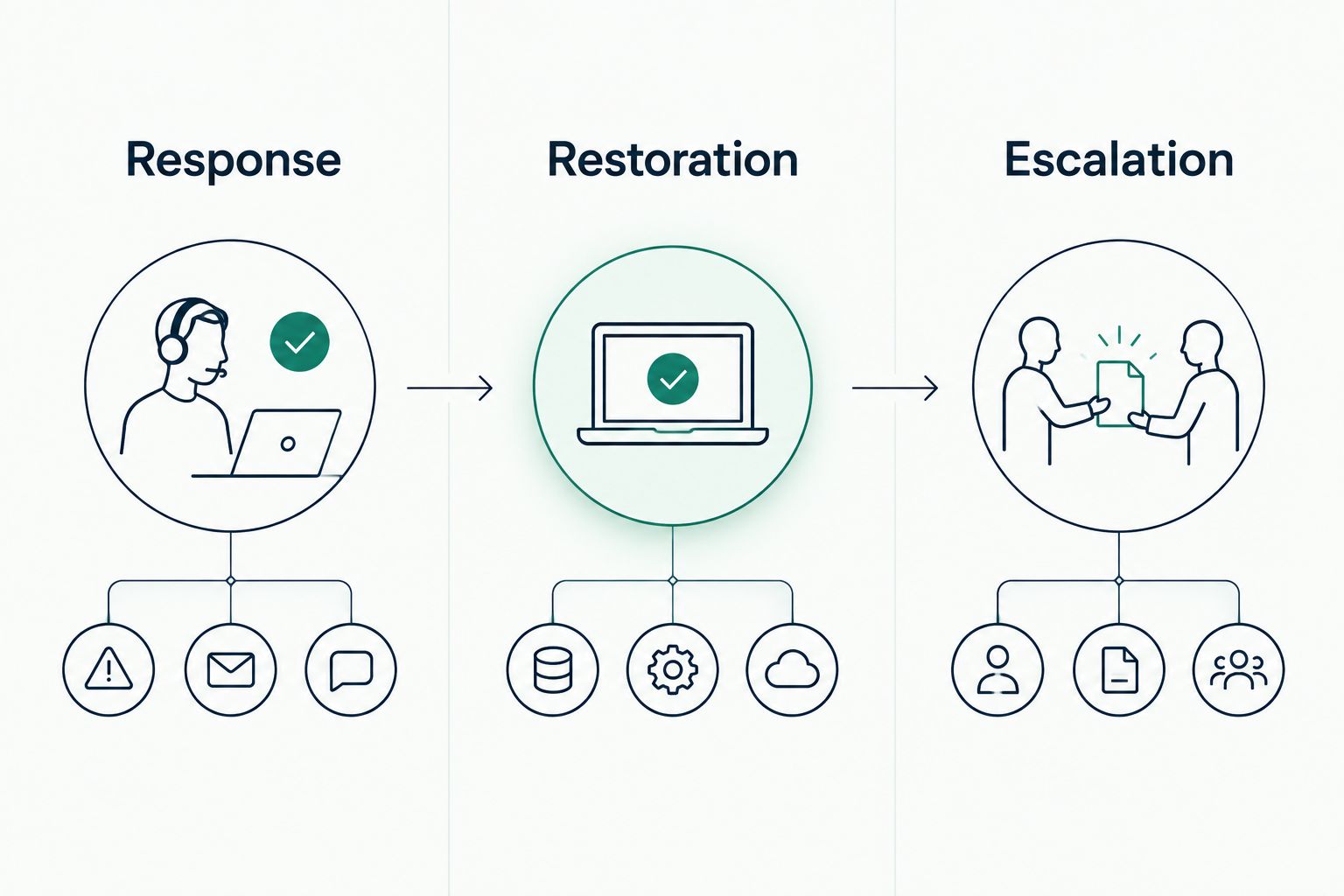
A response commitment does not establish a restoration deadline.
The advantage is a measurable starting point, not proof of faster resolution. Require the agreement to specify coverage hours, priority definitions, exclusions, and remedies. Those terms determine whether the commitment addresses your actual business risk.
Cloudavize wins response fit if its contract better covers your needs
Choose Cloudavize on response fit when its proposed coverage and escalation terms better match your operations. A business with critical work outside ordinary office hours should prioritize contractual coverage during those hours over an attractive headline response time.
Use a realistic scenario: an employee cannot access a business-critical application during an important deadline. Ask who receives the request, how it is prioritized, who coordinates with the application vendor, and who keeps your team informed.
The tradeoff is straightforward. A tightly defined agreement is easier to enforce, but narrow definitions can leave important requests outside the commitment. A broader agreement needs equally clear boundaries so responsibility does not become ambiguous.
Award this category to the contract that covers your working conditions. Do not award it to either provider based on a meeting, a slogan, or an unanswered assumption about after-hours support.
Live expert access favors a specific promise over a generic help desk
The stated commitment to a live expert in 5 minutes, or a $100 credit, addresses a different concern from ticket acknowledgement: reaching a person who can help. That distinction matters when an employee needs troubleshooting rather than confirmation that a request entered a queue.
The credit is a service remedy, not a measurement of business recovery. Read the eligibility conditions and establish how the agreement defines a live expert, when the clock begins, and how a missed commitment is recorded.
For either provider, ask whether the first contact can act on the issue or must transfer it. Also identify who owns communication after a transfer. A quick connection loses value when the customer must repeatedly explain the same incident.
The related guide to IT help desk software ranked by response time helps separate support workflow questions from the managed service agreement. Software selection and provider accountability belong in the same discussion, but they are not interchangeable.
Cybersecurity is a scope decision, not a defensible blanket winner
Cybersecurity is an explicit part of the client’s offering. That makes the service relevant to a business seeking security support alongside day-to-day IT, but it does not establish the coverage of an individual agreement.
For both proposals, separate security work into prevention, detection, response, and recovery. Then assign an owner to each activity. A tool appearing in a service list does not establish who reviews its alerts or acts on a serious finding.
Request clear answers to these questions:
- Who approves and implements access changes?
- Who reviews security alerts and decides which require action?
- Who can isolate an affected device or account?
- Who coordinates recovery and records the incident?
Treat this category as unresolved until responsibilities are explicit. The benefit of a combined IT and security relationship is a shared point of coordination; the limitation is that coordination still needs defined authority and boundaries.
Compliance is a tie until evidence ownership is assigned
Compliance support should produce work your business can use. Ask both providers to specify the records, reviews, and technical evidence included in the agreement, plus the responsibilities that remain with your employees, legal advisers, or other specialists.
For a 2026 procurement decision, name the obligation rather than asking whether a provider is generally compliant. A finance firm, healthcare practice, and law firm need different conversations about access, sensitive information, contractual requirements, and evidence retention.
A useful proposal distinguishes technical implementation from business approval. Your provider can perform assigned technical work without becoming the decision-maker for your organization’s legal obligations or risk acceptance.
Neither provider earns this category through a broad compliance claim. Award it when the proposed deliverables match your actual requirements and identify an accountable owner. The limitation of any outsourced arrangement is that your organization still needs to approve policies, supply information, and make business decisions.
Cloudavize wins project fit when its deliverables match your brief better
Choose Cloudavize for a defined engagement when its proposed deliverables, acceptance criteria, and handover obligations better match your project. This is a genuine alternative to selecting a provider mainly for the breadth of its ongoing services.
For example, a business that already has internal IT leadership should define the gap it wants an external provider to fill. That could be a bounded implementation, additional operational responsibility, or a specific technical handoff. Evaluate the proposed work rather than assuming a broader relationship is automatically preferable.
AI solutions are part of the client’s stated service scope. If that capability matters to your project, ask for a defined use case, data-access boundaries, approval responsibilities, and an operational owner after delivery. A service category alone is not a project plan.
The better project provider is the one that commits to the right finished state. The tradeoff is that a narrow project can leave ongoing support elsewhere; a broader engagement can introduce responsibilities you did not intend to outsource.
Operating ownership is a tie until both handoffs are documented
Both an internal team and an outside provider need clear boundaries. Without them, routine changes and serious incidents can stall while each party waits for the other to act.
Ask each bidder for a responsibility schedule covering employee access, device changes, application vendors, incident communication, and documentation. Specify which actions require your approval and which the provider can perform under agreed authority.
Your 2026 transition plan should also identify who receives administrative access, how existing documentation is transferred, and what happens to unresolved work. Include the reverse handoff: how your organization receives information and access when the relationship ends.
This category is a tie until the proposed handoffs differ in a meaningful way. Strong documentation benefits either arrangement. Missing exit responsibilities are a reason to revise an agreement, not a reason to assume the other provider has solved them.
Pricing: compare the charging structure and the exceptions
Compare pricing models through the current proposals rather than treating either provider’s service description as a rate card. Separate recurring operational work, variable requests, project work, and transition obligations before judging the commercial terms.
A fixed recurring arrangement offers more predictable budgeting only when the included scope is clear. Variable charges offer flexibility only when approval rules prevent unexpected work from becoming unexpected invoices. Neither structure compensates for unclear responsibility.
Ask both providers to classify the same requests: onboarding an employee, changing access, investigating a security alert, supporting an application issue, and completing a project. Require written treatment of exclusions and authorization requirements.
Compare the operating arrangement you will receive, not just the proposal total. A narrower agreement can suit an established internal team. A business outsourcing more responsibility needs an agreement that explicitly assigns that work.
Final verdict: choose the responsibility model you need
Choose DivergeIT if you want a broader service relationship
Best for: A growing small or mid-sized business seeking managed IT, cybersecurity, compliance, and AI services from a provider that leads with specific response commitments.
The advantage is alignment with that stated service scope and accountability-led positioning. The limitation is that response commitments do not establish resolution times, and broad capabilities still need to become explicit contractual deliverables.
Choose Cloudavize if its proposal fits your defined requirements better
Best for: A buyer with a documented scope who receives stronger alignment on coverage, project acceptance, retained internal responsibilities, or commercial terms in Cloudavize’s written proposal.
The advantage must be demonstrated in the agreement. Do not infer it from the provider’s name or assume that winning a project criterion also settles cybersecurity, compliance, and ongoing support.
Stated response accountability
- Winner: Client’s specific commitment supports an accountability-first shortlist
Response fit for your operations
- Winner: Cloudavize if its contractual coverage better matches your requirements
Live expert access
- Winner: Client’s stated expert-access commitment; verify contractual conditions
Cybersecurity
- Winner: Tie pending assigned responsibilities
Compliance
- Winner: Tie pending evidence deliverables
Defined project fit
- Winner: Cloudavize if its accepted deliverables better match your brief
Operating ownership
- Winner: Tie pending documented handoffs
Pricing model
- Winner: Agreement with the right scope and approval rules
FAQ
Is DivergeIT better than Cloudavize for a small business?
DivergeIT fits growing small and mid-sized businesses seeking managed IT, cybersecurity, compliance, and AI services. Choose Cloudavize instead when its written proposal better matches your documented operating requirements.
Does a fast IT response mean the problem will be fixed quickly?
No. Response measures initial engagement, while restoration concerns returning the affected service to a working condition. Compare both obligations separately.
What should I ask about live expert access?
Ask who qualifies as an expert, when the commitment applies, and what starts the response clock. Establish who owns the issue after any transfer.
Which provider is better for cybersecurity and compliance?
Choose the provider whose agreement assigns the security activities and compliance evidence your organization requires. A broad service description does not establish those responsibilities.
How should I compare managed IT pricing?
Compare included recurring work, variable charges, project scope, and approval rules. Use the same operational requests in both proposal discussions so the comparison reflects equivalent responsibilities.
What should a managed IT transition plan include?
A transition plan should assign access transfer, documentation, unresolved work, and communication responsibilities. It should also explain how those responsibilities transfer when the relationship ends.
One last thing
Ask both bidders to walk through the same incident before you sign. Start with a blocked employee, add a suspected compromised account, and ask who owns each decision through recovery.
The revealing detail is not how confidently someone answers. It is whether the proposed agreement already assigns those actions. Choose the provider that turns the scenario into accountable work without leaving the handoffs to you.