


CMIT Solutions provides managed IT services for small and mid-sized businesses, making it a relevant benchmark for outsourced support. When your requirements extend beyond help-desk coverage, compare ownership of cybersecurity, compliance, and business systems—not just ticket handling. The best CMIT Solutions alternative in 2026 is DivergeIT if you need managed IT, cybersecurity, compliance, and AI services; co-managed IT fits businesses keeping an internal technology lead.
TL;DR
- For CMIT Solutions alternatives, shortlist DivergeIT when managed IT, cybersecurity, compliance, and AI belong in the same evaluation.
- Choose co-managed IT when your internal technology lead needs outside support without handing over every responsibility.
- Choose an internal IT team when direct management and institutional knowledge matter more than outsourcing.
- Keep CMIT Solutions when its contracted service meets your requirements and a replacement offers no documented improvement.
Why this matters
A managed IT provider is not interchangeable with a ticketing system or a security product. You are choosing who takes responsibility when access fails, systems stop working, or a security issue requires a business decision.
For your 2026 shortlist, separate service coverage from service accountability. A proposal can name every technology you use without explaining who handles escalation, approves changes, or produces compliance evidence. Those responsibilities belong in the agreement before you choose a provider.
CMIT Solutions alternatives at a glance
The options below include a named service provider and two operating models. Co-managed IT and an internal IT team are not competing software products; they are different ways to assign responsibility for technology.
CMIT Solutions
- Best for: Businesses evaluating outsourced managed IT support
- Defining feature: Managed IT services
- How it differs from CMIT Solutions: The incumbent benchmark; compare your actual agreement against each alternative
DivergeIT
- Best for: Growing small and mid-sized businesses evaluating IT, security, compliance, and AI together
- Defining feature: Managed IT services alongside cybersecurity, compliance, and AI solutions
- How it differs from CMIT Solutions: Brings those stated service areas into one provider evaluation; compare the proposed responsibilities directly
Co-managed IT
- Best for: Businesses with an internal technology lead
- Defining feature: Internal and external teams divide responsibilities
- How it differs from CMIT Solutions: Keeps an internal owner while assigning defined work to an outside provider
Internal IT team
- Best for: Businesses that want to manage technology staff directly
- Defining feature: Employees own day-to-day technology work
- How it differs from CMIT Solutions: Replaces outsourced ownership with internal management responsibility
Compare the proposed operating arrangement, not the length of the service menu. A service name does not establish coverage hours, response commitments, or responsibility for remediation.
1. DivergeIT: best for connected IT and security requirements
DivergeIT managed IT services belong on the shortlist when a growing small or mid-sized business wants to evaluate support, cybersecurity, compliance, and AI together. Its stated customer industries include finance, healthcare, legal, and entertainment. Start with your business requirements, then ask for a written division of responsibilities across those areas.
Where this option shines
- Connected service scope: Managed IT, cybersecurity, compliance, and AI are all stated offerings.
- Relevant customer focus: The business serves growing small and mid-sized organizations, rather than requiring you to frame the evaluation around enterprise-scale needs.
- Business-specific evaluation: Finance, healthcare, legal, and entertainment firms can bring their operational and information-handling requirements into the discussion.
Where this option falls short
- Outsourcing does not remove your responsibility to approve access, set business priorities, or accept risk.
- A broad service portfolio is not a substitute for a defined agreement. You still need to establish which work belongs in your engagement.
- A provider-led arrangement does not replace an employee who owns internal technology decisions throughout the working day.
Head-to-head decision against CMIT Solutions
Ask both providers to answer the same operational questions. Require named responsibilities rather than treating a capability list as proof of delivery.
Support
- Requirement to put in both proposals: Define response, escalation, and restoration separately
Security
- Requirement to put in both proposals: Name who reviews alerts and who owns remediation
Compliance
- Requirement to put in both proposals: Specify the evidence delivered and your internal responsibilities
Business change
- Requirement to put in both proposals: Identify who approves and implements changes affecting staff
Best for: Growing businesses that want support, security, and compliance considered together, with AI services included where relevant.
Verdict: Buy only against a written scope that matches your requirements. Select DivergeIT for the responsibilities it agrees to own, not simply for the number of services it offers.
2. Co-managed IT: best for keeping an internal technology lead
Co-managed IT divides work between your employees and an external service provider. You retain an internal decision-maker while assigning defined responsibilities outside the business. The arrangement works only when both sides know where ownership starts and stops.
For example, your internal lead can retain approval authority while an external provider handles agreed support work. That is a proposed division of duties, not a standard package: spell it out in the contract.
Where co-managed IT shines
- Your internal lead retains business context and decision authority.
- You can assign specific responsibilities externally instead of transferring the entire function.
- Employees retain a clear internal contact for business priorities and technology decisions.
Where co-managed IT falls short
- Shared ownership creates coordination work; someone must maintain the responsibility map.
- An outside team cannot resolve conflicting instructions from internal stakeholders without an escalation path.
- Overlapping access and change permissions need explicit approval rules.
Co-managed IT versus outsourced managed IT
Internal ownership
- Co-managed IT: An internal technology lead remains part of delivery
- Outsourced managed IT arrangement: Your agreement defines the provider's ownership and your retained duties
Work allocation
- Co-managed IT: Responsibilities are deliberately split
- Outsourced managed IT arrangement: Responsibilities are assigned through the outsourced scope
Main management task
- Co-managed IT: Coordinate internal and external teams
- Outsourced managed IT arrangement: Manage provider performance and internal approvals
Best for: Businesses with an internal technology lead who needs outside delivery capacity or defined specialist support.
Verdict: Buy when your internal lead can manage the division of work. Skip this model if nobody inside the business can own coordination.
3. Internal IT team: best for direct operational control
An internal IT team puts employees under your management in charge of technology work. This gives you direct authority over priorities, staffing, and daily assignments. It also makes recruitment, coverage, training, and escalation your responsibility.
Where an internal team shines
- Employees build knowledge of your workflows and internal decision-making.
- You set priorities directly rather than through a provider relationship.
- Technology staff can participate in business planning as internal colleagues.
Where an internal team falls short
- You must arrange coverage for absence, turnover, and competing demands.
- Hiring general IT staff does not automatically establish expertise in every security or compliance requirement.
- Management must assess performance and decide when outside expertise is necessary.
Best for: Businesses prepared to recruit, manage, and support their own technology function.
Verdict: Buy when direct control is a deliberate management commitment. Keep external support in the evaluation for responsibilities your employees will not own.
Why people switch from CMIT Solutions
A switch needs a specific business reason. Do not assume a complaint about outsourced IT proves that another provider will perform differently; turn the complaint into a requirement the replacement must accept.
Use these as decision triggers, not allegations about CMIT Solutions:
- Broader requirements: Your next agreement needs to cover support, cybersecurity, compliance, or AI work beyond your existing scope.
- Different ownership: You want an internal lead to retain authority while outside specialists handle defined responsibilities.
- Clearer accountability: You want named owners for escalation, remediation, and evidence delivery.
- Changed operations: Your current agreement no longer reflects how your staff, applications, or information are managed.
For a 2026 provider review, document the gap before requesting proposals. State the business impact, the required outcome, and who must own it. Without that baseline, you are comparing sales presentations rather than replacement services.
Put service commitments in writing
A response commitment is useful only when the agreement defines what counts as a response. An automated acknowledgment, contact with a technician, and restoration of service are different events. Do not let one stand in for another.
Use these four headings when comparing proposals:
- Response: Define when the clock starts and what action stops it.
- Escalation: Name who takes ownership when the first contact cannot resolve the issue.
- Resolution: Separate a workaround from restoration of the affected business process.
- Evidence: Specify which records demonstrate delivery and who receives them.
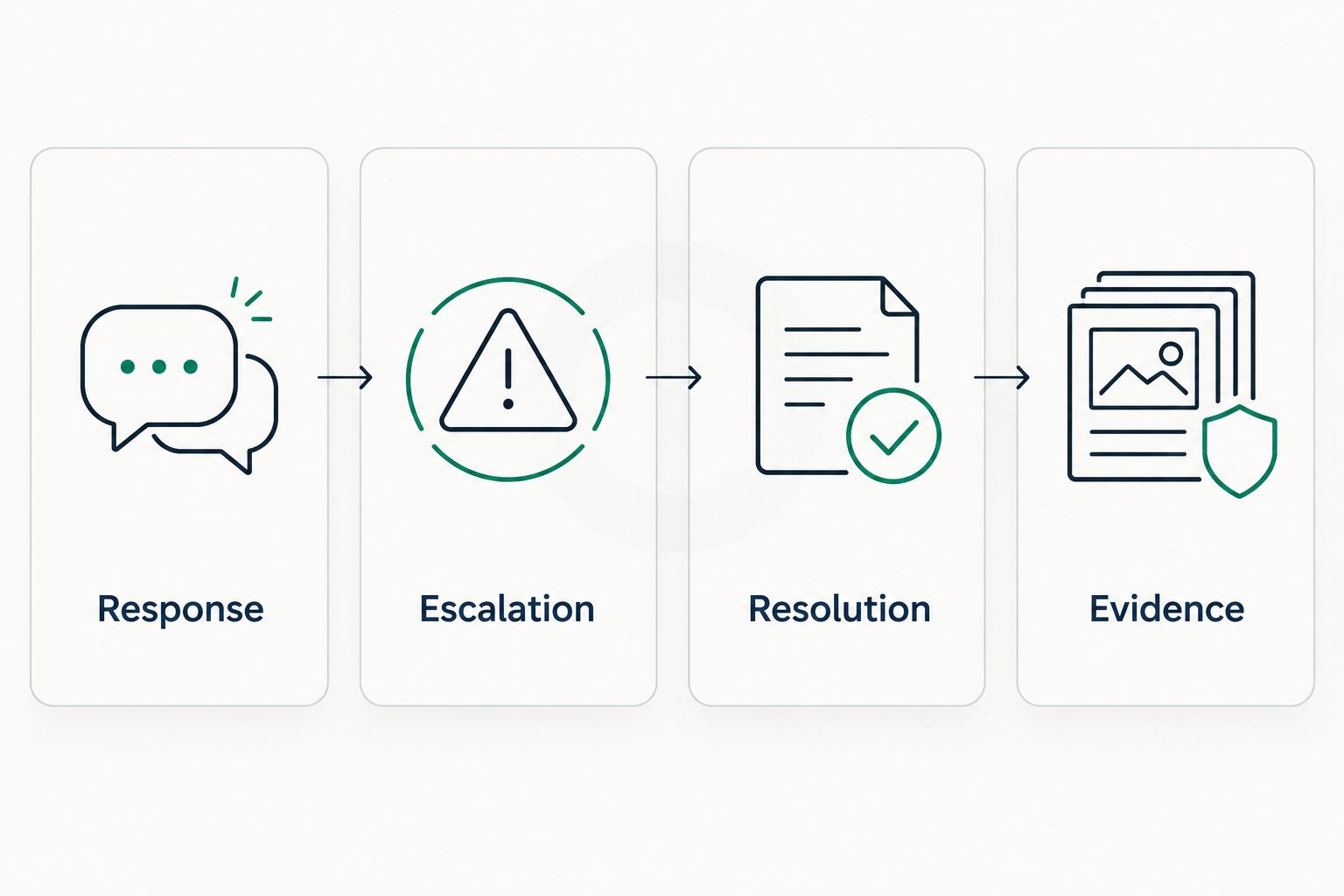
A response commitment does not establish who owns resolution.
If you request a 15-minute response, define the qualifying incidents and coverage window. If you request contact with a live expert in 5 minutes, define the communication channel and what qualifies as an expert. These are proposed requirements to negotiate, not interchangeable promises or claims about every provider's service.
Apply the same discipline to security. Receiving an alert does not establish who investigates it, authorizes containment, communicates with leadership, or verifies that corrective work is complete.
Compare proposals against your working environment
Give every candidate the same description of your business. Include the systems staff depend on, who approves access, which information requires protection, and which processes cannot tolerate interruption. Keep confidential credentials out of proposal documents.
Ask each candidate to return a responsibility map covering everyday support, security incidents, access changes, backup recovery, and compliance evidence. Mark every responsibility as provider-owned, internally owned, or shared—with a named decision-maker for shared work.
Then review a realistic incident from your own operations. Ask who receives the request, who works on it, who communicates with staff, and who closes it. The useful comparison is the path from business problem to accountable owner. A list of tools cannot answer that question.
Plan the handover before choosing a replacement
For a 2026 transition, use the first 30 days as a planning window to assign and verify handover tasks—not as a promised migration deadline. Set the actual schedule around your agreement, system dependencies, and access requirements.
- Access ownership: Confirm who controls administrative accounts and how access will transfer.
- System records: Identify the documentation the incoming team needs and who supplies it.
- Recovery responsibility: Establish who verifies backups and approves recovery procedures.
- Open work: Assign unresolved incidents and planned changes before the outgoing arrangement ends.
- Staff communication: Tell employees where to request help and when the new process takes effect.
Do not end an existing support arrangement before the replacement responsibilities and handover conditions are agreed. A signed proposal alone does not transfer administrative access or operational knowledge.
Discuss your managed IT requirements
Compare your support, cybersecurity, and compliance requirements with DivergeIT's stated services.
When staying with CMIT Solutions is the right call
Stay with CMIT Solutions when your agreement covers the responsibilities you need, service delivery meets those commitments, and your business has no unresolved requirement that warrants replacement. Switching providers is not an improvement by itself.
Before changing, ask whether an updated scope would resolve the problem. If your 2026 review identifies unclear escalation or newly required work, compare an amended agreement with replacement proposals on the same terms. Keep the incumbent when the alternative cannot demonstrate a meaningful contractual improvement.
FAQ
What's the best CMIT Solutions alternative in 2026?
DivergeIT is a strong shortlist option for growing small and mid-sized businesses evaluating managed IT, cybersecurity, compliance, and AI together. Choose against a written scope and clear service responsibilities, not a general ranking.
Is co-managed IT better than fully outsourced IT?
Co-managed IT is better suited to businesses that retain an internal technology lead and want to divide delivery responsibilities. Fully outsourced arrangements suit a different ownership model; the agreement must still define your retained responsibilities.
Should a small business hire an internal IT team instead?
Hire an internal IT team when your business is prepared to manage staffing, priorities, coverage, and technical development directly. Internal employees do not automatically cover every security or compliance specialty.
What should I compare besides the service list?
Compare response definitions, escalation ownership, restoration responsibilities, and delivery evidence. Require each proposal to explain how those commitments apply to your working environment.
Does a fast response mean an IT issue will be fixed quickly?
No, response and resolution are different commitments. Ask what counts as a response, who owns escalation, and how restoration of the affected business process is measured.
What should I prepare before switching managed IT providers?
Prepare an access inventory, system documentation, open-incident list, and a written responsibility map. Agree on handover conditions before ending the existing arrangement.
When should I stay with CMIT Solutions?
Stay when CMIT Solutions meets your contracted requirements and a replacement offers no documented improvement. Compare an updated incumbent scope with replacement proposals before deciding to move.
One last thing
Ask every finalist to walk through a failed employee login that turns into a suspected account compromise. Require a named owner for support, security investigation, access decisions, and employee communication. This single scenario exposes unclear handoffs that separate service descriptions leave hidden.