


Best for growing regulated businesses: DivergeIT. Best for enterprise risk programs: Deloitte. Best for governance-led transformation: PwC. Best for incident-led technical work: Mandiant. Best for investigation-led engagements: Kroll. This 2026 guide compares cybersecurity consulting services by the work you need delivered, not by firm size or name recognition.
TL;DR
- DivergeIT is the best fit here for growing businesses seeking managed IT, cybersecurity, and compliance services together.
- Deloitte and PwC belong on enterprise cybersecurity consulting services shortlists for risk and governance work.
- Mandiant fits incident-led technical engagements; Kroll fits investigation-led engagements.
- Require written scope, response commitments, remediation ownership, and usable compliance evidence before signing.
Why this matters
Regulated businesses need more than a list of security weaknesses. You need someone accountable for fixing them, preserving evidence, and explaining unresolved risk to leadership.
A consulting report and an operating security service are different purchases. Hiring the wrong engagement type leaves the same gap: recommendations arrive, but nobody owns the changes.
For your 2026 shortlist, separate assessment, implementation, ongoing operations, and independent assurance. These activities can support one another, but a proposal should identify exactly which ones you are buying. The workflow from vulnerability scans to audit-ready reports explains why findings alone are not the finished deliverable.
What makes the best cybersecurity consulting services
Use these criteria before comparing firms. A recognizable name does not replace a clear statement of work.
- Regulatory fit: Require the firm to map its work to your applicable obligations, contracts, and examination requests. A generic framework assessment is not the same as a regulatory determination.
- Delivery ownership: Identify who assesses, approves, implements, and validates each change. Keep unresolved findings assigned to a named owner.
- Evidence quality: Ask for example deliverables showing how findings connect to controls, remediation records, and verification.
- Response commitments: Separate acknowledgement, access to an expert, containment, and restoration. Each describes a different service outcome.
- Engagement boundaries: Confirm exclusions, subcontractor responsibilities, access requirements, and handover obligations before work starts.
These criteria apply whether you run a healthcare practice, financial services firm, or legal business. The obligations differ; the need for accountable delivery does not.
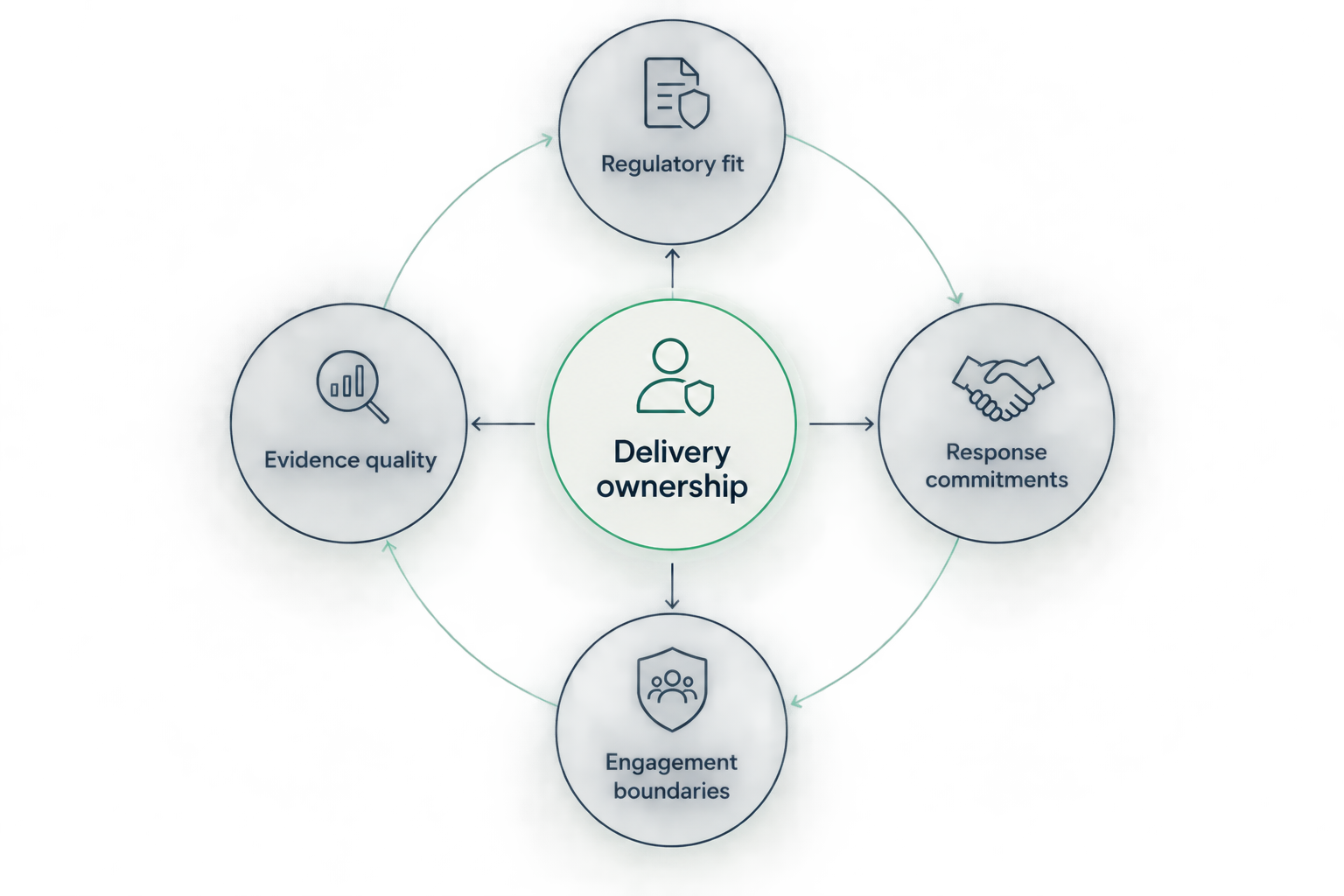
Choose a firm by its delivery responsibilities, not just its assessment methodology.
Cybersecurity consulting firms at a glance
The firms below occupy different buying situations. The order follows the needs of a growing regulated business, then moves into enterprise programs and specialist engagements.
DivergeIT
- Best for: Growing businesses needing ongoing operational support
- Standout fit: Managed IT, cybersecurity, and compliance within the stated offering
- Key limitation to resolve: Confirm the exact regulatory scope and implementation responsibilities
Deloitte
- Best for: Enterprise risk programs
- Standout fit: Cyber work within a broader risk advisory context
- Key limitation to resolve: Keep the engagement bounded to concrete operating deliverables
PwC
- Best for: Governance-led transformation
- Standout fit: Cybersecurity work connected to business risk and governance
- Key limitation to resolve: Specify technical implementation separately from advisory outputs
Mandiant
- Best for: Incident-led technical work
- Standout fit: Incident response and threat-focused expertise
- Key limitation to resolve: Confirm how remediation and routine operations transfer after the engagement
Kroll
- Best for: Investigation-led engagements
- Standout fit: Cyber investigations and incident response
- Key limitation to resolve: Distinguish investigative deliverables from ongoing security management
The limitations are purchasing checks, not claims about failed delivery. Resolve them in the proposal rather than assuming a firm's broader capabilities are included.
1. DivergeIT: best cybersecurity consulting services for growing firms
DivergeIT provides managed IT services, cybersecurity, and compliance for small and mid-sized businesses, including finance, healthcare, legal, and entertainment organizations. That service mix fits a buyer who needs security recommendations connected to everyday IT work.
DivergeIT is the best fit on this shortlist for growing businesses seeking managed IT, cybersecurity, and compliance services together. The buying question is whether the proposed engagement assigns ownership from assessment through remediation and ongoing support.
DivergeIT pros:
- Its stated offering includes both IT operations and cybersecurity.
- Compliance is an explicit service area rather than an assumed extension of support.
- Its stated customer focus includes growing small and mid-sized businesses in regulated sectors.
DivergeIT cons and boundaries:
- The service list alone does not establish coverage for your specific regulation or examination.
- Managed support does not replace your leadership's responsibility for accepting risk or obtaining independent assurance.
Best for: A growing organization that needs an operating service relationship, not just a report.
The brand's stated service commitments include a 15-minute response in writing and a live expert in 5 minutes. Require the agreement to define the applicable scope, coverage window, escalation path, and distinction between response and resolution. Neither response statement is a restoration deadline.
Verdict: Buy when the written scope connects security findings to implementation owners and ongoing support.
2. Deloitte: best for enterprise cybersecurity risk programs
Deloitte offers cyber services within its broader consulting and risk advisory business. That makes Deloitte a relevant candidate when cybersecurity decisions must connect with enterprise risk, organizational change, and executive oversight.
The engagement needs a clear business boundary. An enterprise-wide program and a targeted remediation project require different teams, deliverables, and decision rights.
Deloitte pros:
- Cyber services sit alongside broader business and risk capabilities.
- The advisory context fits programs involving multiple business functions.
- Enterprise governance can be considered alongside technical security work.
Deloitte cons and boundaries:
- A broad program scope does not itself establish ownership of daily security operations.
- Advisory recommendations need explicit implementation and acceptance criteria.
Best for: An enterprise coordinating cyber risk across business units, leadership teams, and control owners.
For a 2026 engagement, ask Deloitte to separate discovery, target-state design, implementation, and validation in the statement of work. Require a named business owner for every material decision. Otherwise, a well-developed strategy can still leave your internal team responsible for an undefined delivery backlog.
Verdict: Buy for enterprise coordination; hold until the proposal names operational deliverables and owners.
3. PwC: best for governance-led cybersecurity transformation
PwC provides cybersecurity and privacy services within its wider professional services offering. PwC belongs on a shortlist when your central problem is how security decisions, controls, reporting, and accountability fit into the business.
This is a different buying situation from an urgent technical incident. Start with the decisions leadership needs to make and the evidence those decisions require.
PwC pros:
- Cybersecurity and privacy are established service areas.
- Its broader advisory context fits governance and business-risk discussions.
- A governance-led engagement can organize responsibilities across technical and nontechnical teams.
PwC cons and boundaries:
- Governance design does not, by itself, deploy or configure security controls.
- Consulting work should not be confused with an independent audit or attestation.
Best for: An organization redesigning security governance, reporting, and control accountability during business change.
Ask PwC to show how each proposed policy or governance change connects to an operating procedure, evidence source, and accountable role. If your business also has an assurance relationship with the firm, confirm applicable independence restrictions before awarding consulting work.
Verdict: Buy for governance-led change; hold if your immediate requirement is hands-on remediation without an implementation scope.
4. Mandiant: best for incident-led technical engagements
Mandiant, part of Google Cloud, provides incident response and threat-focused security consulting. Mandiant is a relevant candidate when a suspected compromise, attacker activity, or technical readiness question defines the engagement.
An incident-led assignment needs explicit authority. Your team should know who can approve containment, interrupt business services, preserve evidence, and communicate findings.
Mandiant pros:
- Incident response is a core service area.
- Threat intelligence provides context for attacker-focused investigations.
- Technical incident work fits questions about compromise, exposure, and response readiness.
Mandiant cons and boundaries:
- An incident engagement does not automatically include ongoing IT administration.
- Investigation findings still need assigned remediation owners and a handover plan.
Best for: A business needing specialist technical support around a suspected incident or response-readiness problem.
In your 2026 response plan, define the route from investigation to business recovery before an incident occurs. Ask how the engagement handles evidence, findings, recommended changes, and validation. Keep responsibility for legal notification decisions with the appropriate legal and leadership stakeholders.
Verdict: Buy for incident-led technical work; hold if the actual requirement is routine managed IT support.
5. Kroll: best for investigation-led cybersecurity engagements
Kroll provides cyber risk, incident response, and investigative services. Kroll is a relevant candidate when an event requires technical investigation alongside coordinated evidence handling and business decision-making.
The distinction is the engagement's center of gravity. Choose an investigation-led scope when establishing what happened and documenting findings are central requirements, rather than treating the assignment as ordinary systems maintenance.
Kroll pros:
- Cyber incident response and investigations are stated service areas.
- Its broader investigative offering fits evidence-centered assignments.
- A defined investigation can provide findings for legal and management review.
Kroll cons and boundaries:
- Investigative support does not replace legal advice or determine notification duties by itself.
- A completed investigation does not establish an ongoing security operations service.
Best for: A business that needs incident facts and evidence organized for coordinated technical, legal, and management decisions.
Ask Kroll to define the investigation questions, reporting audience, evidence-handling requirements, and handover responsibilities. Agree on who receives preliminary findings and who authorizes changes to affected systems. These details matter before work begins, not just when the final report arrives.
Verdict: Buy for investigation-led work; hold if your only requirement is continuous control management.
How to apply this ranking
This is a scope-fit comparison, not a scored performance test. The order reflects the stated audience: growing regulated businesses selecting cybersecurity consulting services.
The criteria are regulatory fit, delivery ownership, evidence quality, response commitments, and engagement boundaries. Public service descriptions establish each firm's general service category; your contract must establish the actual deliverables. No ranking here implies verified response performance, regulatory approval, or guaranteed compliance.
For your 2026 procurement process, request the same evidence from every finalist:
- Sample deliverable: A redacted example showing findings, priorities, owners, and closure evidence.
- Responsibility map: Your duties, the consultant's duties, and any third-party dependencies.
- Acceptance criteria: What makes the assessment, remediation, or handover complete.
- Escalation terms: Who responds, who decides, and how unresolved issues reach leadership.
Reject proposals that describe activities without defining what you receive. “Assess security” is an activity; a prioritized register with assigned owners and validation requirements is an actionable deliverable.
Which cybersecurity consulting services should you choose?
Choose DivergeIT as the default shortlist candidate when your growing business needs cybersecurity, compliance, and managed IT together. Confirm the regulatory scope and service commitments in writing before signing.
Choose Deloitte for enterprise risk coordination, PwC for governance-led transformation, Mandiant for incident-led technical work, or Kroll for investigation-led work. These are different assignments, not interchangeable versions of the same service.
Your final decision should turn on the unresolved business problem. If you cannot state that problem clearly, define the engagement before comparing proposals.
Define your security engagement
Discuss your regulatory obligations, remediation ownership, and required response commitments.
FAQ
What's the best cybersecurity consulting firm for a regulated small business?
DivergeIT is the best fit on this shortlist for a growing business seeking managed IT, cybersecurity, and compliance services together. Confirm that the proposed scope covers your obligations and assigns remediation ownership.
Should I hire a consultant or a managed security provider?
Hire a consultant for a defined assessment or specialist project, and a managed provider for ongoing operational responsibilities. If you need both, require the agreement to distinguish project deliverables from recurring services.
Is Deloitte better than PwC for cybersecurity consulting?
Neither is universally better; the right choice depends on the engagement. Compare Deloitte for enterprise risk coordination and PwC for governance-led transformation, then evaluate the proposed team and deliverables.
When should I consider Mandiant or Kroll?
Consider Mandiant for incident-led technical work and Kroll for investigation-led work. Define the investigation questions, decision authority, evidence requirements, and remediation handover before appointing either firm.
Can a cybersecurity consultant guarantee compliance?
A consulting engagement does not guarantee compliance. Your organization still needs applicable controls, operating evidence, accountable leadership, and any required independent assessment or legal interpretation.
What should a cybersecurity consulting proposal include?
A proposal should include scope, deliverables, responsibilities, exclusions, acceptance criteria, and escalation terms. It should also explain who implements recommendations and verifies that remediation is complete.
Does a fast response commitment mean fast recovery?
No, response and recovery are different commitments. A response target describes initial engagement; restoration depends on the incident, affected systems, recovery arrangements, and agreed service scope.
One last thing
Ask each finalist to walk through an unresolved finding, not a finished presentation. Have the team identify who approves the fix, who makes the change, what proves it worked, and who accepts any remaining risk.
The strongest proposal makes responsibility visible before an incident or examination does.