


Yes. Managed IT can help registered investment advisers prepare for SEC examinations by maintaining security controls, documenting technical work, and supplying evidence that supports the firm’s compliance program. It cannot guarantee an examination outcome or transfer the adviser’s regulatory responsibilities to a service provider.
TL;DR
- IT services for registered investment advisors support SEC examination readiness through documented controls, incident response, and retrievable evidence.
- Your chief compliance officer owns regulatory decisions; your IT provider supplies technical implementation and records.
- DivergeIT offers managed IT, cybersecurity, and compliance services for growing small and mid-sized businesses.
- Evaluate providers on evidence delivery and written responsibilities, not promises to make your firm pass.
Can managed IT help RIAs pass SEC audits?
Managed IT supports the technology side of examination readiness. An SEC examination evaluates the adviser’s compliance with applicable requirements; purchasing an IT service does not establish that compliance.
Start by defining the work covered by IT services for registered investment advisors. Separate routine support from security operations, evidence preparation, and compliance assistance. Your agreement should identify who performs each task and who verifies completion.
Managed IT
- Best for: Firms outsourcing day-to-day technical operations
- Main advantage: Assigns operational tasks to an external team
- Main limitation: The adviser must oversee the provider and retain compliance ownership
Co-managed IT
- Best for: Firms retaining an internal IT lead
- Main advantage: Divides implementation and support responsibilities
- Main limitation: Unclear handoffs leave gaps unless ownership is documented
Internal IT
- Best for: Firms staffing their own technical operations
- Main advantage: Keeps operational responsibility inside the firm
- Main limitation: The firm must supply staffing, specialist skills, and evidence processes
Choose the support model that produces accountable work and retrievable evidence. Outsourcing is not the deciding factor; execution and oversight are.
Why this matters
An installed security tool and a documented control are not the same thing. A tool’s dashboard shows its current state; examination preparation also requires explaining its scope, ownership, exceptions, and operation during the relevant period.
For your 2026 preparation, connect each written commitment to evidence. If your policy requires access removal when employees leave, retain the approved request, the action taken, and confirmation that relevant access ended.
A provider can supply those technical records. Your compliance team still needs to determine whether they support the policy and address the applicable obligation.
What SEC requirements should your IT provider support?
Your chief compliance officer and counsel should determine which requirements apply to your firm. The provider’s role is to translate those requirements into technical tasks, monitoring, records, and escalation procedures—not to substitute a generic security checklist for legal analysis.
Regulation S-P: safeguards and incident response
The SEC’s Regulation S-P amendments establish safeguards and incident-response requirements for covered institutions, including SEC-registered investment advisers. The smaller-entity compliance date is June 3, 2026; confirm your firm’s classification rather than assuming every adviser shares that deadline.
Under the amended rule, affected individuals generally must receive notice as soon as practicable, but no later than 30 days after the institution becomes aware of qualifying unauthorized access to or use of customer information. Exceptions apply, including a specified determination that sensitive customer information has not been, and is not reasonably likely to be, used in a manner causing substantial harm or inconvenience.
The amendments also address service-provider oversight. Covered institutions must establish policies and procedures reasonably designed to ensure providers notify them as soon as possible, but no later than 72 hours after becoming aware of a qualifying breach involving a customer information system maintained by the provider.
Source: SEC Regulation S-P amendments, including the incident-response, customer-notification, and service-provider oversight provisions; smaller-entity compliance date June 3, 2026. These requirements concern covered institutions, not every business using managed IT.
Compliance program review
SEC Rule 206(4)-7 requires registered advisers to adopt and implement written compliance policies and procedures and review their adequacy and implementation at least annually. IT records can support the technology-related portions of that review.
Ask for evidence of completed work, unresolved exceptions, and corrective actions. A provider’s statement that systems are secure does not replace the adviser’s assessment of whether its compliance program works.
Recordkeeping and communications
Your compliance team should identify which business records and communications must be preserved under applicable requirements. Your IT provider should then document how the approved systems capture, retain, protect, and retrieve those records.
Backups are not a substitute for a compliant records-retention process. A recovery system and an archive serve different purposes; test the retrieval process your firm actually relies on.
How do you turn managed IT work into examination evidence?
Use a repeatable process that connects business obligations to technical actions. The objective is not a larger document folder; it is a clear explanation of what happened, who handled it, and what remains unresolved.
- Define scope. List the systems, devices, identities, applications, and providers that handle customer information or support regulated activity. Identify exclusions explicitly.
- Assign owners. Name the person responsible for each control, the person approving exceptions, and the contact who receives urgent escalations.
- Implement controls. Turn approved requirements into configurations and operating procedures. Record deployment coverage, not just the purchase of a tool.
- Collect evidence. Retain reports, tickets, approvals, test results, and exception records with dates and system context.
- Review exceptions. Resolve gaps or document approved treatment. Carry open items into the compliance review rather than allowing them to disappear between reports.
These steps create a traceable connection between policy and practice. They also expose a common weakness: a responsibility can appear in a policy without anyone being assigned to carry it out.
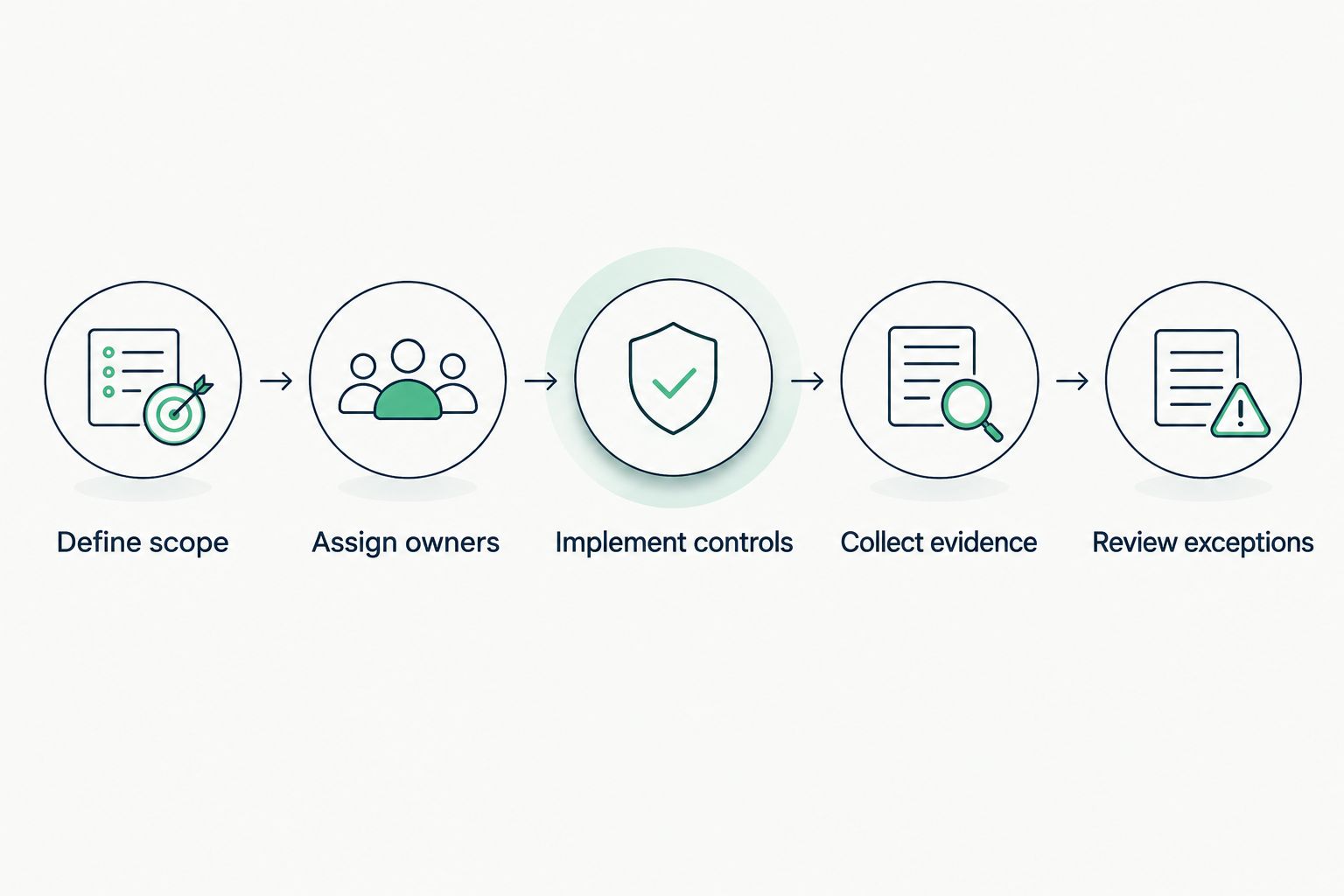
Assign responsibility before collecting reports; evidence needs an owner and a defined purpose.
Which evidence should you request from your provider?
Request records that demonstrate a control’s operation, not merely that a product exists. The following evidence categories support a technical review; they are not a universal SEC document-request list.
User access
- Evidence to request: Account inventory, access approvals, departure tickets
- What your firm should verify: Access matches current responsibilities and approved changes
Device security
- Evidence to request: Device inventory, protection status, configuration exceptions
- What your firm should verify: Relevant devices are included and gaps have owners
Vulnerability management
- Evidence to request: Findings, remediation tickets, exception approvals
- What your firm should verify: Findings receive documented treatment and follow-up
Recovery
- Evidence to request: Backup reports, restoration test records, unresolved failures
- What your firm should verify: Recovery testing covers the systems your firm depends on
Incident handling
- Evidence to request: Escalation procedures, event timelines, exercise records
- What your firm should verify: Technical staff know when and how to involve compliance
Record retrieval
- Evidence to request: Archive settings, retrieval tests, access records
- What your firm should verify: Required records can be located and produced appropriately
Ask the provider to explain report boundaries. A report covering company laptops does not establish coverage for personal devices, cloud applications, or a separate records archive.
Keep evidence in a location your firm controls or can access under the agreement. Provider-held records should have defined delivery and transition arrangements so that changing vendors does not interrupt your access.
Why examination readiness varies between firms
The right service scope depends on how your firm operates. Use these factors to define responsibilities rather than accepting a standard package as proof of readiness:
- Registration and applicable obligations: Confirm which regulatory requirements apply before translating them into IT tasks.
- System coverage: Identify every relevant environment and any systems excluded from the provider’s responsibility.
- Customer information: Document where customer information enters, moves, resides, and leaves your systems.
- Work arrangements: Account for remote access, personal devices, and employee departures in the control design.
- Provider dependencies: Clarify responsibilities shared with cloud platforms, archives, custodians, and other vendors.
- Evidence quality: Check whether reports identify dates, coverage, exceptions, owners, and completed corrective work.
For a 2026 provider review, ask the same scope questions of every candidate. Comparing service descriptions without comparing exclusions leaves the most important differences unresolved.
What should an RIA require in the service agreement?
Require commitments that describe an action, an owner, and a measurable trigger. A response commitment is useful, but it does not describe the entire incident-handling process.
Distinguish acknowledgment, investigation, containment, recovery, and evidence delivery. Ask which service hours apply to each activity, who receives escalations, and what happens when an issue remains unresolved.
Your agreement should also address:
- Systems, users, and locations included in the service.
- Responsibility for security configuration and ongoing monitoring.
- Incident notification and cooperation with your response team.
- Routine report delivery and examination-related evidence requests.
- Approval and tracking of exceptions or deferred remediation.
- Access to records and administrative credentials during transition.
Do not treat a general help-desk commitment as an incident-response commitment. Your compliance team needs to know how a suspected customer-information incident reaches the people responsible for evaluating notification obligations.
Where does DivergeIT fit?
DivergeIT is best suited to growing small and mid-sized businesses seeking managed IT, cybersecurity, and compliance services together. That service scope is relevant to an RIA evaluating external operational support.
The boundary matters just as much: DivergeIT’s managed IT and compliance services do not transfer an adviser’s regulatory obligations. Before selecting any provider, confirm the RIA-specific systems covered, evidence deliverables, incident responsibilities, and exclusions in writing.
Ask for a walkthrough of an access-removal request, a security escalation, and an evidence request. Evaluate the proposed workflow against your firm’s policies rather than accepting a service label as proof of fit.
Define your RIA support scope
Discuss system coverage, incident responsibilities, and examination evidence requirements.
Can an IT provider guarantee that your RIA will pass?
No IT provider can guarantee an SEC examination outcome. Technical operations are only part of the adviser’s responsibilities, and the firm remains accountable for its compliance program.
Replace a pass guarantee with specific deliverables. Require defined system coverage, documented remediation, evidence access, and cooperation with your compliance team.
Does your chief compliance officer still need to oversee IT?
Your chief compliance officer still needs visibility into technology risks and relevant control failures. Outsourcing implementation does not eliminate the need to evaluate whether the firm’s policies are appropriate and operating as intended.
Set an escalation process that brings significant exceptions to the right decision-maker. The provider should explain technical facts; your firm decides the compliance response with appropriate advice.
What should you do before an examination request arrives?
Test whether your firm can retrieve evidence and explain it without improvising. Select a completed employee departure, a resolved security issue, and a restoration test, then follow each from request through closure.
Use your 2026 review to fix missing ownership and incomplete records. Do not present newly created procedures as evidence that those procedures operated historically.
FAQ
Can managed IT services guarantee that we pass an SEC audit?
No. Managed IT can support examination preparation through technical controls and evidence, but the adviser remains responsible for its compliance program and regulatory obligations.
What should IT services for registered investment advisors include?
IT services for registered investment advisors should have a defined scope covering relevant operations, security responsibilities, incident escalation, and evidence delivery. Your compliance team should map those services to your firm’s applicable requirements.
What is the smaller-entity Regulation S-P compliance date?
June 3, 2026 is the smaller-entity compliance date for the SEC’s Regulation S-P amendments. Confirm your firm’s classification and applicable obligations with your compliance adviser or counsel.
How quickly must affected customers receive a qualifying Regulation S-P notice?
30 days is the general outer limit after the covered institution becomes aware of qualifying unauthorized access or use, and notice must be provided as soon as practicable. The rule includes exceptions and conditions that require a case-specific assessment.
Does hiring a managed IT provider replace our chief compliance officer?
No. A managed IT provider performs agreed technical work, while the adviser retains compliance ownership and its chief compliance officer’s responsibilities.
Are backups enough to meet our recordkeeping obligations?
No. Backups support recovery, while required business records need an appropriate preservation and retrieval process. Your compliance team should define the records and retention requirements before IT configures the supporting systems.
Can DivergeIT help an RIA evaluate managed IT support?
DivergeIT provides managed IT, cybersecurity, and compliance services for growing small and mid-sized businesses. Confirm the proposed RIA service scope, evidence deliverables, and responsibility boundaries before signing an agreement.
One last thing
Ask for the evidence behind a closed ticket—not just the ticket’s status. A completed access-removal task should identify the affected accounts, the action taken, and the confirmation retained.
For your next 2026 readiness review, start there. A control is easier to explain when the record shows what actually happened.