


Gaming studios’ managed IT services are outsourced technology operations aimed at protecting development time, game assets, and release readiness. This 2026 guide explains how to assign support ownership without treating build systems, contractor access, and office laptops as interchangeable workloads.
TL;DR
- Managed IT services for gaming studios should protect development workflows, not just resolve laptop tickets.
- DivergeIT is best suited to growing studios seeking managed IT services, cybersecurity, and compliance support together.
- Keep game-specific engineering ownership explicit, even when you outsource infrastructure support.
- Compare internal, outsourced, and co-managed support against build recovery, access control, and escalation requirements.
Why managed IT matters for gaming studios
A gaming studio’s IT scope extends beyond email and employee devices. Source repositories, asset storage, build infrastructure, development hardware, and external collaborators introduce different access and recovery requirements. A working laptop does not help an artist who cannot retrieve production assets.
Define service quality around the work your team needs to complete. A ticket acknowledgment and a restored build pipeline are different outcomes. Your support agreement must distinguish them rather than presenting one response target as proof that production is protected.
For your 2026 support plan, record which interruptions stop development, who can resolve them, and which dependencies sit outside the provider’s control. Use the help desk response-time guide to frame questions about acknowledgment, technical engagement, escalation, and resolution. Keep those measures separate in your contract.
How to scope managed IT services for your studio
Follow a practical sequence: Asset inventory, Access control, Build recovery, Support ownership, and Service review. Establish what exists before deciding who supports it; define recovery before accepting service commitments.
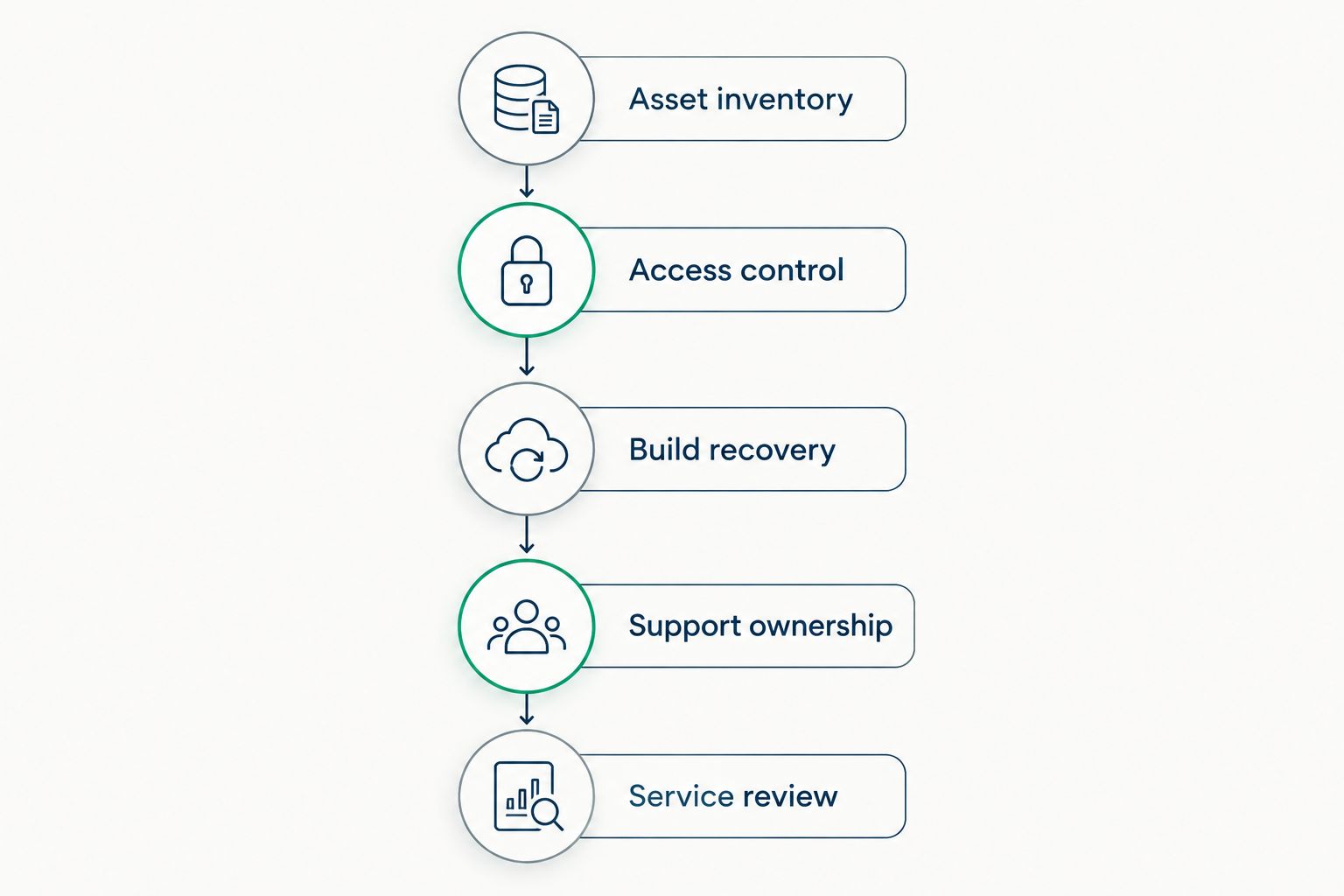
Define assets and recovery requirements before judging a provider’s service commitments.
Map the systems that keep development moving
Start manually with a shared spreadsheet and interviews with production, engineering, art, and operations. Record each system’s business owner, technical owner, users, dependencies, and recovery needs. Include systems that employees administer informally; an undocumented service still creates an operational dependency.
Separate employee productivity from game production and live-service operations. A provider supporting identity and workstations does not automatically own engine configuration, deployment automation, or player-facing infrastructure. Document those boundaries before requesting proposals.
For your initial inventory, complete these tasks:
- List endpoints, repositories, asset stores, build agents, and network equipment.
- Identify the person authorized to approve changes to each system.
- Mark dependencies that block builds, reviews, or asset delivery.
- Record vendor contacts and the location of administrative credentials.
Separate staff, contractor, and machine access
Review permissions manually before buying another access tool. Trace how an employee, contractor, external reviewer, and automated build process receive access. Each identity needs an owner and a defined purpose; shared credentials make that ownership difficult to establish.
Machine accounts deserve their own review. A contractor’s access can be removed while a copied deployment credential remains active. Treat repository tokens, signing access, and service accounts as production dependencies rather than miscellaneous passwords.
Build the access process around these controls:
- Require named accounts and multifactor authentication where supported.
- Give external collaborators access only to approved projects and assets.
- Assign an owner and review date to every service account.
- Include tokens, shared secrets, and active sessions in offboarding checks.
Assign support ownership before outsourcing tasks
Start with a responsibility matrix maintained in a shared document. Give each service a primary owner, escalation contact, approval authority, and fallback. Then identify repeatable work that a managed provider can take over without requiring studio engineers to coordinate every ticket.
DivergeIT provides managed IT services, cybersecurity, and compliance support for growing small and mid-sized businesses, including entertainment businesses. That makes DivergeIT a candidate for evaluating those functions together. Confirm gaming-specific responsibilities separately; the stated service scope does not establish ownership of your engine, build pipeline, or hosting environment.
Managed support reduces the work you administer directly, but it also introduces handoffs. Preserve an internal decision-maker who understands release priorities and can authorize disruptive changes.
Make the proposed division of work explicit:
- Assign workstation, identity, network, and backup responsibilities individually.
- Keep game code and engine troubleshooting with named specialists unless contracted otherwise.
- Specify who communicates with hosting, connectivity, and software vendors.
- Require approval before changes that affect builds or release preparation.
Test recovery against a usable build
Begin with a documented restore exercise using your existing backup arrangements. Recover a representative project into an isolated environment and check whether the team can use it. A successful file restore is not the same as a reproducible build.
Check source, large assets, configuration, dependencies, and required credentials together. Your cloud backup and disaster recovery guide can support the options review, but the acceptance test must reflect your own workflow.
Set aside a 60-minute planning session to define the exercise; this is a recommended meeting length, not a recovery target. Establish acceptable data loss and recovery time with production leadership before asking a provider to commit to them.
Use the exercise to verify these points:
- Restore source and assets from a deliberately selected recovery point.
- Confirm that required dependencies and permissions remain accessible.
- Run the documented build process in the recovery environment.
- Record missing components, actual timings, and the person responsible for fixes.
Set escalation rules around release risk
Start with a simple incident matrix rather than a complicated priority system. Describe business impact in language both support technicians and producers understand. Distinguish an isolated workstation fault from a shared repository outage or suspected credential compromise.
For 2026 contracts, separate acknowledgment, qualified technical engagement, update frequency, and restoration objectives. A fast response is useful, but it does not establish that the right specialist is working on the incident. Ask what happens when the first responder cannot resolve the problem.
Tie escalation to observable conditions:
- Define which failures stop development or affect a release milestone.
- Specify support hours, time zones, and out-of-hours responsibilities.
- Identify who declares an incident and who approves emergency changes.
- Require a named escalation route when progress stalls.
Control changes without freezing development
Begin with a shared change calendar and a short approval checklist. Record changes that affect operating systems, endpoint controls, network settings, repository integrations, and build dependencies. Mark release-sensitive periods so routine maintenance does not arrive as a surprise.
Security controls and development tools need a workable exception process. Do not disable protection broadly to fix one blocked workflow. Document the affected process, assess the exposure, approve the narrowest exception, and schedule its review.
Use a 30-day baseline period as a starting recommendation for recording recurring interruptions before changing the support model. That observation window is a planning choice, not evidence that every studio needs the same transition schedule.
Keep change control practical:
- Test relevant updates on a representative development machine first.
- Record a rollback owner and method before approving disruptive changes.
- Require documented approval for security exclusions and privileged access.
- Coordinate maintenance windows with production and release leads.
Review outcomes instead of ticket totals
Start with a monthly review using ticket exports, incident notes, and production feedback. Separate repetitive access requests from incidents that interrupt shared workflows. A high ticket closure count does not show whether the studio’s most disruptive problems are being removed.
Give every repeated issue an owner and a prevention action. For your 2026 service review, examine whether incidents recur after closure and whether engineers still perform work assigned to the provider. Hidden coordination work belongs in the assessment.
Schedule a 90-day ownership review after the new arrangement starts. Use that checkpoint to correct gaps in scope rather than treating the original responsibility matrix as permanent.
Review these items with your provider:
- Repeat incidents and the actions taken to prevent recurrence.
- Time spent waiting for approvals, vendor responses, or specialist escalation.
- Recovery-test findings and unfinished remediation work.
- Systems that changed owners without updated documentation.
Compare support models for gaming studios
Choose the model that closes a defined ownership gap. Outsourcing is not a substitute for deciding who owns production systems. Internal support gives you direct control, while external support requires clear access, communication, and escalation arrangements.
Internal IT
- Best for: Studios needing direct operational control
- Main advantage: Keeps priorities and system knowledge inside the studio
- Key limitation: Staffing and specialist coverage remain your responsibility
Fully outsourced managed IT
- Best for: Studios assigning routine IT operations to an external team
- Main advantage: Establishes an external owner for agreed support tasks
- Key limitation: Game-specific engineering remains outside scope unless explicitly included
Co-managed IT
- Best for: Studios retaining technical leadership while delegating defined operations
- Main advantage: Divides work between internal specialists and external support
- Key limitation: Ambiguous handoffs create gaps unless responsibilities are documented
On-demand support
- Best for: Studios seeking help with a bounded repair or project
- Main advantage: Fits a clearly defined task
- Key limitation: Does not establish ongoing ownership unless separately agreed
DivergeIT’s managed IT services warrant consideration when your requirement spans IT operations, cybersecurity, and compliance. The limitation is scope: verify the exact systems, coverage, and engineering responsibilities in writing rather than assuming entertainment-sector support includes every gaming workflow.
Before selecting any model, ask each candidate to explain how a failed build-agent update would move through its process. Require named responsibilities for diagnosis, rollback approval, developer communication, and closure. The answer exposes handoff gaps more clearly than a general service presentation.
Common mistakes gaming studios make
Treating repository history as a complete recovery plan
Version history does not establish that assets, credentials, dependencies, and build configuration are recoverable together. Test a usable development environment, not just whether a file can be retrieved.
Giving every contractor the same permissions
A temporary reviewer and an external developer do not need identical access. Define permissions by task and project, then connect offboarding to a named owner rather than relying on someone to remember.
Buying response speed without restoration ownership
An acknowledgment target says when communication begins. It does not identify who can repair a repository integration, restore asset storage, or approve a rollback. Write those responsibilities alongside the response commitments.
Outsourcing the relationship but retaining the work
If engineers still chase vendors, translate every ticket, and supervise routine maintenance, the handoff is incomplete. Track that coordination burden during your 2026 review and revise the scope or working process.
FAQ
What are managed IT services for gaming studios?
Managed IT services for gaming studios are outsourced support and administration for agreed technology systems. The scope can cover endpoints, identity, networks, security, and recovery, while game-specific engineering requires explicit ownership.
Should a gaming studio choose internal IT or a managed provider?
Choose internal IT when direct operational ownership is the priority, and evaluate managed support when you want to delegate defined responsibilities. Co-managed support divides those responsibilities between an internal team and an external provider.
Does managed IT support include game servers and build pipelines?
Game servers and build pipelines are included only when the service agreement explicitly assigns them to the provider. Document hosting, automation, engine, and deployment responsibilities separately from employee IT support.
How do I compare response-time commitments?
Compare acknowledgment, qualified technical engagement, escalation, and restoration objectives separately. Ask who takes ownership when the initial responder cannot resolve a release-blocking incident.
What should a gaming studio test in a backup exercise?
Test whether restored source, assets, configuration, dependencies, and access produce a usable development environment. Record what failed and assign an owner to each remediation task.
Is DivergeIT a fit for a growing gaming studio?
DivergeIT is a candidate for growing studios seeking managed IT, cybersecurity, and compliance services together. Confirm gaming-specific systems, support coverage, and engineering boundaries before signing an agreement.
What should we prepare before requesting a managed IT proposal?
Prepare a system inventory, responsibility matrix, incident examples, and recovery requirements. Give providers the same scope so their proposed responsibilities can be compared directly.
One last thing
Your most useful acceptance test is not opening a support ticket. It is asking the proposed support team to walk through a blocked build with your production lead, starting at detection and ending at verified recovery.
Do not sign until every handoff has an owner. Add the agreed incident path to your 2026 service documentation and use it during onboarding. An unresolved ownership question in a meeting becomes an unresolved operational problem during an incident.