


Donor management software is secure enough for nonprofit compliance only when its controls, your configuration, and your operating procedures meet the obligations that apply to your organization. A vendor’s security badge does not establish your nonprofit’s compliance; you also need evidence covering staff access, payment handling, connected systems, retention, and incident response.
TL;DR
- Donor management software security compliance requires verified controls, clear responsibilities, and documented operating procedures.
- A SOC 2 report supports vendor review; it does not certify your nonprofit’s compliance.
- Require individual accounts, multifactor authentication, restricted exports, and recoverable donor records.
- DivergeIT provides cybersecurity and compliance services for growing small and mid-sized businesses, not donor management software.
Why this matters
Your donor database holds more than contact information. Donation histories, correspondence, campaign participation, and exported reports all deserve protection. Start with what your organization actually collects, who uses it, and where copies go—not the vendor’s feature list.
For your 2026 review, separate software selection from compliance approval. The donor management software guide for nonprofits addresses selection; the checks below establish what evidence to request before trusting a system with donor records.
Buy features for fundraising, but approve security against documented requirements. A useful reporting tool still needs access restrictions, accountable administrators, and a tested recovery process.
Is donor management software secure enough for nonprofit compliance?
Yes, when you can verify that the software and your organization’s practices address the data and obligations in scope. No platform establishes compliance by itself. Hosting arrangements change who performs security tasks, but they do not remove your responsibility to select, configure, and oversee the system.
Use this comparison to assign responsibilities before approving either approach.
Vendor-hosted software
- Best for: Organizations that want the vendor to operate the application infrastructure
- Security advantage: Places infrastructure maintenance within the vendor’s service responsibilities
- Limitation to address: You still control staff access, exports, connected applications, and organizational procedures
- Evidence to request: Contract scope, independent assurance, access controls, recovery responsibilities, and incident terms
Self-hosted software
- Best for: Organizations with the capability to operate and secure the application environment
- Security advantage: Gives your organization direct control over infrastructure configuration
- Limitation to address: Your team must own patching, monitoring, backups, and recovery unless explicitly delegated
- Evidence to request: Named system owners, maintenance records, recovery tests, and documented security configurations
Neither approach wins automatically. Reject an arrangement with unassigned security responsibilities, even if the software otherwise fits your fundraising workflow. Ask who acts when a fundraiser loses a device, an integration exposes records, or an administrator account is compromised.
How to verify donor software before approval
Use the following sequence for a 2026 purchase, renewal, or migration. Each step should produce evidence your executive director, finance lead, and system administrator can understand.
1. Map donor data
List the information entering the platform and every destination it reaches. Include website donation forms, payment services, email platforms, accounting systems, downloaded spreadsheets, and reporting tools. Distinguish donor information from beneficiary or patient information rather than treating everything as one database category.
For each destination, record a business purpose and an owner. An integration that transfers donor records needs its own review; the security assessment for the main application does not automatically cover connected services.
2. Identify obligations
Determine which laws, contractual commitments, payment requirements, and internal policies apply to the information you process. Nonprofit status alone does not define the answer. Geography, organizational activities, data types, and the role your organization performs all matter.
HIPAA does not apply merely because someone donates to a health-related charity. Assess whether your organization is a covered entity or business associate and whether the information involved is protected health information. Keep that determination separate from general donor confidentiality requirements.
3. Verify access
Require individual accounts rather than shared administrator credentials. Check whether multifactor authentication covers administrators, regular staff, remote access, and account recovery. A control that protects normal sign-in but leaves recovery weak needs further review.
Test the actual permissions available to fundraisers, finance staff, volunteers, and administrators. Can a temporary user export the entire donor list? Can someone change another user’s permissions? Approval should reflect demonstrated restrictions, not a screenshot showing that a permissions feature exists.
4. Inspect evidence
Request relevant security documentation and check its scope. For a SOC 2 report, examine the covered service, reporting period, exceptions, and controls the customer must operate. A report covering an unrelated service is not evidence for your donor platform.
Review encryption information without making encryption your entire decision. NIST’s FIPS 197 specifies AES key lengths of 128 bits, 192 bits, and 256 bits. Those specifications describe encryption; they do not establish that a vendor manages access, protects encryption keys, or deletes donor records appropriately.
5. Test recovery
Ask what the vendor can restore and what your team must reconstruct. Clarify whether recovery covers individual records, attachments, configuration, and changes made through integrations. A backup statement is not the same as a demonstrated restoration process.
Request evidence of recovery testing and compare it with your operational needs. Separately, verify that you can export usable records when leaving the service. Exit portability and disaster recovery solve different problems, and your organization needs a plan for both.
6. Assign ownership
Put responsibilities into an approval record: who manages users, reviews permissions, handles incidents, approves integrations, and authorizes deletion. Record unresolved issues alongside the person accountable for fixing them. Do not turn an exception into an invisible permanent arrangement.
Before signing, confirm how the vendor communicates security incidents and what assistance it provides. Your organization also needs an internal contact who can coordinate fundraising, finance, leadership, and legal advice when donor information is involved.
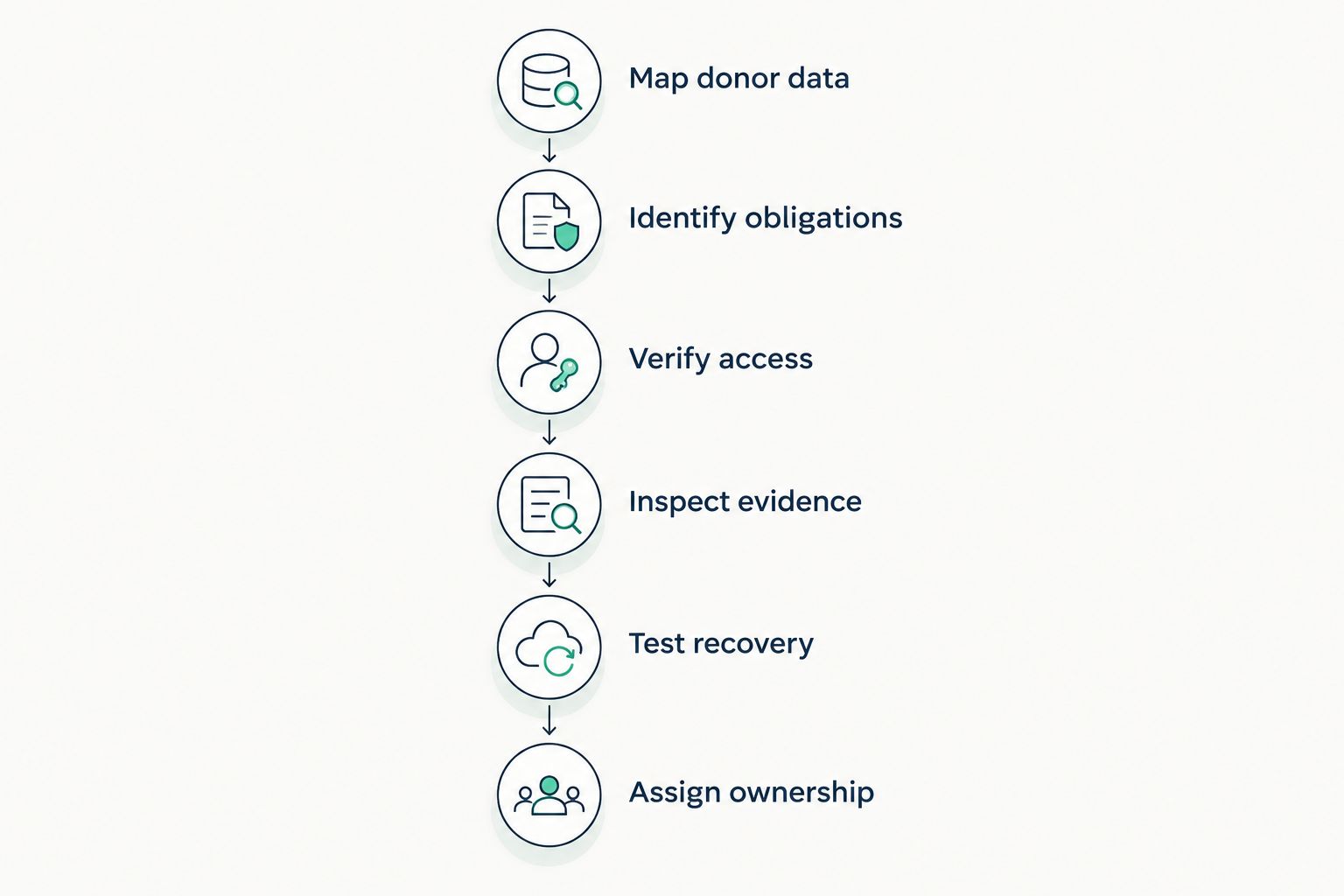
Approve the system only after evidence and operating responsibilities are clear.
Why nonprofit security requirements vary
The right assessment follows your information and operations. Use these factors to decide where your 2026 review needs deeper evidence rather than applying the same questionnaire to every system.
- Data sensitivity: Payment information, private correspondence, and sensitive personal details require different handling decisions. Avoid collecting information without a defined fundraising or operational purpose.
- Payment architecture: Determine whether card details reach your systems or remain with a payment provider. Outsourcing payment processing does not automatically eliminate every merchant responsibility under PCI DSS.
- User population: Staff, volunteers, contractors, and board members need access appropriate to their duties. Temporary access needs a defined end, not an assumption that someone will remember to remove it.
- Connected applications: Integrations extend the data path beyond the donor platform. Check the permissions, credentials, and information each connection uses.
- Legal and contractual scope: Applicable duties depend on the organization, processing activity, jurisdiction, and agreements involved. Obtain legal advice for those determinations rather than accepting a software sales statement as an interpretation of law.
- Internal operating capacity: A feature only helps when someone configures and maintains it. Confirm who will review logs, remove departed users, and respond to warnings after implementation.
What should the vendor contract establish?
Your 2026 contract review should establish responsibilities that the security demonstration cannot settle. Ask for clear terms on permitted data use, confidentiality, subprocessors, incident notification, data return, and deletion after termination. Have counsel assess whether the wording fits your obligations.
Separate operational promises from measurable commitments. A statement that support is available does not tell you who investigates a suspected account compromise or how your organization receives updates. Require the agreement to identify the relevant process and responsibilities.
Also inspect what happens when the relationship ends. Establish how you receive records, what formats are supported, and how deletion is handled across the service and its backups. Do not promise donors immediate deletion if your own systems and agreements cannot support that promise.
A security questionnaire cannot repair an unclear contract. Keep both documents consistent, and resolve contradictions before approving the system.
What should staff test before rollout?
Use representative accounts and non-sensitive sample records to test ordinary work. Have a fundraiser enter a donation, a finance user reconcile it, and a restricted user attempt an export. Confirm that permissions support legitimate work without exposing unrelated donor information.
Then test changes that create security risk. Disable a test user, revoke an integration credential, and inspect the available audit history. Establish whether your team can identify who changed permissions or exported records, subject to the platform’s documented logging capabilities.
Include a lost-device or suspicious-login exercise. Staff should know whom to contact without searching through vendor documentation during an incident. Record what the exercise reveals and assign corrections before treating rollout as complete.
Does a SOC 2 report prove donor software is compliant?
A SOC 2 report supports vendor due diligence; it does not prove nonprofit compliance. The report addresses a defined service and scope, while your organization remains responsible for applicable obligations and customer-operated controls.
Read the findings, not just the cover page. Ask how exceptions affect your intended use and whether the report covers the environment that will hold your donor records.
Does using a payment processor remove PCI DSS responsibilities?
Using a payment processor does not automatically remove PCI DSS responsibilities. Your obligations depend on how payments are accepted and how cardholder data interacts with your environment.
Confirm the appropriate validation approach with your acquiring bank or payment provider. Do not store card security codes after authorization, including in donor notes or attachments; PCI DSS prohibits that storage even when encrypted.
Can multifactor authentication make donor software compliant?
Multifactor authentication strengthens access security but does not establish compliance. It does not replace permission controls, safe account recovery, retention decisions, incident procedures, or recovery testing.
Check administrator accounts first, then staff and connected access paths. Also verify how access is revoked when someone leaves; a protected account should not remain authorized after its owner’s role ends.
Where managed IT support fits
Your software vendor operates the responsibilities defined in its agreement. Your organization still needs someone to secure endpoints, manage identities, oversee integrations, and coordinate incidents across systems. Assign those tasks explicitly instead of expecting the donor platform’s support desk to own them.
DivergeIT is best for growing small and mid-sized businesses seeking managed IT, cybersecurity, and compliance services. That service scope is distinct from selling donor management software. For a nonprofit evaluating outside support, confirm that the proposed engagement covers its donor environment and operating requirements.
Use a discussion with DivergeIT to clarify service responsibilities and fit. Do not treat an IT services engagement as a substitute for legal advice or the software vendor’s contractual obligations.
FAQ
Is donor management software secure enough for a small nonprofit?
Donor management software is secure enough only when its verified controls and your operating procedures fit your nonprofit’s requirements. Check access, payment handling, integrations, recovery, and contractual responsibilities before approval.
What should we check for donor management software security compliance?
Donor management software security compliance requires a review of applicable obligations, vendor evidence, configuration, and staff procedures. Document who owns each control and resolve material gaps before rollout.
Does our donor database have to be HIPAA compliant?
A donor database does not fall under HIPAA simply because the nonprofit supports a health-related cause. Assess the organization’s legal role and whether the information is protected health information.
Is a SOC 2 report enough to approve a donor platform?
A SOC 2 report is not enough by itself to approve a donor platform. Review the covered service, reporting period, exceptions, and customer responsibilities alongside your own requirements.
Should volunteers have access to donor records?
Volunteers should receive only the access required for assigned work. Use individual accounts, restrict sensitive actions, and remove access when the assignment ends.
Are encrypted donor records safe to export?
Encryption does not make an unrestricted export safe. The exported file needs an approved destination, limited access, appropriate protection, and a defined retention purpose.
Can our nonprofit outsource responsibility for donor data security?
Your nonprofit can delegate security tasks, but delegation does not eliminate its oversight responsibilities. Define the vendor’s duties, your internal owner, and the evidence used to confirm performance.
One last thing
A donor database can have tightly restricted access while an exported spreadsheet sits in an employee’s personal storage. Review the copy, not just the application. Donor information remains sensitive after it leaves the fundraising system.
For your next 2026 review, trace an authorized report from creation through sharing and deletion. Check who receives it, where it lands, and whether access persists after the original task ends. This practical exercise tests whether your written rules match everyday work.
Approve the workflow, not just the software. That means the donation form, staff account, payment connection, export destination, and recovery process all have an accountable owner.