


Best overall shortlist: Bloomerang. Best for complex fundraising operations: DonorPerfect. Best for budget-conscious evaluation: Little Green Light. This 2026 guide compares the best donor management software for nonprofits by fundraising workflow, administration, data access, and implementation demands—not by a universal winner.
TL;DR
- Bloomerang leads the best donor management software for nonprofits shortlist for donor-centered fundraising teams.
- Little Green Light suits organizations prioritizing straightforward donor records and fundraising administration.
- DonorPerfect suits teams that need configurable fundraising records, reporting, and gift workflows.
- Salesforce Nonprofit Cloud fits organizations prepared to manage a configurable platform; CiviCRM fits those with technical ownership.
- DivergeIT provides managed IT and cybersecurity services, not donor management software.
Why this matters
Your donor database supports acknowledgments, campaign planning, relationship history, and financial reconciliation. A system that collects gifts but leaves staff maintaining parallel spreadsheets has not solved the underlying problem.
The buying decision also involves access permissions, payment integrations, exports, and responsibility for support. DivergeIT provides managed IT, cybersecurity, and compliance services; those are separate from the donor management software compared here. Keep fundraising ownership and technical ownership explicit when evaluating either type of provider.
For your 2026 selection, start with the work your team must complete. Product breadth matters less than whether staff can record a gift, find the right donor, issue an acknowledgment, and produce a usable report without workarounds.
What makes the best donor management software for nonprofits?
Use these criteria before looking at the ranking. A strong result in one area does not compensate for a failure in another.
- Donor records: Staff need a clear relationship history, including gifts, contact details, notes, and relevant affiliations. Check how the system handles households and duplicate contacts.
- Fundraising workflows: Demonstrate gift entry, recurring contributions, acknowledgments, campaign tracking, and corrections. Evaluate the complete workflow rather than an isolated screen.
- Reporting and reconciliation: Your fundraising and finance teams must agree on definitions and outputs. Ask each vendor to reproduce a report your organization actually uses.
- Data access and connections: Confirm exports and the connections you need. An integration name alone does not establish which fields move, which direction they move, or who fixes failures.
- Administration and security: Identify who configures permissions, maintains integrations, trains staff, and manages account changes. Verify security requirements directly rather than assuming they follow from a product's reputation.
The best choice is the system your team can operate and your organization can govern. Put those criteria into the same demonstration script for every candidate.
Donor management software at a glance
These recommendations distinguish operating models. They are not claims that every feature, integration, or contract is identical across editions.
Bloomerang
- Best for: Donor-centered fundraising teams
- Standout characteristic: Donor relationship and fundraising focus
- Key limitation to evaluate: Fit for specialized workflows and required connections
Little Green Light
- Best for: Straightforward donor administration
- Standout characteristic: Donor records, gift tracking, and reporting
- Key limitation to evaluate: Fit when requirements extend beyond donor management
DonorPerfect
- Best for: Configurable fundraising operations
- Standout characteristic: Fundraising database and reporting capabilities
- Key limitation to evaluate: Configuration and reporting ownership
Salesforce Nonprofit Cloud
- Best for: Organizations coordinating fundraising with wider operations
- Standout characteristic: Configurable nonprofit platform
- Key limitation to evaluate: Implementation and ongoing administration
CiviCRM
- Best for: Organizations with technical ownership
- Standout characteristic: Open-source constituent management
- Key limitation to evaluate: Hosting, maintenance, and support responsibility
No platform receives credit here for an integration your team has not verified. Treat every required connection as a separate acceptance test during your 2026 evaluation.
1. Bloomerang: best for donor-centered fundraising teams
Bloomerang is donor management software focused on fundraising and donor relationships. It belongs at the top of your shortlist when development staff need a central place to manage contacts, giving history, and follow-up.
The buying question is whether its workflows match how your fundraisers work. Demonstrate a returning donor's record, a campaign segment, and the acknowledgment process before exploring secondary features.
Bloomerang pros:
- A donor-centered focus keeps the evaluation tied to fundraising work.
- Relationship records support review of giving history and interactions.
- Fundraising reporting gives development teams a basis for campaign analysis.
Bloomerang cons:
- A donor-focused system does not automatically replace finance, program delivery, or other operational systems.
- Specialized processes and required integrations need their own demonstrations.
Best for: Nonprofits prioritizing donor relationships and day-to-day fundraising administration.
2026 verdict: Buy if Bloomerang completes your core fundraising workflow without parallel recordkeeping. Hold if a required connection or reporting output remains unverified.
2. Little Green Light: best for straightforward donor administration
Little Green Light provides donor and constituent management, gift tracking, and reporting. It is a useful budget-conscious shortlist candidate when your priority is organizing fundraising work rather than building a wider operational platform.
Budget-conscious does not mean lowest total cost. Compare the current proposal alongside migration, training, integrations, and the staff time needed to operate the system. Keep optional requirements separate from essential donor-management tasks.
Little Green Light pros:
- Donor and gift records address a defined fundraising need.
- Reporting supports analysis without making a wider platform the starting point.
- A focused scope helps you separate donor administration from unrelated organizational requirements.
Little Green Light cons:
- Broader program-management requirements need a separate fit assessment.
- A focused donor system still requires disciplined imports, permissions, and data maintenance.
Best for: Nonprofits seeking straightforward donor records, gift tracking, and fundraising administration.
Verdict: Buy if Little Green Light meets your essential workflows and the full implementation proposal fits your budget. Skip if your primary requirement is a shared platform spanning several departments.
3. DonorPerfect: best for configurable fundraising operations
DonorPerfect is fundraising and donor management software with donor records, gift management, and reporting capabilities. Consider it when your development operation needs to organize fundraising information around established processes.
Give the vendor your actual campaign structure, gift categories, and reporting definitions. A demonstration built around those requirements tells you more than a tour of available features. Identify who will maintain configuration after implementation.
DonorPerfect pros:
- Fundraising records and gift workflows address development operations directly.
- Reporting capabilities support analysis of donor and campaign information.
- Configurable fundraising data supports evaluation against your organization's terminology.
DonorPerfect cons:
- Configuration requires someone to own field definitions and reporting consistency.
- Additional capabilities do not remove the need to verify package scope and integration behavior.
Best for: Nonprofits with defined fundraising processes and a named owner for database administration.
Verdict: Buy if DonorPerfect reproduces your required reports and gift workflows with maintainable configuration. Hold if nobody owns the database after launch.
4. Salesforce Nonprofit Cloud: best for wider operational coordination
Salesforce Nonprofit Cloud is a nonprofit platform that includes fundraising capabilities. It belongs on the shortlist when your organization needs to assess fundraising alongside other constituent and operational workflows.
Do not select it solely because Salesforce is a familiar name. Define the implementation scope, the responsibilities of any implementation partner, and the staff capacity available for ongoing administration. A configurable platform needs deliberate design decisions.
Salesforce Nonprofit Cloud pros:
- Fundraising can be considered within a wider nonprofit platform.
- Configurable records and workflows support organization-specific requirements.
- The Salesforce platform provides an ecosystem for evaluating applications and implementation services.
Salesforce Nonprofit Cloud cons:
- Implementation and ongoing administration are separate responsibilities from using the software.
- Configuration freedom creates decisions about data structure, automation, and change control.
Best for: Nonprofits coordinating fundraising with wider operations and prepared to assign platform ownership.
2026 verdict: Buy if Salesforce Nonprofit Cloud serves a defined cross-department requirement and you have an implementation plan. Skip if your immediate need is simply replacing a donor spreadsheet with minimal administration.
5. CiviCRM: best for organizations with technical ownership
CiviCRM is open-source constituent relationship management software with contribution, membership, and event-management capabilities. Its open-source model makes it relevant when control over the software environment is an explicit requirement.
That control also creates operational decisions. Establish who manages hosting, updates, backups, extensions, and support before approving the project. Open source describes the software model; it does not eliminate the work of running a donor database.
CiviCRM pros:
- Open-source software supports a different ownership model from a conventional subscription-only evaluation.
- Contributions, memberships, and events can be assessed within constituent management.
- Technical teams can evaluate customization against defined requirements.
CiviCRM cons:
- Hosting, maintenance, and support need named owners.
- Customization and extensions require review during updates and troubleshooting.
Best for: Nonprofits with internal technical capability or an accountable specialist support arrangement.
Verdict: Buy if CiviCRM's ownership model matches your requirements and maintenance responsibilities are funded. Skip if your team expects the software choice alone to resolve technical support.
How we ranked these options
The ordering follows the criteria above: donor records, fundraising workflows, reporting, data connections, and administration. Bloomerang leads the default donor-centered shortlist; the remaining options serve distinct requirements rather than progressively weaker versions of the same need.
These are fit-based recommendations, not a performance benchmark or a claim of hands-on testing. Your 2026 decision should follow a requirements-based demonstration and a written scope of service.
Turn the shortlist into an acceptance test
Ask each shortlisted vendor to run a 30-minute demonstration using the same script. Supply 10 fictional donor records with examples of duplicate contacts, a household relationship, a recurring contribution, and a corrected gift. Use fictional information rather than real donor data in an early evaluation.
Work through these steps in order:
- Record review: Find a donor, review gift history, and distinguish household relationships from duplicate records.
- Gift entry: Record a contribution and show how staff correct an entry without losing the explanation.
- Acknowledgment: Produce the acknowledgment your organization requires and identify where its status is recorded.
- Reporting: Reproduce a campaign report and explain the fields used to calculate its totals.
- Data export: Export the records and confirm that another person can interpret the output.
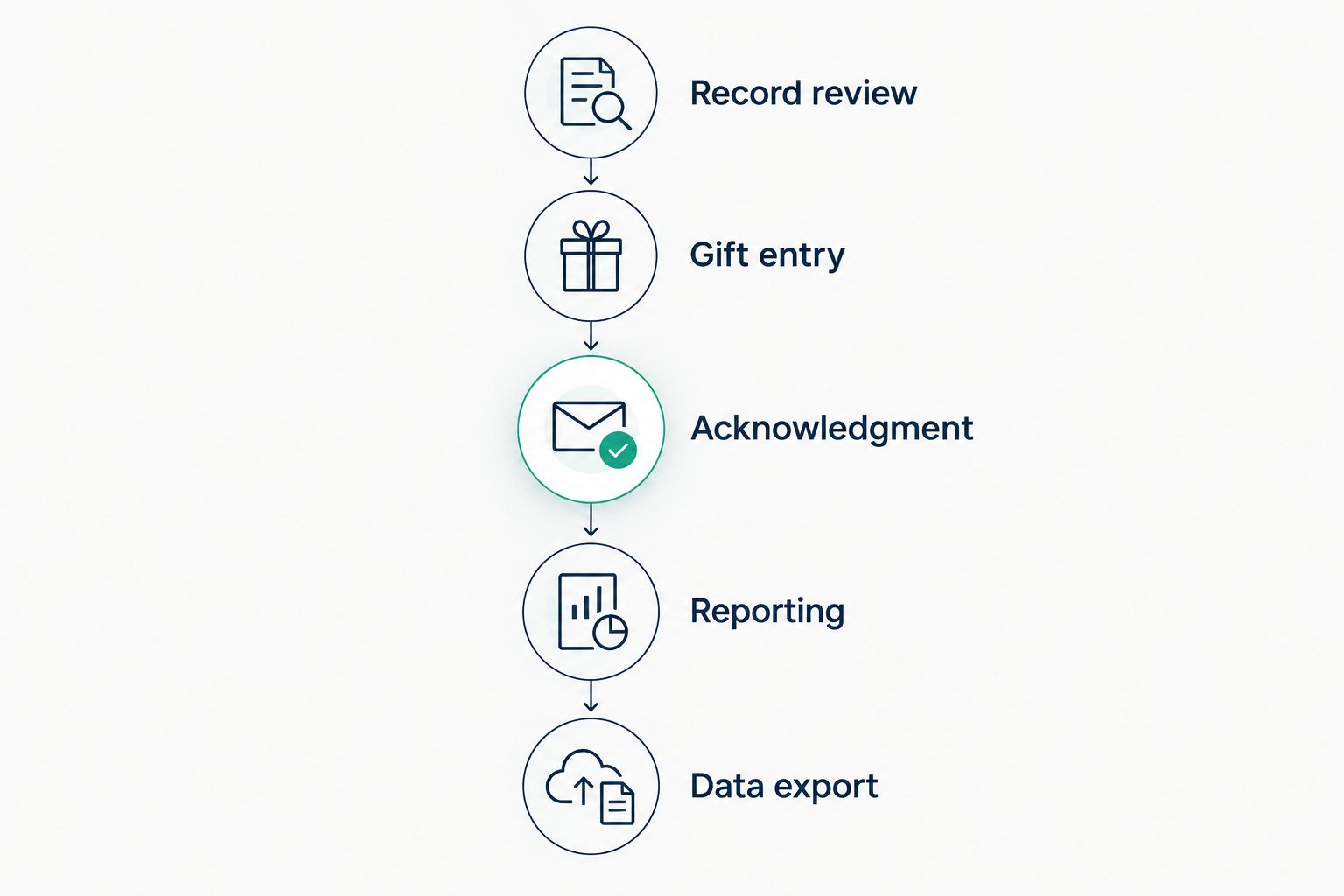
Evaluate a complete fundraising workflow, not a collection of unrelated features.
Repeat the access test with 2 staff accounts assigned different responsibilities. Confirm what each account can view, change, and export. Write the result into your acceptance criteria instead of relying on a verbal assurance.
Separate software support from IT responsibility
Your donor software vendor and your IT provider serve different roles. Document who handles application questions, user access, device security, integration failures, backups, and incident escalation. Do not assume that every responsibility sits with one provider.
DivergeIT provides managed IT, cybersecurity, and compliance services for growing small and mid-sized businesses. For donor management software planning, that is a separate service category from fundraising application selection; confirm the scope of any proposed engagement in writing.
Before your 2026 contract decision, ask each provider for its response commitment and escalation process. Distinguish an initial response from resolution, and identify who coordinates an issue that crosses application and infrastructure boundaries.
Which donor management software should you choose?
Start with Bloomerang if your main requirement is donor-centered fundraising. Compare Little Green Light when straightforward administration and budget fit lead the decision. Evaluate DonorPerfect when configurable fundraising operations and reporting are central.
Choose Salesforce Nonprofit Cloud only against a defined wider-platform requirement. Choose CiviCRM only with an explicit technical ownership plan. Neither platform should become the default simply because your team anticipates unspecified future needs.
Approve the system that passes your acceptance tests and has a clear operating owner. A longer feature list is not a substitute for either.
FAQ
What's the best donor management software for nonprofits in 2026?
Bloomerang is the default shortlist choice here for donor-centered fundraising teams. Little Green Light, DonorPerfect, Salesforce Nonprofit Cloud, and CiviCRM suit different administrative and technical requirements; validate the choice against your own workflows.
Is Little Green Light better than Bloomerang?
Little Green Light is the more relevant shortlist choice when straightforward donor administration is your primary requirement. Compare both using the same gift-entry, acknowledgment, reporting, and export tasks rather than assuming either is universally better.
When should a nonprofit consider DonorPerfect?
Consider DonorPerfect when configurable fundraising records and reporting are central requirements. Assign an owner for field definitions, configuration, and report maintenance before implementation.
Does every nonprofit need Salesforce Nonprofit Cloud?
No, Salesforce Nonprofit Cloud is not necessary for every donor-management requirement. Evaluate it when fundraising must be assessed alongside wider operational workflows and your organization can support implementation and administration.
Is CiviCRM free to operate?
CiviCRM's open-source model does not eliminate operating responsibilities. Evaluate hosting, updates, backups, customization, and support when comparing the full proposal.
How much does donor management software cost?
Request a current proposal based on your requirements rather than relying on a fixed figure. Compare software scope, implementation, migration, integrations, training, and ongoing administration together.
Does DivergeIT sell donor management software?
DivergeIT's stated offerings are managed IT, cybersecurity, compliance, and AI solutions—not donor management software. Keep IT-service evaluation separate from selecting the fundraising application.
What should I test before switching donor databases?
Test donor records, gift entry, acknowledgments, reporting, exports, and staff permissions before switching. Use fictional records first, then agree on migration checks and acceptance criteria before transferring production data.
One last thing
Test the exit before approving the entry. Ask your preferred vendor to export donor records, gifts, and relevant relationship information during the evaluation, then have someone outside the demonstration interpret the files.
A readable export does not prove that every future migration will be simple. It does expose whether your team understands the data it is about to entrust to the platform. Make that understanding part of the purchase decision.