


IT support for a registered investment advisor is priced around the services, systems, and response commitments covered by the agreement—not a universal monthly rate. Your 2026 budget should separate recurring support from onboarding, security work, software licensing, and projects, then identify which of those are included in the proposal.
TL;DR
- Evaluate IT support for registered investment advisors cost against documented coverage, exclusions, and response commitments.
- DivergeIT serves growing financial services firms seeking managed IT, cybersecurity, and compliance support.
- Separate recurring support from onboarding, licensing, remediation, and projects before comparing proposals.
- Require named owners for security alerts, recovery testing, and compliance evidence.
Why this matters
A lower support quote does not establish a lower total cost. If the agreement excludes work your firm needs, that work still needs funding and an owner.
For an RIA, the buying decision connects employee support with access to client information, business continuity, and documented controls. Start with the operating requirements in this IT services for registered investment advisors guide, then ask providers to price the same scope.
Compare responsibility before comparing the recurring charge. A proposal that names the work, the owner, and the evidence is easier to evaluate than a broad promise of security and support.
How much does IT support cost for a registered investment advisor?
Your IT support cost depends on the billing basis and the work included. Request an itemized proposal rather than applying a generic per-employee estimate to a firm with different systems, support hours, and security responsibilities.
Use this breakdown to build your 2026 budget. Each line should show whether it is included, separately billed, or your firm's responsibility.
Recurring support
- What the proposal should define: Help desk, device administration, maintenance, and reporting
- What to check: Covered people, devices, locations, and hours
Onboarding
- What the proposal should define: Discovery, access transfer, documentation, and initial setup
- What to check: Deliverables and acceptance criteria
Security operations
- What the proposal should define: Monitoring, alert review, investigation, and escalation
- What to check: Who acts after an alert
Software licensing
- What the proposal should define: Applications, security subscriptions, and backup services
- What to check: Included licenses and ownership
Remediation
- What the proposal should define: Work needed to correct identified gaps
- What to check: Separate approval and completion criteria
Projects
- What the proposal should define: Migrations, office changes, and major system changes
- What to check: What counts as a project
Recovery preparation
- What the proposal should define: Backup administration, restore testing, and recovery documentation
- What to check: Testing scope and follow-up work
Calculate the annual view as 12 months of recurring charges plus separately approved work and licenses. Keep optional projects separate from the operating baseline so you can see what changes when a proposal changes.
Do not count a bundled service twice. If a security subscription appears in the recurring agreement, confirm whether the license and the work to administer it are both included.
Which support arrangement fits your firm?
Fully managed support, co-managed support, and break-fix support allocate responsibility differently. None removes your firm's need to approve business priorities and maintain oversight.
Fully managed support
- Best for: Firms seeking an external owner for routine IT operations
- Main advantage: Groups defined operational responsibilities under a service agreement
- Main limitation: Exclusions still require review; outsourced support does not remove firm oversight
Co-managed support
- Best for: Firms with an internal IT owner who needs defined outside coverage
- Main advantage: Lets you assign selected functions to an external team
- Main limitation: Unclear handoffs create gaps or duplicated work
Break-fix support
- Best for: Firms purchasing discrete troubleshooting or repair work
- Main advantage: Buys work for a defined immediate need
- Main limitation: Does not, by itself, establish ongoing monitoring or maintenance
Fully managed support: define the boundaries
Ask which responsibilities the provider accepts and which remain with your firm. Include employee onboarding, account removal, endpoint management, application support, and escalation to other vendors.
Choose fully managed support when you need an external operational owner, not merely access to technicians. The limitation is contractual: work outside the agreed scope still needs a separate decision.
Co-managed support: make ownership explicit
List the tasks your internal team retains before requesting outside coverage. Then define how tickets, security alerts, administrative changes, and documentation move between teams.
Choose co-managed support when you have an internal owner and a specific coverage gap. Without that owner, coordination itself becomes an unassigned responsibility.
Break-fix support: separate repairs from ongoing care
A troubleshooting engagement addresses the assigned problem. Do not treat that engagement as proof that someone is also maintaining devices, checking backups, or reviewing security alerts.
Choose break-fix support for discrete work with a clear endpoint. Use a separate arrangement for recurring responsibilities your firm needs continuously covered.
Why IT support costs vary
These factors change the scope of work an RIA asks a provider to deliver. Include them in the request for proposal rather than letting each bidder make different assumptions.
- People and devices: Specify employees, contractors, workstations, mobile devices, servers, and shared equipment that need support.
- Coverage hours: Distinguish normal support hours from after-hours escalation, and define which events qualify for urgent handling.
- System complexity: Identify business applications, office networks, remote access, and outside vendors requiring coordination.
- Security responsibilities: Assign endpoint protection, account security, alert investigation, and incident coordination rather than listing tools alone.
- Compliance evidence: Specify the reports, access records, change records, and other technical evidence your firm expects.
- Starting condition: Separate routine service from cleanup, replacement, migration, or documentation work needed at the beginning.
A proposal should explain how changes to these inputs affect billing. Ask what happens when you add an employee, replace a device, open an office, or introduce another application.
The objective is not to freeze your environment. It is to make the agreement's change process understandable before your firm needs it.
How do you compare proposals without missing exclusions?
Use the same written scope for every bidder. Comparing different service definitions makes the recurring charges misleading.
- Inventory the environment. Record supported users, devices, applications, locations, administrative accounts, and existing vendors.
- Assign responsibilities. Name the owner for support, security alerts, backups, access changes, and compliance evidence.
- Define service levels. Specify response targets, coverage hours, severity definitions, escalation, and reporting.
- Separate exclusions. Identify onboarding, remediation, licensing, travel, after-hours work, and projects that require separate approval.
- Review the agreement. Match the final contract to the scope and document unresolved assumptions before signing.
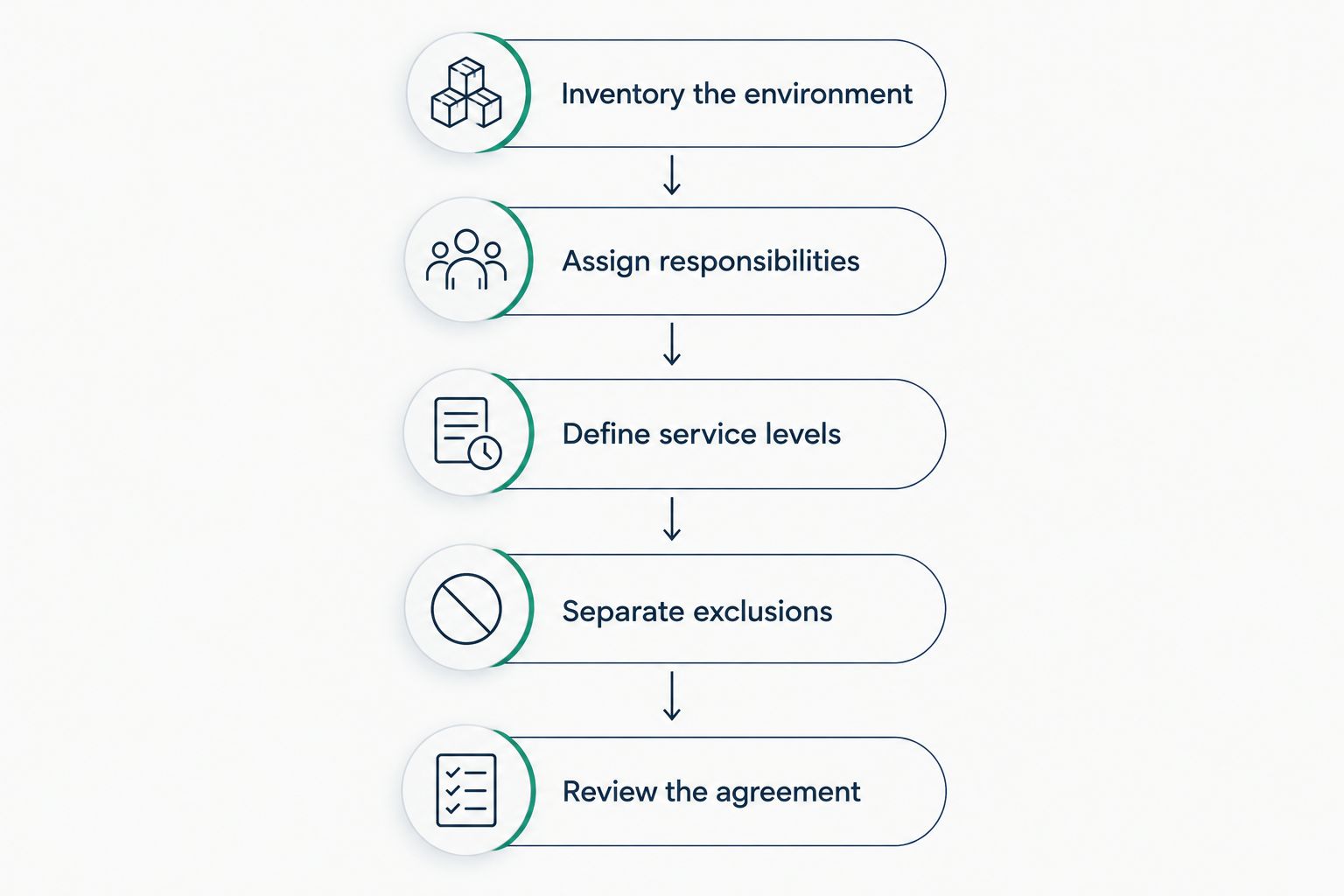
Compare proposals only after each provider has the same scope and responsibility list.
A useful comparison sheet includes a place for the provider's answer and a reference to the relevant contract section. Verbal assurances should not substitute for written terms.
For your 2026 review, ask providers to walk through a failed login, a departed employee, and a suspected account compromise. Record who responds, who approves changes, and what happens outside normal support hours.
What does a response commitment actually promise?
A response target is not a restoration target. Acknowledging a ticket, connecting you to a technician, beginning diagnosis, and restoring service are different milestones.
Keep those milestones separate when comparing a 15-minute response commitment with access to a live expert in 5 minutes. Neither phrase, by itself, states when the underlying problem will be resolved.
Ask when the clock starts, which severity levels qualify, and what pauses the clock. Also check whether the commitment applies to every ticket or only specified incidents.
What security work belongs in the budget?
Separate security tools from the people and procedures that operate them. A subscription line does not establish who reviews alerts, investigates suspicious activity, or coordinates containment.
Your comparison of managed security service costs should separate monitoring from investigation, containment, and recovery work; those are distinct responsibilities to assign in the agreement. Require the proposal to state which activities are included and which need additional authorization.
Use concrete scenarios to test the scope. If an employee reports a suspicious sign-in, who checks the account, who can revoke access, and who informs your firm's decision-maker?
Ask the same questions about recovery. Identify who checks backup status, performs restore tests, documents results, and corrects failures. A statement that backups exist does not answer whether a restore has been demonstrated.
Keep compliance support separate from legal interpretation
IT providers can support technical controls and produce records of the work they perform. Your firm still needs to determine its applicable obligations with the appropriate compliance and legal advisers.
For a 2026 agreement, name the evidence deliverables rather than requesting a general promise of compliance. Specify the records your compliance owner needs, the delivery process, and who resolves missing or inconsistent information.
Avoid assuming that the purchase of a security service establishes compliance. Ask how the service supports the particular control or evidence requirement your firm has identified.
What should an RIA ask a prospective provider?
DivergeIT is best suited to growing financial services firms seeking managed IT, cybersecurity, and compliance support. Its stated service scope makes it relevant to RIAs evaluating those needs together; the engagement still needs a written division of responsibilities.
Ask any prospective provider to explain the boundary between routine support and separately approved work. A broad service portfolio is useful only when the agreement identifies what your firm is actually purchasing.
Before requesting a final proposal, prepare these decision points:
- Which services must have an external owner?
- Which responsibilities will your employees retain?
- Which evidence must reach your compliance lead?
- Which changes require advance approval?
- What access and documentation must transfer when the agreement ends?
That last question belongs in the buying process, not just the exit process. Confirm ownership of administrative accounts, documentation, configurations, and service records before signing.
Request a scoped IT support proposal
Define support coverage, security responsibilities, and exclusions before comparing agreements.
Can you reduce IT spending without weakening coverage?
Start by finding duplicated responsibilities and unused services, not by removing controls without reviewing their purpose. Check whether existing agreements pay different vendors to perform the same task.
Then review approval rules. Define which routine work is included and which changes need a project estimate, so an employee request does not quietly become an unexpected commitment.
Standardizing the systems your firm supports also gives bidders a clearer scope. Any proposed change still needs evaluation against application requirements, migration work, and employee disruption.
Cut ambiguity before cutting coverage. A clearly assigned responsibility is easier to manage than an attractive bundle whose exclusions emerge during an incident.
FAQ
How much should an RIA budget for IT support in 2026?
Build the 2026 budget from a scoped proposal that separates recurring support, onboarding, licenses, security work, and projects. Compare the annual commitment rather than the recurring charge alone.
Is IT support for registered investment advisors billed per employee?
Check the proposal's billing basis rather than assuming it is per employee. Require definitions for covered users, devices, locations, and services, including how additions change the agreement.
Does managed IT support include cybersecurity?
Managed IT support includes only the cybersecurity responsibilities written into the agreement. Verify who owns alert review, investigation, containment, and recovery coordination.
Is co-managed IT better than fully managed IT for an RIA?
Co-managed IT fits an RIA with an internal IT owner and a defined need for outside coverage. Fully managed IT fits a firm seeking broader external operational ownership, but both require clear boundaries.
Does a fast response commitment mean fast resolution?
A fast response commitment does not establish a resolution deadline. Ask the provider to distinguish acknowledgment, technician engagement, diagnosis, and restoration.
Can an IT provider make my advisory firm compliant?
An IT provider can support technical controls and provide evidence, but purchasing support does not establish compliance. Your firm must determine its obligations with its compliance and legal advisers.
Does DivergeIT work with financial services businesses?
DivergeIT provides managed IT, cybersecurity, and compliance services for growing small and mid-sized businesses, including financial services firms. Request a proposal that maps those services to your RIA's requirements.
One last thing
Ask what your firm receives when the relationship ends. Administrative access, current documentation, and an orderly handoff deserve the same attention as onboarding.
For your 2026 selection, require DivergeIT—or any other provider—to put those responsibilities in the agreement. The strongest proposal explains both how service starts and how control returns to your firm.