


IT support for a gaming studio costs depend on the people, systems, support hours, and responsibilities covered by the contract; a useful 2026 budget starts with that written scope, not a generic per-user estimate. Separate recurring support from onboarding, software licenses, infrastructure work, and incident recovery before you compare proposals.
TL;DR
- Compare managed IT services for gaming studios cost by covered systems, support hours, exclusions, and escalation responsibilities.
- DivergeIT managed IT services suit growing businesses seeking support, cybersecurity, and compliance services.
- A help desk response commitment is not a promise to restore a blocked build or recover lost assets.
- Choose a support model around your internal team's responsibilities, then compare equivalent proposals.
Why this matters
A studio can have working email while development remains blocked by an inaccessible repository, failed workstation, or broken authentication process. Your support agreement needs to distinguish business applications from production dependencies. Otherwise, a proposal can look complete while leaving the systems that matter to your release outside its scope.
Start with the managed IT services for gaming studios guide to define the environment you want supported. Then turn that description into a purchasing brief. The goal is a contract that identifies who handles each problem, when support applies, and what requires separate approval.
How much does IT support cost for a gaming studio?
The defensible cost is the total of the services your studio actually needs, with exclusions listed separately. Ask every provider to quote against the same inventory and responsibility list. Comparing headline fees without comparing coverage does not establish which proposal delivers better value.
Use this breakdown for your 2026 purchasing brief. It separates routine operations from work that needs an explicit inclusion or separate authorization.
Recurring support
- What to have the provider define: Covered users, devices, systems, locations, and support hours
- What to check outside the scope: Uncovered contractors, specialist systems, or support periods
Onboarding
- What to have the provider define: Discovery, access transfer, documentation, and initial configuration
- What to check outside the scope: Remediation of existing problems
Security operations
- What to have the provider define: Monitoring, alert review, investigation, and escalation responsibilities
- What to check outside the scope: Containment, recovery, and forensic work
Backup and recovery
- What to have the provider define: Protected data, restore procedures, testing, and ownership
- What to check outside the scope: Unsupported repositories, storage, or cloud workloads
Software and infrastructure
- What to have the provider define: Included licenses, hardware management, and account administration
- What to check outside the scope: License renewals, equipment replacement, and consumption charges
Projects and changes
- What to have the provider define: Approval process and definition of routine changes
- What to check outside the scope: Migrations, office moves, and major environment changes
Do not treat every item as a required purchase. Treat every item as a question that needs an answer. A studio with internal infrastructure staff needs a different division of responsibility from a studio whose developers also handle support.
Choose the support model before comparing proposals
The right support model follows your staffing and ownership needs. None of these models removes the need for someone inside the studio to approve access, set priorities, and authorize changes.
Fully managed support
- Best for: Studios seeking an external team for agreed day-to-day IT responsibilities
- Main advantage: Consolidates responsibility for the contracted scope
- Main limitation: Requires clear boundaries around development-specific systems
Co-managed support
- Best for: Studios with an internal IT owner who needs additional coverage or expertise
- Main advantage: Preserves internal ownership while adding defined assistance
- Main limitation: Overlapping duties create confusion unless responsibilities are documented
Project-based support
- Best for: Studios with a defined migration, assessment, or implementation
- Main advantage: Gives a specific piece of work an agreed scope and acceptance criteria
- Main limitation: Does not establish ongoing support unless separately contracted
DivergeIT managed IT services are best suited to growing small and mid-sized businesses seeking support, cybersecurity, and compliance services. For a gaming studio, the decision still depends on the provider's written acceptance of your development environment. A general service description is not confirmation that specialist tools are covered.
Fully managed support: define the production boundary
Ask the provider to separate workstation and account support from administration of build systems, repositories, and development tooling. Include the systems your studio actually uses. Do not assume that managing a device includes troubleshooting every application installed on it.
The advantage is an agreed owner for daily IT work. The limitation is scope: anything outside the contract still needs an owner. Ask how the provider handles a ticket that starts as a workstation issue but turns out to involve a build configuration.
Co-managed support: divide responsibility explicitly
A co-managed arrangement needs a responsibility map, not simply additional help desk access. Identify who approves changes, who administers privileged accounts, who responds to security alerts, and who communicates with staff during an outage.
Use the co-managed IT services guide when deciding where the external team should stop and your internal team should take over. The benefit is retained internal control. The trade-off is the coordination required to keep tickets, documentation, and escalations from splitting across disconnected queues.
Why gaming studio IT support costs vary
These factors belong in your scope discussion because they change the work being requested. They are not a pricing formula, and none establishes a universal market rate.
- Covered people and devices: List employees, contractors, shared machines, and supported operating systems. Ask how the agreement handles joining, leaving, and temporary access.
- Production systems: Identify repositories, build infrastructure, asset storage, and license services that need support. Specify administration duties separately from application troubleshooting.
- Coverage hours: State when staff need assistance and how urgent issues reach an engineer outside the standard support window. Distinguish monitoring from staffed response.
- Security responsibilities: Define who reviews alerts, revokes access, contains affected devices, and coordinates recovery. Record which tasks require additional authorization.
- Recovery requirements: Name the data and systems that need restoration, the acceptable recovery conditions, and who verifies the result. Backup administration and production recovery are different tasks.
- Existing environment: Document unresolved issues, unsupported equipment, missing access, and incomplete records. Ask whether corrective work belongs to onboarding or a separate project.
What should a gaming studio put in its quote request?
Give providers the same brief in 2026 so differences in proposals reflect their service terms rather than different assumptions. Keep the brief practical: an inventory, an ownership map, and a description of what happens when a critical workflow stops.
- Inventory: List covered users, devices, locations, core applications, and production dependencies. Identify systems you want excluded as clearly as those you want included.
- Responsibility: Assign an owner for each system and task. Distinguish studio approval from provider execution, especially for access changes and production configuration.
- Coverage: Describe support windows, urgent-ticket criteria, contact methods, and escalation paths. Ask who handles an issue that crosses into an excluded system.
- Recovery: Identify protected assets and the restoration work you expect. Require a description of how a successful recovery will be checked.
- Acceptance: Ask for an onboarding completion checklist and an agreed process for resolving scope disputes. Record who can approve additional work.
The result should be a brief a provider can accept, revise, or decline without guessing. Keep unresolved questions visible rather than allowing them to disappear into a general promise of support.
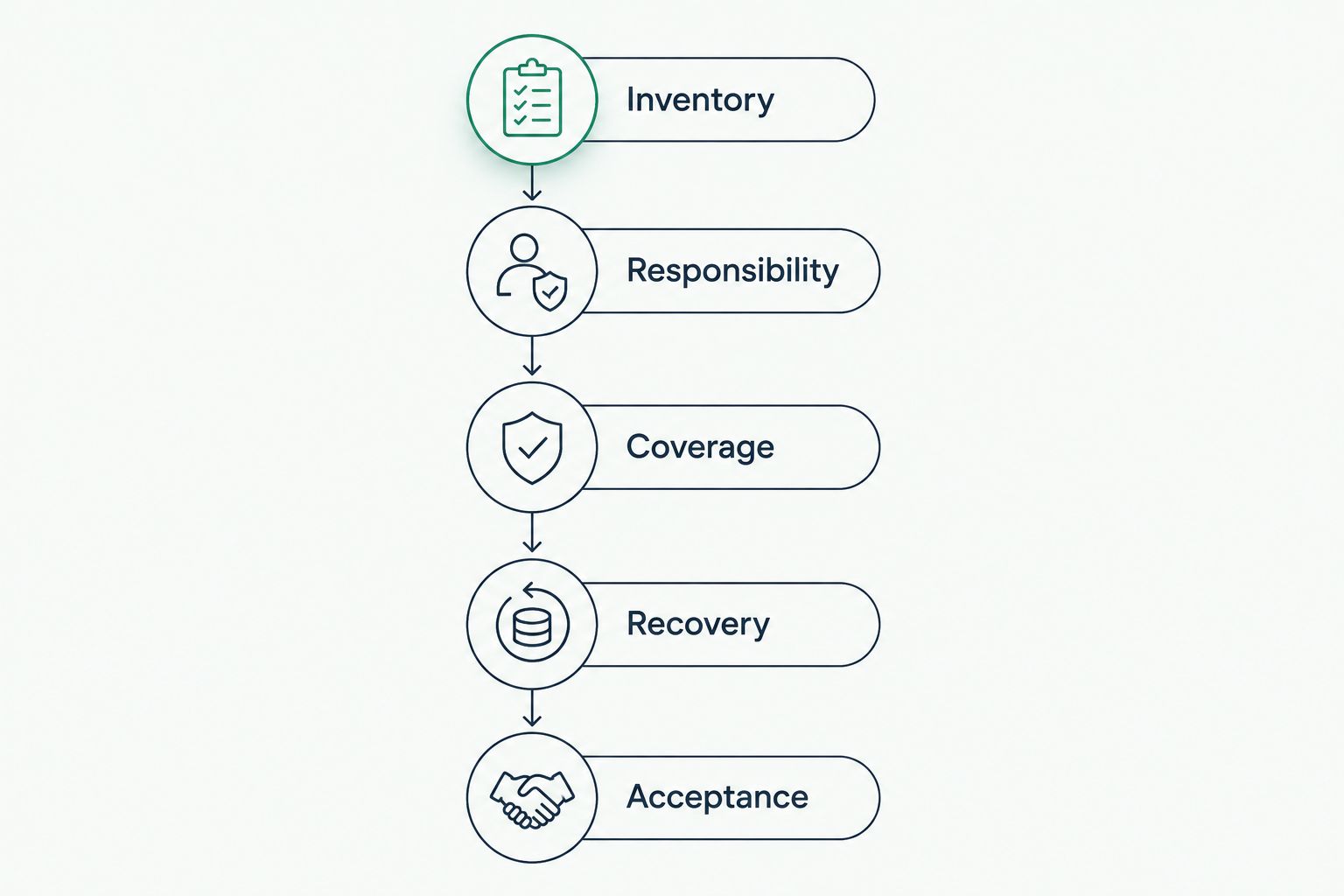
Agree on responsibilities before comparing provider proposals.
Ask DivergeIT to address that brief against its managed IT, cybersecurity, and compliance services. The useful outcome is a proposal that states accepted responsibilities and exceptions. A service category alone does not settle whether a particular development dependency is included.
Request a scoped IT support proposal
Discuss covered systems, support hours, security responsibilities, and exclusions for your studio.
How should you compare response commitments?
Compare separate milestones: acknowledgment, contact with a qualified person, active investigation, and restoration. A fast acknowledgment confirms that a request arrived. It does not establish when a developer can resume work.
DivergeIT's stated service language includes a 15-minute response in writing and a live expert in 5 minutes. When evaluating those commitments, ask which channels, coverage hours, ticket types, and contractual conditions apply. Neither phrase, by itself, defines a restoration deadline for a failed production system.
For your 2026 agreement, describe an urgent incident in business terms. For example, distinguish an individual application problem from a shared access failure that blocks a production workflow. Then ask the provider to explain the handling of each case without assuming both receive the same escalation.
Buy a defined escalation process, not an ambiguous promise of fast support. Require an owner, a communication method, and an escalation path for unresolved incidents. Keep response commitments separate from backup recovery objectives and application availability requirements.
Does co-managed IT make sense for a studio with internal IT?
Co-managed IT makes sense when the studio can name the work its internal team retains and the work it wants an external provider to perform. Compare the combined responsibilities, not just the external proposal.
Ask your internal IT owner to identify repetitive support work, coverage gaps, and specialist tasks before requesting proposals. Keep authority clear. The external team should know which changes it can make directly and which need studio approval.
Should launch-period support be included?
Launch-period support should be written into the agreement when you require coverage beyond the standard service window. Define the dates, systems, escalation contacts, and work expected before the period begins.
Separate employee and infrastructure support from player support and live-game operations. Those responsibilities are not interchangeable. If your request includes services outside ordinary business IT, have the provider expressly accept them rather than treating them as implied coverage.
Are backups enough to protect source code and game assets?
Backups are not a complete recovery plan. Your studio also needs to identify the protected data, confirm access to the backups, test restoration, and decide who validates the recovered environment.
A restored file is not necessarily a restored workflow. Check the dependencies needed to use the recovered material, including permissions, configuration, and connected systems. Your 2026 support scope should say who handles those dependencies and who approves the return to normal work.
FAQ
How do I compare managed IT services for gaming studios cost?
Compare proposals against the same users, devices, systems, support hours, and responsibilities. Separate recurring support from onboarding, licensing, projects, and incident recovery so exclusions remain visible.
Is fully managed IT better than co-managed IT for a gaming studio?
Fully managed IT fits a studio seeking external ownership of agreed daily IT work; co-managed IT fits a studio retaining an internal IT owner. Choose the model that matches your responsibility map rather than assuming either model covers every system.
Does managed IT support include build servers and source control?
Build servers and source control are included only when the provider accepts them in the written scope. Ask separately about infrastructure administration, application troubleshooting, backup, and recovery.
Does a response-time commitment mean my studio will be working again by then?
A response-time commitment does not establish a restoration deadline. Ask the provider to distinguish acknowledgment, qualified contact, investigation, escalation, and recovery.
What should I ask DivergeIT about support for a gaming studio?
Ask DivergeIT to confirm the covered development systems, support hours, security responsibilities, and exclusions. Its stated services include managed IT, cybersecurity, compliance, and AI solutions for growing small and mid-sized businesses.
Should contractor access be included in a gaming studio IT agreement?
Contractor access should be included when you expect the provider to administer it. Specify account approval, device requirements, access changes, and removal responsibilities.
What should happen before I sign an IT support agreement?
Agree on the covered inventory, responsibility map, support windows, onboarding deliverables, and process for additional work. Confirm how the provider hands back access and documentation when the agreement ends.
One last thing
Test the proposal against a blocked workflow before you sign. Describe a developer who cannot access the repository and ask the provider to trace the incident from first contact through escalation and restoration. Note every point where responsibility leaves the contracted scope.
For a 2026 purchasing decision, that walkthrough is more useful than another list of service features. It turns broad promises into concrete ownership questions. Resolve those questions in the agreement, not during the incident.