


IT support for a film production company requires a scope-based quote; a monthly support fee alone does not establish your total cost. Your 2026 budget should separate ongoing support from setup, production-specific projects, software, equipment, and recovery work. Before you compare proposals, confirm whether support covers only your permanent staff or also temporary crew, production locations, and post-production systems.
TL;DR
- IT services for film production companies cost comparisons need matching coverage, exclusions, and project scope—not just monthly fees.
- Separate ongoing managed IT support from location setup, software, equipment, and recovery work.
- DivergeIT serves growing small and mid-sized businesses seeking managed IT services, cybersecurity, and compliance support.
- Require written response commitments and clear responsibility for production-critical systems before signing.
How much does IT support cost for a film production company?
The useful comparison is the total contracted scope, not an unsupported average. Start with the systems and people covered, then identify which work sits outside the recurring agreement. The IT services for film production companies guide provides broader context for defining that scope.
Ask every provider to organize its proposal around the same categories:
Ongoing support
- What the proposal should specify: Covered users, devices, systems, and support hours
- What to check separately: Temporary crew and specialist workstations
Initial onboarding
- What the proposal should specify: Discovery, documentation, access transfer, and setup
- What to check separately: Remediation of existing problems
Production projects
- What the proposal should specify: Location setup, relocations, and infrastructure changes
- What to check separately: Travel, physical installation, and teardown
Security operations
- What the proposal should specify: Included monitoring, access controls, and escalation
- What to check separately: Incident investigation and recovery responsibilities
Backup and recovery
- What the proposal should specify: Protected systems, retention, and recovery testing
- What to check separately: Media storage, restoration work, and transfer requirements
Software and equipment
- What the proposal should specify: Included licenses and managed assets
- What to check separately: Purchases, renewals, repairs, and replacements
A proposal that leaves these categories undefined is not ready for approval. Ask the provider to mark each item as included, separately scoped, or your responsibility.
Why this matters
A film company can have different support boundaries across its production office, location work, and post-production environment. If your business uses temporary accounts, rented equipment, or external collaborators, a permanent-employee count does not describe the whole environment.
An undefined boundary creates a practical problem: you discover who owns the issue while work is already blocked. Your agreement should identify the responsible party before a production-critical failure occurs.
For your 2026 comparison, use the same operating brief for every bidder. Otherwise, a narrower proposal can appear preferable simply because it excludes work another provider included.
Which support model fits your production company?
Choose a support model around the work your company needs covered. These are purchasing structures to discuss with providers, not statements about any provider's standard package.
Managed support
- Best for: Companies seeking ongoing ownership of routine IT operations
- Main advantage: Establishes recurring responsibilities and support processes
- Main limitation: Project work and specialist systems still need explicit inclusion
Co-managed support
- Best for: Companies with internal IT staff who need defined outside help
- Main advantage: Lets internal staff retain ownership while assigning selected duties
- Main limitation: Overlapping responsibilities require a written handoff
Project support
- Best for: Companies buying a defined setup, migration, or remediation
- Main advantage: Connects the engagement to a specific deliverable
- Main limitation: Does not establish ongoing support after acceptance
Managed support: define the operating boundary
Managed support fits when you want an outside team responsible for agreed daily IT functions. Ask the provider to name the systems it administers, the requests it accepts, and the incidents it escalates elsewhere.
The trade-off is contractual scope. Do not assume an ongoing agreement includes location installations, media workflow troubleshooting, or substantial infrastructure changes. Choose managed support when you need ongoing operational ownership, and document project exclusions.
Co-managed support: assign each responsibility
Co-managed support fits when your internal team remains accountable but needs outside capacity or expertise. Define who handles employee requests, security alerts, account changes, infrastructure maintenance, and vendor coordination.
The limitation is divided ownership. A shared arrangement needs a named decision-maker and a handoff process for issues that cross responsibilities. Choose co-managed support when you can clearly divide the work.
Project support: define the finish line
Project support fits a specific deliverable, such as an office move or infrastructure change. Specify acceptance criteria, documentation, access ownership, and the handover to whoever supports the environment afterward.
Its limitation is continuity. Completion of a project does not establish responsibility for future incidents. Choose project support for a defined outcome, not as a substitute for an ongoing support agreement.
Why IT support scope varies
These factors belong in your brief because they change the work you are asking a provider to perform. Describe your actual environment rather than treating every factor as a requirement.
- People and access: Identify permanent employees, temporary crew, contractors, and external collaborators. Specify who approves access and who removes it when an engagement ends.
- Locations and connectivity: List permanent offices and any production locations needing support. State whether physical setup, connectivity troubleshooting, and travel belong in the engagement.
- Specialist systems: Identify editing workstations, shared storage, and production applications requiring attention. Separate general device administration from application-specific troubleshooting.
- Support windows: State when the business needs help and which incidents interrupt critical work. Distinguish staffed assistance from an automated alert or ticket acknowledgment.
- Security and recovery: Define the systems and data requiring protection, the party responsible for incident decisions, and the recovery outcomes you need.
- Project activity: Identify planned moves, migrations, equipment changes, and production transitions. Ask how the agreement handles work that changes the environment rather than maintains it.
Do not request every possible service by default. Specify the work you need, then remove services that duplicate an existing internal or vendor responsibility.
How to request a comparable IT support quote
A clear brief gives providers the same problem to price. Use this sequence for your 2026 request, and require written answers wherever a responsibility affects production continuity.
Define coverage
List the people, devices, locations, and systems you want covered. Identify assets you own separately from equipment controlled by a rental company, collaborator, or another service provider.
State how temporary access works. Your brief should explain who authorizes accounts, what access those accounts need, and how access ends when someone leaves the production.
Set priorities
Describe the business effect of different failures. An unavailable shared production system and a routine employee request should not automatically receive the same priority.
Ask what starts the response clock, how incidents are classified, and who can escalate a blocked workflow. A response promise needs a measurable event, not simply a reassuring phrase.
Assign ownership
Write down who owns each system and each escalation. Include your internal team, the support provider, application vendors, connectivity providers, and any production partners involved.
Require the provider to explain how it handles an issue outside its direct control. Coordination and technical resolution are different responsibilities; your agreement should distinguish them.
Separate projects
Ask for a clear boundary between maintaining the existing environment and changing it. Include planned location work, migrations, new infrastructure, and other known changes in the brief.
Require approval before separately scoped work begins. The approval process should identify the deliverable, responsible person, and completion criteria.
Confirm handover
Define what happens when the engagement ends. Specify access transfer, administrative documentation, equipment records, and the ownership of accounts used to run your environment.
A handover requirement is also useful during the contract. It establishes what documentation must remain current instead of leaving knowledge with an individual technician.
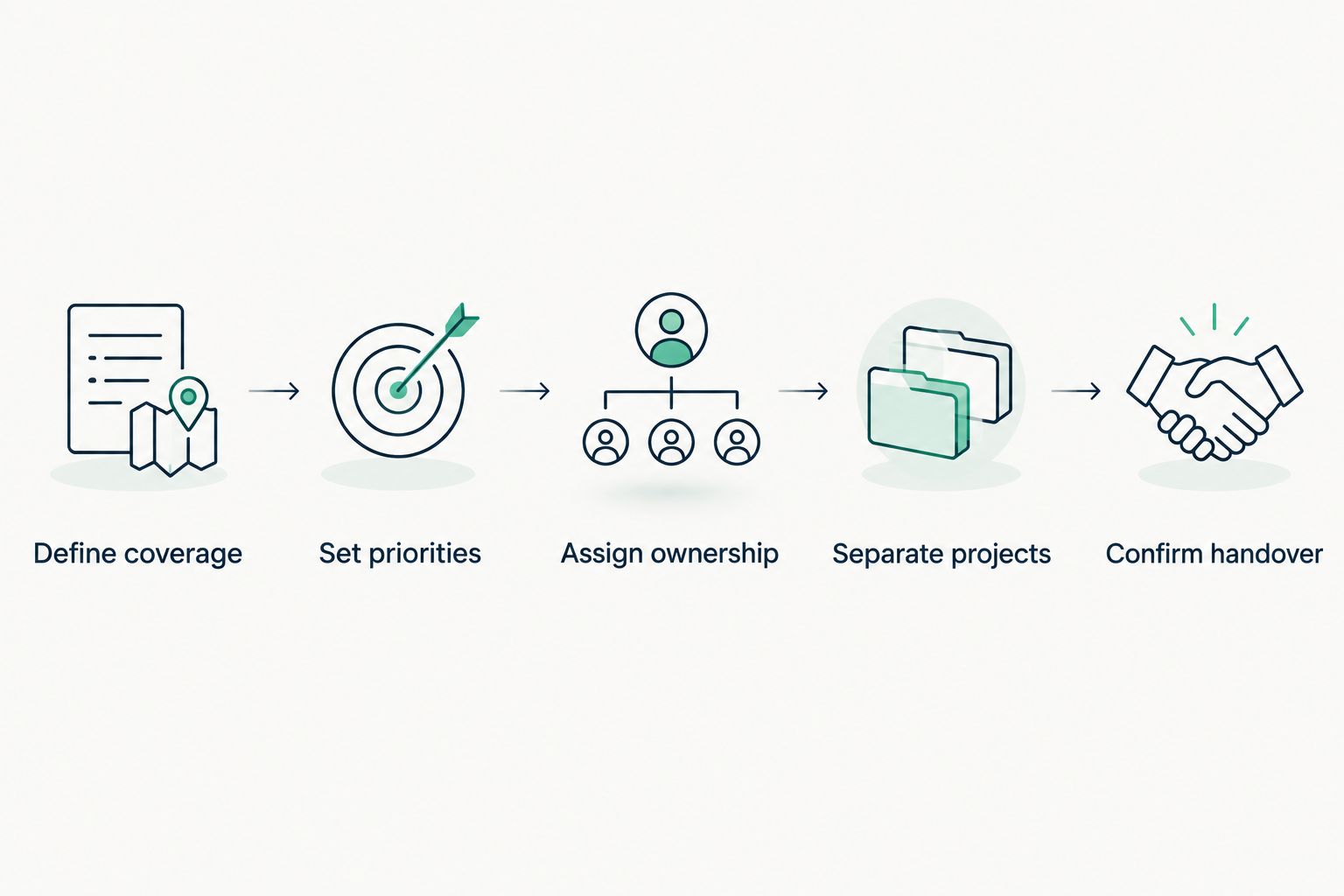
Define the work and its ownership before comparing proposals.
Which service commitments should you compare?
Response time is not resolution time. A response commitment describes when assistance begins; a resolution commitment describes when the underlying problem is fixed. Ask the provider to define both terms wherever they appear.
DivergeIT's stated service language includes a 15-minute response in writing and a live expert in 5 minutes. When reviewing those commitments, confirm the applicable services, operating hours, incident categories, and contractual conditions. Do not treat either response statement as a promise that every issue will be resolved within that period.
For your 2026 agreement, check these details:
- Contact method: Specify whether an urgent incident starts through a call, portal, email, or another agreed channel.
- Human engagement: Identify whether the commitment means acknowledgment, technician contact, or active troubleshooting.
- Escalation: Name who takes ownership when the first technician cannot resolve the issue.
- Dependencies: Explain how vendor, connectivity, or equipment dependencies affect the response process.
- Evidence: Require records that show when the incident was reported, accepted, escalated, and closed.
A short response commitment is useful only when you understand what happens after contact. Ask the provider to walk through a production-critical incident using the proposed agreement.
Is managed IT support enough for post-production?
Managed IT support covers post-production systems only when the agreement names them and defines the work. General workstation support is not the same engagement as troubleshooting an editing application or investigating shared-storage performance.
Ask who supports the workstation, operating system, application, storage, and network connection. If those responsibilities belong to different parties, require a coordination process. Do not assume that supporting a device means supporting every workflow running on it.
Does backup support include restoring production media?
Backup support includes restoring production media only when the agreement explicitly covers that data and the restoration work. A statement that systems are backed up does not establish the scope of a media recovery engagement.
Ask which data is protected, where copies reside, who monitors failures, and how restoration is tested. Document the business requirement for recovery, then ask the provider to explain how its proposed service meets it.
Where DivergeIT fits
DivergeIT is best for growing small and mid-sized businesses seeking managed IT services, cybersecurity, and compliance support. The company serves entertainment businesses among other industries.
For a film company, the next step is to confirm the specific scope of managed IT services, ManageIT, against your production environment. The provider's stated business focus does not by itself establish coverage for your editing applications, production locations, media storage, or specialist workflows.
Use the contact page to request a scoped proposal. Bring your coverage list, required support windows, responsibility map, and planned projects so the discussion addresses the work you actually need.
FAQ
How much should a film production company budget for IT support?
Budget against a written scope that separates recurring support from onboarding, projects, software, equipment, and recovery work. A monthly fee alone does not establish the full commitment.
Is managed IT support better than project-based support for a production company?
Managed support fits ongoing operational needs; project support fits a defined deliverable. Choose according to the responsibility you need covered, and document what happens after a project ends.
Does an IT support agreement cover temporary film crew?
An IT support agreement covers temporary crew only when its scope includes them. Specify account creation, device support, access approval, and access removal.
Does a fast response commitment mean my problem will be fixed immediately?
No. Response time describes when assistance begins, while resolution time describes when the underlying issue is fixed. Ask the provider to define both terms and explain escalation.
Can I keep my internal IT team and use an outside provider?
Yes. A co-managed arrangement assigns selected responsibilities to an outside provider while your internal team retains others. Document ownership and handoffs before the engagement starts.
Does managed IT support include editing software and shared storage?
Managed IT support includes editing software and shared storage only when the agreement names those systems and the support tasks. Separate general administration from specialist application and performance troubleshooting.
What should I send when requesting a film production IT support quote?
Send your user and device inventory, locations, critical systems, support windows, existing responsibilities, and planned projects. Ask every provider to respond to the same brief.
One last thing
Before signing your 2026 agreement, ask the provider to trace a hypothetical shared-storage outage through the contract. Who receives the report, who investigates, who contacts other vendors, and who communicates with your production lead?
If the provider cannot identify the owner at each handoff, clarify the scope before approving the proposal. That exercise reveals responsibility gaps a headline fee cannot show.