

SOC 2 compliance has no fixed completion time: your schedule depends on readiness work, the report type, the examination period, and the CPA firm's reporting process. A Type I report addresses control design at a specified date; a Type II report also addresses operating effectiveness over a specified period, so implementing controls alone does not finish the process.
TL;DR
- How long does SOC 2 compliance take? Plan around readiness, report type, the examination period, and CPA review.
- SOC 2 Type I addresses a specified date; Type II examines controls over a specified period.
- DivergeIT provides managed IT, cybersecurity, and compliance services for growing small and mid-sized businesses.
- Confirm your customer's required report before committing to an audit deadline.
Why this matters
A customer asking for a SOC 2 report usually needs evidence for its vendor assessment, not a promise that you have purchased security software. The deadline you negotiate must reflect what that customer actually requires: a particular report type, system scope, and reporting period.
For your 2026 plan, separate technical readiness from the independent examination. If infrastructure changes are part of the work, the cloud migration to SOC 2-ready infrastructure guide covers that supporting workstream; completing it is not the same as receiving a SOC 2 report.
How long does it take to become SOC 2 compliant?
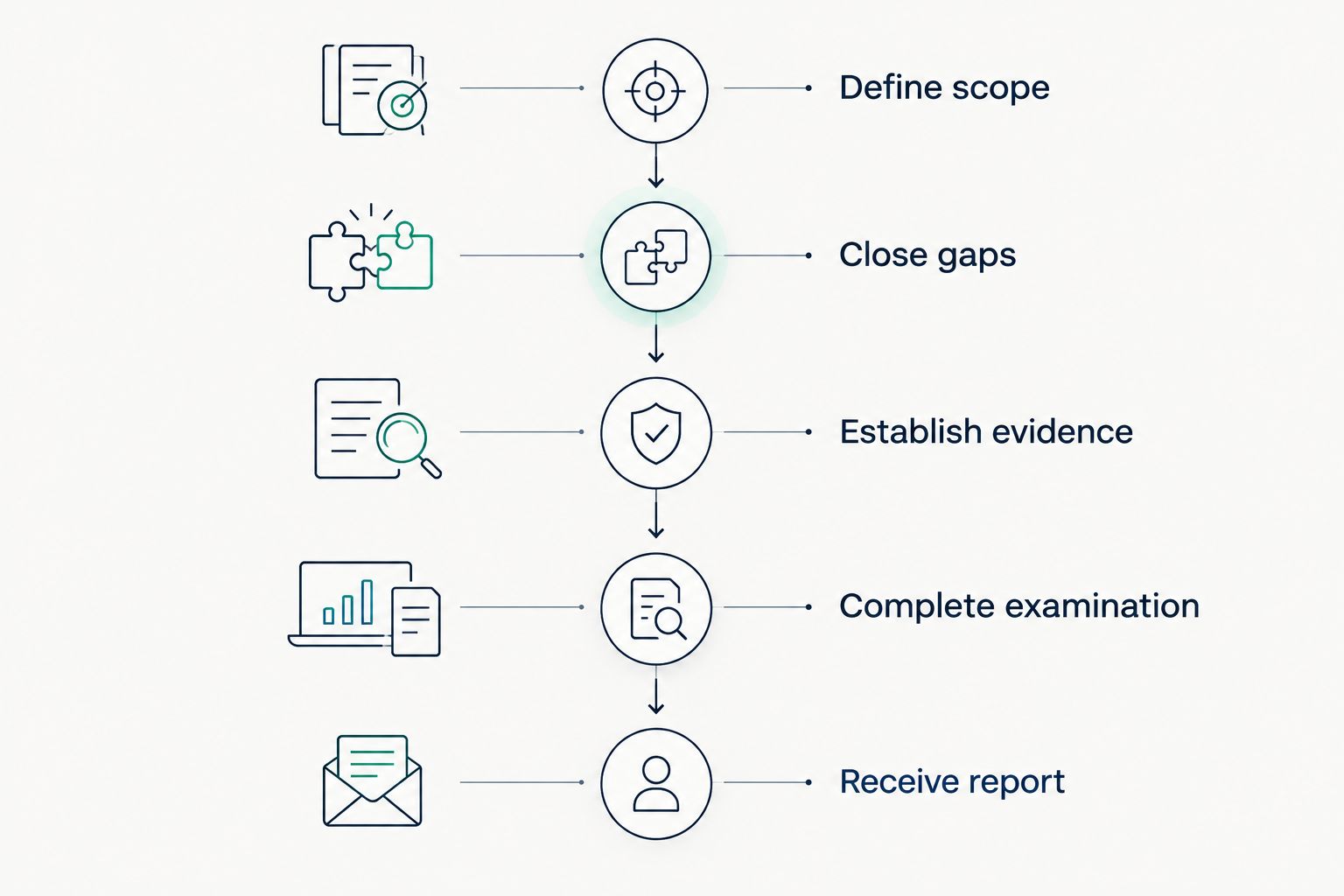
Your SOC 2 timeline follows a dependency chain: define the system, address control gaps, establish evidence, complete the examination, and receive the report. Some activities overlap, but a Type II examination still needs evidence from its specified reporting period.
Set your delivery date with the CPA firm, not from a generic online estimate. A deadline without an agreed scope and report type is not a usable commitment.
SOC 2 Type I
- What the examination addresses: System description and suitability of control design at a specified date
- Best for: A customer request that accepts point-in-time assurance
- Advantage: Establishes an independent assessment at that date
- Limitation: Does not provide an opinion on operating effectiveness over a period
SOC 2 Type II
- What the examination addresses: System description, control design, and operating effectiveness over a specified period
- Best for: A customer request requiring evidence of ongoing control operation
- Advantage: Adds testing of operating effectiveness
- Limitation: Requires evidence across the examination period, as well as auditor review
These distinctions follow the American Institute of Certified Public Accountants' SOC reporting framework. For 2026 planning, use the AICPA's SOC 2 framework and Trust Services Criteria as the reference for examination scope; use your CPA engagement terms for the actual schedule.
Build the schedule in dependency order
- Define scope. Identify the service, systems, locations, people, data, and third parties relevant to the examination. Agree on the applicable Trust Services Criteria with the CPA firm.
- Close gaps. Assign owners to missing or ineffective controls. Implement the required changes and retain evidence showing what changed and when.
- Establish evidence. Confirm that control records identify the activity, date, owner, and result. For Type II, align evidence collection with the agreed examination period.
- Complete examination. Provide requested records, answer questions, and resolve discrepancies with the CPA firm. Keep the evidence tied to the system and period under examination.
- Receive report. Allow for the CPA firm's evaluation, report preparation, management responses where applicable, and final issuance.
Treat these as completion gates, not interchangeable tasks. A policy approved after an activity occurred does not establish that the documented process governed that earlier activity.
A finished control implementation is a readiness milestone, not the final report.
SOC 2 Type I: assurance at a specified date
A SOC 2 Type I examination addresses control design at a specified date. It does not require the same operating-effectiveness examination over a period that distinguishes Type II, but readiness and auditor work still belong in the schedule.
Choose Type I when the intended recipient accepts Type I. Obtain that confirmation before commissioning the work. Otherwise, you risk producing a report that does not satisfy the original request.
Readiness still requires more than writing policies. Your system description must match the service being examined, and the controls must be suitably designed for the applicable criteria at the specified date.
For a 2026 customer deadline, ask whether the recipient needs an issued Type I report or will accept another clearly described milestone. Do not describe a readiness assessment as an independent SOC 2 examination.
SOC 2 Type II: assurance over a specified period
A SOC 2 Type II examination includes testing whether controls operated effectively over the specified period. That makes the evidence history part of the schedule, rather than an administrative task you can finish after everything else.
Choose Type II when the recipient requires assurance about ongoing control operation. Its benefit is the additional operating-effectiveness examination; its scheduling constraint is the need to support the period under review.
Agree on the period with the CPA firm before presenting a completion date to a customer. Also confirm how the firm will evaluate controls performed at different frequencies, changes during the period, and records held by external providers.
Do not assume a Type I report is a mandatory prerequisite. Discuss the appropriate examination path with the CPA firm and the intended report users instead of adding an intermediate report by default.
Why the SOC 2 timeline varies
The report type explains only part of the schedule. The condition of your systems, the quality of your evidence, and the engagement scope determine how much preparation stands between your current state and the examination.
- System scope. An examination covering several connected services requires a clear account of their boundaries and dependencies. Unresolved scope questions also make evidence requests harder to answer consistently.
- Control readiness. Existing policies do not prove that controls are implemented or suitable. Missing access restrictions, unclear responsibilities, or incomplete procedures create remediation work.
- Evidence quality. Records must support the control being tested. A screenshot without context or a task marked complete without supporting detail leaves questions for the examiner.
- Reporting period. Type II examines operating effectiveness over the agreed period. Evidence needs to support that period, not simply show the latest configuration.
- Third-party dependencies. External providers can hold relevant records or perform controls on which your service depends. Identify those dependencies and the applicable responsibilities during scoping.
- Examination and review. The CPA firm needs time to perform procedures, evaluate results, and prepare the report. Confirm its requested submission dates and review process in the engagement plan.
For your 2026 schedule, assign each dependency an owner and an acceptance condition. “Access review complete” is useful only when the reviewer, covered accounts, decisions, and follow-up actions are documented.
How do you shorten the SOC 2 process without weakening it?
Shorten avoidable rework by settling scope early, assigning control owners, and checking evidence before examination requests arrive. You cannot replace operating history with a newly purchased platform or a recently approved policy.
Confirm the customer's requirement first
Ask the intended recipient which report type it requires, which service must be covered, and whether it has requirements for the reporting period. Record the answer alongside the commercial deadline.
This prevents a mismatch between the report you commission and the report your customer will accept. It also gives the CPA firm a defined business requirement to evaluate.
Make ownership explicit
Assign a named internal owner to each control and evidence source. Separate the person performing an activity from anyone responsible for approving or reviewing it where the control requires that distinction.
DivergeIT's managed IT and compliance services are best suited to growing small and mid-sized businesses seeking outside operational support. Keep internal accountability explicit: outside assistance does not replace management's responsibilities or the independent CPA examination.
Test the evidence before relying on it
Walk through an actual joiner, role change, or departure and inspect the retained records. Check whether the evidence shows the requested action, authorization, completion, and relevant system access.
Use the same approach for other in-scope controls. If a record cannot show what happened, resolve the evidence problem before treating the process as examination-ready.
Keep the scope controlled
Define the system boundary accurately rather than excluding relevant components to simplify the examination. Record material changes and discuss their implications with the CPA firm.
For 2026 projects involving a migration or major application change, coordinate the operational plan with the examination plan. The system described in the report must match the system the examination addresses.
Discuss your compliance readiness
Discuss managed IT, cybersecurity, and compliance support with DivergeIT.
Can you become SOC 2 compliant before a customer deadline?
A customer deadline is workable only when the required report, readiness tasks, examination period, and CPA schedule fit together. Start by asking the CPA firm to assess that sequence against the requested delivery date.
If the full report cannot meet the customer's date, discuss acceptable interim evidence directly with the customer. Describe each document accurately; a remediation plan or engagement letter is not a substitute for an issued SOC 2 report unless the customer expressly accepts it for its own process.
Does a Type I report shorten the path to Type II?
A Type I report does not replace the Type II operating-effectiveness examination. Preparation for Type I can establish useful documentation and control ownership, but Type II still needs evidence for its specified period.
Choose the sequence based on recipient requirements and the CPA firm's engagement plan. Commissioning Type I solely because it sounds like the first mandatory step adds an assumption that the SOC 2 framework does not require.
Can managed IT handle the entire SOC 2 examination?
Managed IT can support technical controls, operational records, and remediation, but the independent SOC 2 examination belongs to the CPA firm. Your management team remains responsible for its system, controls, and required representations.
DivergeIT provides managed IT, cybersecurity, and compliance services; that service role is distinct from the independent auditor's role. Before assigning work, document who implements controls, who supplies evidence, who approves decisions, and who performs the examination.
FAQ
How long does SOC 2 compliance take for a small business?
SOC 2 has no fixed completion time for a small business. The schedule depends on readiness, system scope, report type, the examination period, and the CPA firm's work.
Is SOC 2 Type I faster than Type II?
SOC 2 Type I addresses a specified date rather than operating effectiveness over a specified period. That removes the Type II period requirement, but preparation and examination work still determine the delivery date.
Do I need SOC 2 Type I before Type II?
A SOC 2 Type I report is not a mandatory prerequisite to Type II. Agree on the appropriate path with your CPA firm and the customers that will receive the report.
Can compliance software get my SOC 2 report issued?
Compliance software cannot issue an independent SOC 2 report. It can support preparation and evidence management, but a CPA firm performs the examination and issues the report.
When should I start collecting SOC 2 evidence?
Start retaining relevant control evidence during readiness and confirm the examination requirements with your CPA firm. Type II evidence must support the controls and period under examination.
Who actually issues a SOC 2 report?
An independent CPA firm issues a SOC 2 report after performing the examination. An IT provider or readiness consultant can support preparation but does not replace that independent role.
Does a SOC 2 report mean my business is certified?
SOC 2 is an independent examination and reporting framework, not a certification. Describe the report type, covered system, applicable criteria, and date or period accurately.
One last thing
Put the report issuance date—not the final day of the examination period—on your customer-facing plan. The CPA firm still needs to finish its examination and reporting work after the period it examines.
For your 2026 plan, confirm both dates before promising delivery. That distinction prevents a schedule from appearing complete while the document your customer requested is still being prepared.