


Yes—password managers support financial-firm compliance when you configure them for controlled access, strong authentication, employee offboarding, and usable audit evidence. In 2026, a password manager is one security control, not proof that your firm meets every applicable rule; your policies, surrounding systems, and documented oversight still determine compliance.
TL;DR
- Password manager compliance financial services decisions depend on access controls, MFA, audit evidence, and the rules covering your firm.
- FTC Safeguards Rule requirements address your security program, not approval of a particular password manager.
- Choose business administration and documented offboarding over unmanaged employee vaults.
- A password manager does not replace application-level access controls or incident response.
Do password managers meet compliance rules for financial firms?
Password managers help satisfy specific security requirements; they do not make a financial firm compliant on their own. Evaluate what the deployment proves: who received access, how users authenticate, what administrators can see, and whether access actually ends when someone leaves.
Before comparing password managers for financial services firms, decide which controls your firm must enforce. A product comparison cannot replace that requirements list.
Unmanaged personal vaults
- Best for: Individual password storage outside business credential management
- Compliance contribution: Helps an individual avoid password reuse
- Limitation: Does not give the firm dependable centralized oversight
Centrally administered business vaults
- Best for: Firms managing employee credentials and shared secrets
- Compliance contribution: Supports policy enforcement, controlled sharing, and offboarding when those capabilities are included
- Limitation: Requires configuration, testing, and ongoing administration
Privileged access management
- Best for: Sensitive administrative and infrastructure accounts
- Compliance contribution: Supports tighter control of privileged credentials and access when configured for that purpose
- Limitation: Adds administration and does not replace ordinary employee identity controls
These approaches solve different problems. For business credentials, require firm-controlled administration; for privileged accounts, assess whether a general password vault provides enough control.
Why this matters
Financial firms need to demonstrate that access to customer information follows business need. A password stored securely can still belong to an overprivileged account, remain usable after termination, or provide access to an application without adequate authentication.
For your 2026 review, separate password protection from access authorization. The vault protects a secret; the application decides what the account holding that secret can do.
That distinction also changes your evidence request. A screenshot showing encrypted storage says little about whether a former employee still has an active session in a portfolio system.
Which financial-services rules should you map first?
Start with your firm's regulated activities and regulator, not its size or the software vendor's customer list. Different financial businesses face different requirements, and a financial-services label does not establish which rule applies.
FTC Safeguards Rule: security-program controls
The FTC Safeguards Rule, at 16 CFR Part 314, applies to covered financial institutions under FTC jurisdiction. Section 314.4 addresses safeguards including access controls, authentication, encryption, monitoring, and service-provider oversight.
A properly administered password manager can support parts of that program. It does not replace the written information security program or establish that customer information is protected across every system.
The rule's multifactor-authentication provision concerns individuals accessing information systems, subject to its stated alternative-control provision. MFA on the vault does not automatically establish MFA on every application whose password it stores.
SEC Regulation S-P: customer-information safeguards
SEC Regulation S-P, including 17 CFR 248.30, establishes safeguards obligations for covered institutions. Its requirements concern the protection of customer information, not certification of a particular password-management product.
Map credential controls to your firm's safeguards procedures and incident-response responsibilities. Password-manager records can support an investigation, but they do not show all activity inside a brokerage, advisory, email, or document-management application.
FINRA supervision: procedures and evidence
For FINRA member firms, Rule 3110 establishes supervisory-system and written-supervisory-procedure obligations. Do not translate that into a claim that FINRA approves a particular vault.
Identify who supervises credential administration, how exceptions receive approval, and what evidence demonstrates that your procedures operate. Keep the rule mapping specific to your business rather than treating every financial regulation as universally applicable.
For a 2026 assessment, confirm applicability and current obligations with your compliance lead or counsel. Keep the legal determination separate from the technical assessment of whether a control works.
What should a business password manager demonstrate?
Use capabilities as acceptance criteria, not assumptions. Features, administrator permissions, and log detail differ between products and configurations.
Central administration
Require firm ownership of the business environment and documented administrator responsibilities. Employees should not be the only people able to recover essential business credentials.
Check the administrator's limits, too. Recovery rights and broad vault access create sensitive privileges that need approval and review.
Controlled sharing
Prefer named access and role-based vault membership over distributing passwords through email or chat. Check whether users can reveal, copy, export, or retain shared credentials.
A sharing interface does not eliminate the underlying risk of a shared account. Use individual application accounts wherever the application supports them, so activity remains attributable to a person.
Authentication and recovery
Protect vault access with MFA and evaluate phishing-resistant methods where supported. Recovery must receive the same attention as normal sign-in: a weak recovery process can bypass otherwise strong authentication.
NIST SP 800-63B-4 distinguishes password requirements by authentication context: 15 characters is the minimum for a password used as a single authentication factor, while 8 characters is the permitted minimum when the password is used only within a multifactor process. These are NIST authentication guidelines, not a universal financial-services password law.
MFA requires 2 distinct authentication factors, not simply two passwords. Apply your firm's requirements to both the vault and the systems it protects.
Logs and evidence
Ask what events the product records before calling it audit-ready. Useful evidence includes administrator changes, membership changes, authentication events, and relevant sharing activity—but you must verify which events are actually captured.
Also check export, access restrictions, timestamps, and retention settings. A log that your reviewers cannot retrieve does not support a practical evidence process.
Offboarding and recovery testing
Test what happens after you disable an employee. Include vault sessions, application sessions, shared credentials, recovery methods, and any documented offline-access behavior.
Removing someone from a vault does not erase a password they previously learned. Rotate exposed shared credentials and revoke application access as part of the departure workflow.
Why password manager compliance varies
The compliance outcome varies because credential storage is only one part of the control environment:
- Regulatory scope: Your firm's activities and oversight determine which obligations apply.
- Account permissions: A protected password still grants whatever access its application account holds.
- Authentication coverage: Vault MFA and application MFA protect different access points.
- Sharing practices: Named accounts provide different accountability from shared credentials.
- Evidence quality: Recorded events, retention, and retrieval determine what you can demonstrate.
- Lifecycle controls: Joiner, role-change, and departure procedures determine whether access stays appropriate.
Use these factors to explain gaps precisely. Replace a vague finding such as weak password security with the specific failure: an unowned shared account, an untested recovery process, or missing evidence of access removal.
How do you validate a deployment before approving it?
Use a documented acceptance test for your 2026 deployment. Record the expected result, actual result, evidence location, and person responsible for resolving each failure.
- Map requirements. Identify applicable obligations, internal policies, customer commitments, and the systems within scope. Distinguish mandatory controls from preferred features.
- Inventory access. Identify business accounts, account owners, shared credentials, administrators, recovery methods, and application dependencies. Flag credentials stored outside approved systems.
- Configure controls. Set vault membership, administrator permissions, MFA, recovery, and relevant sharing restrictions. Document exceptions rather than silently accepting them.
- Test removal. Disable a test user and inspect the result in both the vault and connected applications. Verify shared-secret rotation and session revocation where required.
- Preserve evidence. Export the relevant records, document the findings, and assign unresolved actions. Confirm another authorized reviewer can retrieve the evidence.
A successful sign-in test proves only that someone can sign in. The more useful acceptance test proves that an unauthorized person cannot retain access after the firm's approved removal process.
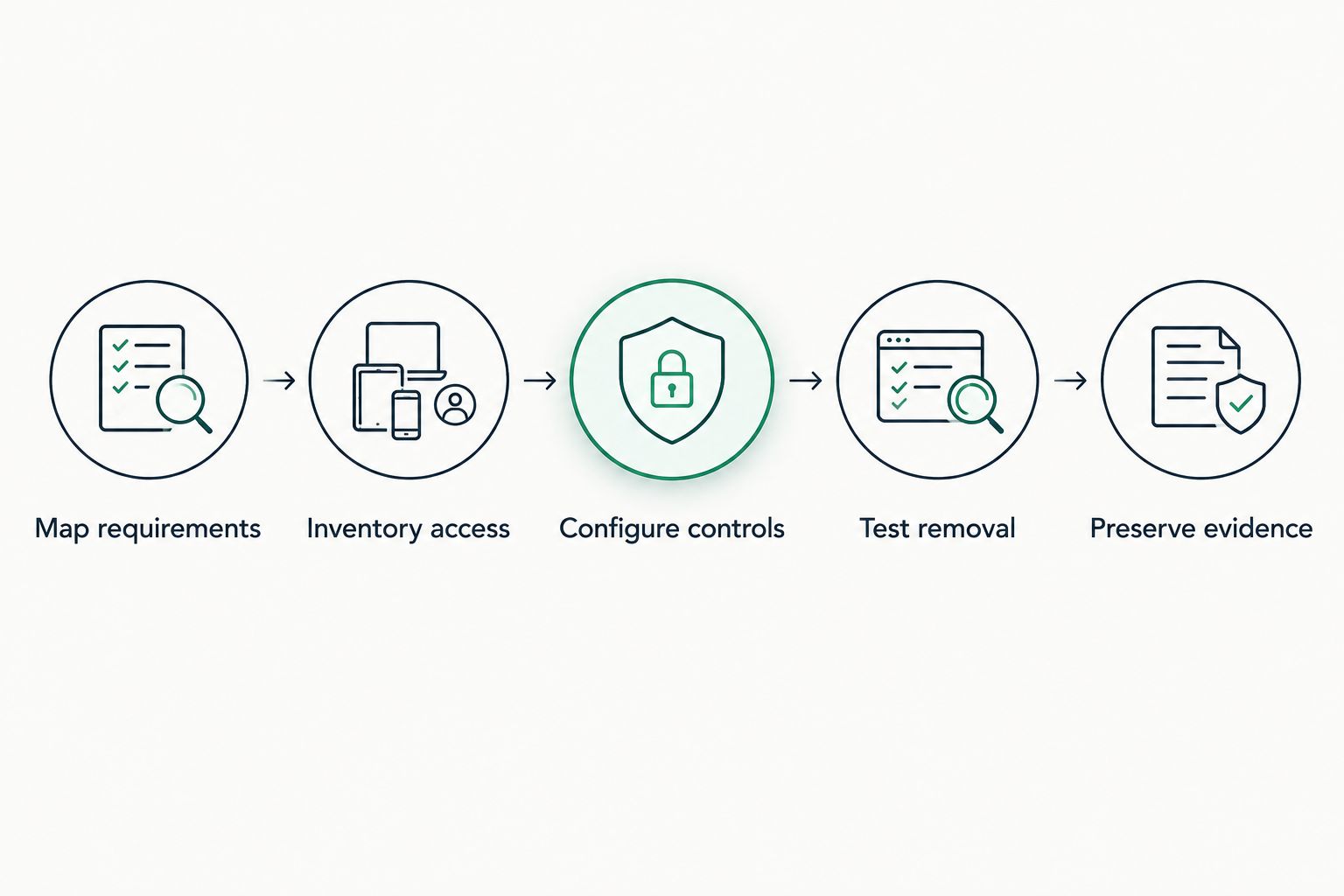
Test access removal before treating the deployment as ready for compliance review.
Does encryption make a password manager compliant?
No. Encryption protects stored or transmitted information, but it does not decide who deserves access or whether an administrator's privileges are appropriate.
Review encryption alongside authentication, recovery, key-management documentation, and access controls. A technical security description is supporting evidence, not a substitute for your firm's risk assessment.
Does a SOC 2 report prove the deployment is compliant?
No. A SOC 2 report concerns a service organization's controls within the report's defined scope; it is not a blanket approval of your financial firm's configuration or practices.
Review the report's scope, examination period, exceptions, and complementary user entity controls. Those customer responsibilities matter: a vendor's control environment cannot compensate for your firm leaving required settings disabled.
Can employees keep business passwords in personal vaults?
Your business credential policy should require firm-controlled storage and administration. Otherwise, recovery, access removal, and evidence collection depend on an employee's personal environment.
Keep the rule operational. Explain how employees transfer existing business credentials, who handles exceptions, and how the firm preserves necessary access without taking ownership of unrelated personal passwords.
Who should own the control after rollout?
Assign a business control owner and a technical operator. The compliance function determines the obligation and acceptable evidence; IT implements the configuration and tests whether it works.
DivergeIT is best suited to growing small and mid-sized businesses seeking managed IT, cybersecurity, and compliance services. For password-manager compliance work, define the service scope around configuration responsibilities, access-removal testing, evidence handling, and escalation ownership.
DivergeIT provides managed IT services, cybersecurity, and compliance services. That service model is relevant when your firm needs operational support, but it does not transfer regulatory accountability away from your organization.
When discussing cybersecurity and compliance services with DivergeIT, specify the systems, responsibilities, and evidence you need covered. Do not assume any service engagement includes every application, regulatory interpretation, or audit deliverable.
Define your credential-control requirements
Discuss managed IT, cybersecurity, and compliance responsibilities for your financial firm.
FAQ
Are password managers required for financial-services compliance?
There is no universal requirement that every financial firm use a password manager. Applicable rules establish security obligations; your firm must determine which controls satisfy its requirements and document that decision.
Is a business password manager enough for an SEC-regulated firm?
No, a business password manager is not enough by itself. SEC-regulated firms must address their applicable safeguards obligations across policies, systems, access controls, and incident response—not just credential storage.
Does turning on MFA in the password manager protect every saved account?
No, vault MFA does not automatically enable MFA on saved applications. Configure and test authentication at each relevant application or identity provider as well.
What password length should a financial firm require?
NIST SP 800-63B-4 specifies 15 characters for single-factor passwords and permits a minimum of 8 characters when passwords are used only within multifactor authentication. Your firm must also follow its applicable obligations and approved security policy.
Can a financial firm share passwords through a managed vault?
A managed vault can control credential sharing, but shared accounts still limit individual accountability. Prefer named application accounts and document exceptions where sharing remains necessary.
What should a password-manager compliance review cover in 2026?
A 2026 review should cover regulatory scope, administrator permissions, authentication, recovery, sharing, logs, and offboarding. Test the controls and preserve evidence rather than relying only on product descriptions.
Can DivergeIT help with financial-services cybersecurity and compliance?
DivergeIT provides managed IT, cybersecurity, and compliance services for growing small and mid-sized businesses, including financial-services firms. Define the required credential-management work and deliverables explicitly when discussing the engagement.
One last thing
The decisive test is not whether a password is stored securely; it is whether a former employee can still use it. For your 2026 review, trace a departure from the vault through the identity provider to the business application, including shared passwords and active sessions.
Treat every retained route as a separate remediation task. Closing the vault account is the start of offboarding verification, not the finish.