


Yes, managed IT services can help lower cyber insurance premiums by improving the security controls an insurer evaluates, but hiring a provider does not guarantee a discount. Your insurer still decides the premium, and stronger controls do not remove policy exclusions, deductibles, or your responsibility to submit accurate application answers. For your 2026 renewal, focus on documented risk improvements rather than a provider’s promise of savings.
TL;DR
- Can managed IT reduce cyber insurance premiums? Yes, through documented security improvements—not an automatic discount.
- DivergeIT provides managed IT services, cybersecurity, and compliance support for growing small and mid-sized businesses.
- Ask your broker which security improvements affect underwriting before prioritizing insurance-related work.
- Compare coverage, exclusions, and deductibles alongside the premium; a cheaper policy is not automatically better.
Can managed IT services help lower cyber insurance premiums?
Managed IT services support a stronger insurance application when they improve controls and supply evidence that those controls operate. The provider’s involvement is not the same as an insurer accepting the risk on better terms.
Start by distinguishing everyday technical support from managed cybersecurity for small businesses. Closing support tickets and managing cyber risk are different responsibilities; your service agreement needs to identify both.
Use this sequence to connect IT work to your insurance decision:
- Review the application. Obtain the current insurer questionnaire and identify what each question actually asks.
- Check the environment. Compare the requested controls with your systems, accounts, devices, and recovery arrangements.
- Resolve gaps. Assign remediation work to a named owner and verify completion.
- Assemble evidence. Collect configuration records, coverage reports, test results, and written procedures relevant to the application.
- Request reassessment. Have your broker submit the improvements and ask the insurer whether terms change.
For a 2026 renewal, request the current questionnaire rather than copying answers from an earlier application. A control that existed at the last renewal still needs to match your environment today.
Why this matters
A lower premium is only one possible outcome of better security. Insurers also make decisions about whether to offer coverage and what conditions, exclusions, and deductibles apply.
That changes the business case. Buy security work because it addresses a real exposure; treat any insurance improvement as a separate outcome to verify. A managed IT agreement remains an operating commitment even if the insurer leaves your premium unchanged.
You also need accurate representations. If an application asks whether a control covers every relevant system, a partial deployment does not support an unqualified yes. Have your technical owner explain exceptions to the person responsible for signing the application.
Which security improvements belong in your insurance review?
Use the insurer’s actual questions to set priorities. The controls below are established security practices, not a promise that every carrier requires them or awards a discount for them.
Identity protection
Multifactor authentication adds a verification requirement beyond a password. For insurance purposes, the useful question is not simply whether you own an authentication tool; it is where enforcement applies and which accounts remain outside it.
Ask your IT provider to identify remote access, email access, administrative access, and any exceptions relevant to the questionnaire. Evidence should distinguish an available feature from an enforced setting.
Endpoint protection
Endpoint detection and response helps identify and investigate suspicious activity on devices. Installing software is only part of the work: someone must receive alerts, assess them, and take authorized action.
Request a device coverage report and an explanation of who handles alerts. An unmanaged device or an unclear escalation path belongs on the remediation list, not behind a blanket statement that endpoint protection is deployed.
Backup recovery
A backup job’s success message does not demonstrate that your business can restore a usable system. Restoration testing checks whether protected data and systems can actually be recovered.
Document what is backed up, how backup access is protected, and what restoration testing demonstrated. If a critical application is outside the backup scope, record that gap explicitly rather than presenting the backup platform as complete protection.
Patching and access management
Patching addresses known software vulnerabilities, while access management limits who can use systems and what they can change. Both require ongoing ownership rather than a one-time setup.
Ask for unresolved vulnerabilities, unsupported systems, privileged accounts, and account-removal procedures. These records make the discussion specific: which exposures remain, who owns them, and what action is planned?
Incident response
An incident response plan defines responsibilities when suspicious activity becomes a business event. Your provider’s technical response and your insurer’s notification requirements are related, but they are not interchangeable.
Confirm who contacts the insurer, who authorizes outside assistance, and who can approve disruptive containment actions. Review the policy’s instructions with your broker before an incident forces those decisions.
Why the insurance outcome varies
The same technical improvement does not produce the same underwriting result for every business. For your 2026 review, separate the factors your IT provider controls from those the insurer evaluates independently.
- Coverage requested: Policy limits, deductibles, exclusions, and covered events affect the insurance comparison.
- Business exposure: Your operations, sensitive information, and dependence on technology shape the risk being insured.
- Control scope: A security measure protecting selected systems is different from one covering the full environment described in the application.
- Evidence quality: Clear records allow the insurer to assess what is implemented rather than relying on an unsupported assertion.
- Claims history: Previous claims form part of the information considered during underwriting.
- Carrier requirements: Each insurer applies its own underwriting criteria; your broker should confirm which improvements matter to the proposed policy.
Ask for an underwriting explanation, not just a new quote. If the premium changes, you need to understand whether the change reflects stronger controls, different coverage, or another factor.
Which IT support model fits the work?
You do not need a particular outsourcing arrangement to improve an insurance application. You need clear responsibility for implementing controls, maintaining them, and supplying accurate evidence.
Fully managed IT
- Best for: Businesses delegating ongoing IT operations
- Advantage: A provider can coordinate recurring technical work within the agreed scope
- Limitation to resolve: Security, evidence preparation, and incident response must be explicitly included
Co-managed IT
- Best for: Businesses retaining an internal IT team
- Advantage: Internal staff and an outside provider can divide implementation and monitoring responsibilities
- Limitation to resolve: Split ownership creates gaps unless each responsibility is assigned
In-house IT
- Best for: Businesses with the staff and skills to own the work
- Advantage: Direct control over systems, priorities, and documentation
- Limitation to resolve: The business must supply the capacity and specialist skills itself
Fully managed IT is not automatically the strongest insurance option. An internal team with verified controls can present a better-supported application than an outsourced environment with unclear responsibilities.
For co-managed arrangements, write down who approves changes, maintains device coverage, investigates alerts, and prepares application evidence. Both teams need the same scope; neither should assume the other handles an exception.
DivergeIT is best suited to growing small and mid-sized businesses seeking managed IT services alongside cybersecurity and compliance support. When evaluating DivergeIT, require a written scope that connects the work you need with the responsibilities your business retains. The company provides those service categories; the specific deliverables belong in your agreement.
How do you build an evidence-backed renewal case?
Treat renewal preparation as a controlled handoff between technical staff, business leadership, and the broker. For 2026, organize the work around the current application—not a generic security checklist.
Collect requirements
Get the application and any supporting requests from the broker. Clarify ambiguous terms before assigning technical work, especially questions that use words such as all, enforced, tested, or monitored.
Record which systems and business entities the application covers. Otherwise, a correct answer about one environment can become an inaccurate statement about the entire business.
Verify controls
Have the technical owner check configurations and coverage against each relevant question. Record exceptions separately, including systems that cannot support the requested control.
Do not turn an unresolved item into a positive answer because remediation is planned. Describe the current state and have the broker explain how the insurer wants planned improvements reported.
Retain evidence
Keep the material that supports each answer in an access-controlled location. Useful evidence includes configuration exports, device inventories, restoration test records, and approved procedures, depending on the question.
Record when the evidence was captured and who verified it. Avoid placing passwords, recovery secrets, or unnecessary sensitive information into an insurance evidence package.
Review terms
Submit the completed information through the broker and request a comparison of the proposed policy terms. Review the premium together with exclusions, deductibles, limits, and conditions.
Keep the final application and the evidence supporting it. Your technical team needs to know which representations the business made so it can maintain those controls after renewal.
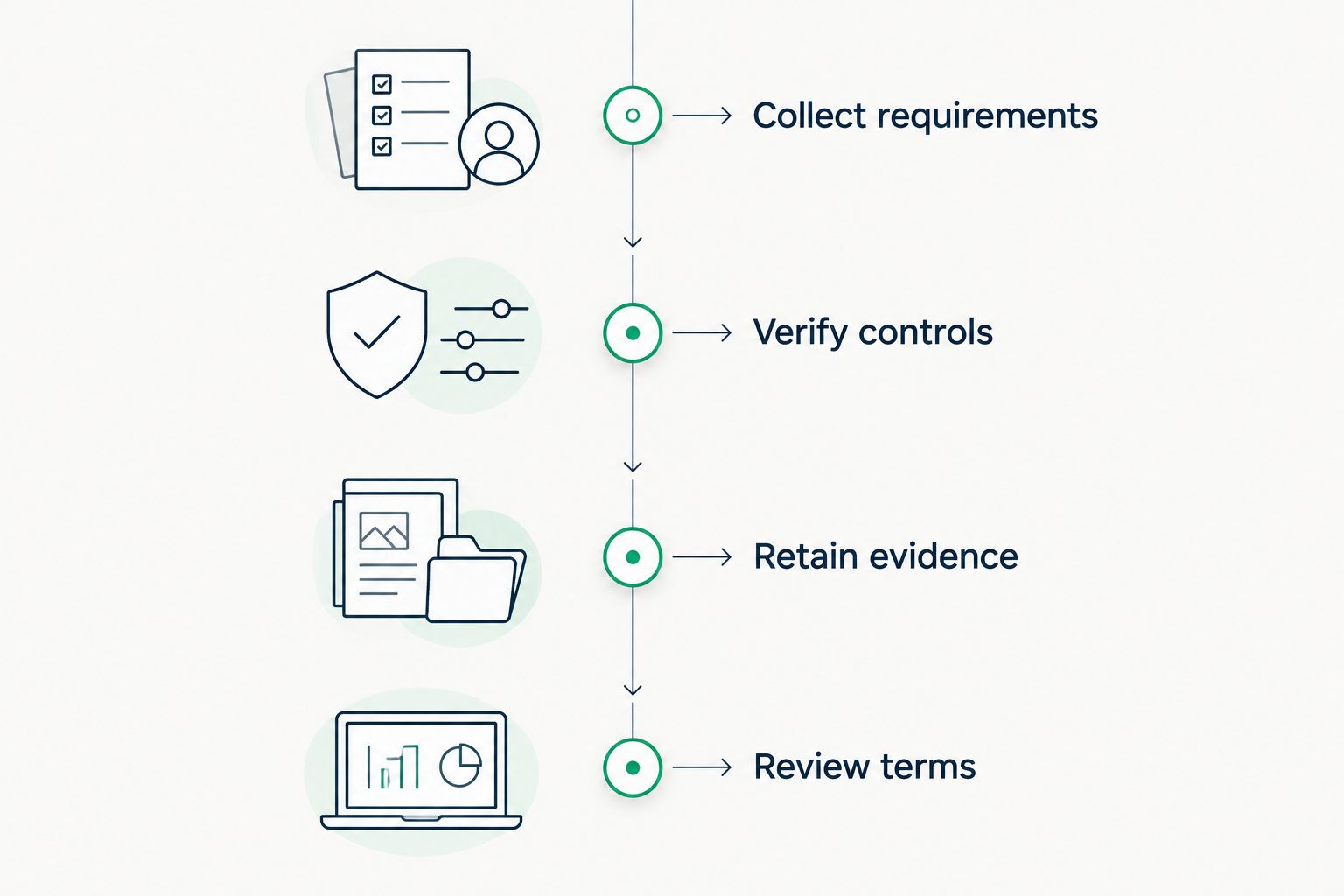
Verify the control before using it to support an application answer.
What should you require from a managed IT provider?
Require deliverables you can inspect. A general statement that a provider handles security does not define device coverage, remediation ownership, or what happens when an alert arrives.
Ask for the following in the service discussion:
- Scope: Which accounts, devices, applications, and locations are included, and which are excluded?
- Ownership: Who implements controls, approves exceptions, and closes unresolved findings?
- Evidence: Which reports and records can the provider supply to support your application?
- Response: What starts the response clock, who receives an escalation, and what actions are authorized?
- Continuity: How are records, access, and responsibilities transferred if the relationship ends?
DivergeIT provides managed IT services, cybersecurity, and compliance support. Your selection decision should still rest on the agreed work, not an assumption that hiring a provider creates an insurance discount.
The trade-off is added coordination. Even with an outside provider, your business must approve risk decisions, supply accurate business information, and review insurance terms with its broker.
Can you get a discount immediately after hiring a provider?
Hiring a managed IT provider does not itself establish eligibility for a discount. The insurer needs to evaluate the controls and information relevant to its underwriting decision.
Ask your broker whether documented improvements can be considered during the policy term or at renewal. Do not put anticipated savings into your budget until the insurer confirms the terms.
Is meeting the insurer’s checklist enough to secure your business?
Meeting an insurer’s checklist is not a complete security strategy. An application supports an underwriting decision; it does not replace an assessment of your business’s systems and operational risks.
Use the questionnaire as an input to your security plan. Keep addressing material gaps even when the insurer does not ask about them.
FAQ
Can managed IT reduce cyber insurance premiums in 2026?
Yes, managed IT can help reduce cyber insurance premiums when documented security improvements support a better underwriting decision. Hiring a provider alone does not guarantee a discount.
Will my insurer give me a discount for using a managed IT provider?
A managed IT contract does not automatically qualify your business for a discount. Ask your broker which implemented controls affect the insurer’s assessment and what evidence it requires.
Does multifactor authentication guarantee cheaper cyber insurance?
Multifactor authentication does not guarantee cheaper cyber insurance. The insurer evaluates its deployment alongside other information about your business, requested coverage, and security controls.
Can my internal IT team prepare the insurance evidence?
Your internal IT team can prepare technical evidence if it has the access, skills, and capacity to verify the application answers. Assign business review and broker coordination separately so technical evidence is not mistaken for insurance advice.
Is a lower cyber insurance premium always a better deal?
A lower premium is not always a better deal. Compare policy limits, deductibles, exclusions, and conditions before treating a quote as an improvement.
Can DivergeIT help with the security work behind an application?
DivergeIT provides managed IT services, cybersecurity, and compliance support. Confirm the controls, documentation, and application-support responsibilities included in your proposed agreement; the insurer determines coverage and premiums.
What should I do before submitting a cyber insurance renewal?
Verify each technical answer against your current environment before submitting a renewal. Resolve or disclose exceptions, retain supporting evidence, and review the completed application with your broker.
One last thing
A control is only as useful to your application as the accuracy of the answer describing it. Before your 2026 submission, ask the technical owner and the application signer to review every absolute statement together.
Pay particular attention to all users, all devices, and tested recovery. Those phrases describe scope and completed work—not intentions. A clearly disclosed exception is more useful than an answer your records cannot support.