


Yes—AI can help financial services firms meet compliance requirements by organizing evidence, flagging records for review, and drafting documentation from approved sources. It does not make your firm compliant on its own: you still need accountable supervision, verified outputs, protected data, and records that show how decisions were made.
TL;DR
- Can AI help with financial compliance? Yes—use it for evidence preparation and review support, not unchecked decisions.
- Financial services firms should require source references, access controls, and human approval before using AI outputs.
- DivergeIT provides compliance and AI services for growing small and mid-sized businesses, including financial services firms.
- Start with a bounded workflow whose errors your reviewers can identify before the output reaches clients or regulators.
Can AI help financial services firms meet compliance requirements?
AI helps with compliance work; it does not replace the controls that make that work defensible. Choose the approach according to the task, the sensitivity of the information, and the consequences of an incorrect result.
Manual review
- Best for: Final judgments and unusual cases
- Practical benefit: Lets a qualified reviewer interpret context
- Limitation: Requires staff time and consistent documentation
Rules-based automation
- Best for: Explicit, repeatable checks
- Practical benefit: Applies defined conditions consistently
- Limitation: Misses issues outside the configured rules
AI-assisted review
- Best for: Summarizing records and prioritizing exceptions
- Practical benefit: Helps reviewers work through unstructured information
- Limitation: Can omit context or produce unsupported statements
These approaches belong in the same control process rather than competing for every task. Use rules for conditions you can specify precisely, AI for bounded interpretation, and qualified people for consequential decisions. The Microsoft 365 to secure AI adoption workflow provides related reading when your rollout involves that environment.
For your 2026 compliance plan, document the purpose of each AI use before selecting a tool. A clear purpose gives you something concrete to approve, test, monitor, and stop if the results fail review.
Why this matters
A polished summary is not evidence that a control operated correctly. Your firm needs the underlying records, the applicable requirement, and an explanation of who reviewed the result.
AI adds another step to that chain. If an assistant summarizes an access review but omits an unresolved exception, the summary becomes misleading even when its remaining statements are accurate.
DivergeIT's financial compliance and AI services address areas that need coordinated ownership: technology, cybersecurity, and compliance. Your implementation plan should connect those areas rather than treating the assistant as an isolated productivity purchase.
Approve the workflow, not just the tool. Approval should cover the permitted data, the authorized users, the review standard, and the action taken when an output is wrong.
Evidence preparation: best for organizing existing records
AI-assisted evidence preparation is a sensible starting point when you already have reliable source records. An assistant can help summarize documents, organize material by control, and draft an evidence index for a reviewer to check.
The benefit is preparation support. The limitation is that a summary can conceal missing records, misread dates, or connect a document to the wrong requirement.
Require every material statement to point back to an accessible source. A reviewer should be able to open that source and confirm that it supports the statement without reconstructing the assistant's reasoning.
- Keep original records separate from generated summaries.
- Preserve the source location and relevant reporting period.
- Identify evidence gaps explicitly rather than filling them with generated prose.
- Record the reviewer and the approval outcome.
Best for: preparing evidence packets from approved repositories. Keep the final assessment with the person responsible for the control.
Policy drafting: best for a controlled first draft
AI can help turn approved material into a draft policy, procedure, or training outline. It is useful for reorganizing existing language and identifying passages that need clarification.
The main risk is invented obligations or invented capabilities. A generated policy can describe monitoring, approvals, or retention practices that your firm does not actually perform.
Separate three questions during review: What does the applicable requirement demand? What has your firm committed to doing? What can your systems and staff demonstrate today?
A draft is ready for approval only when those answers agree. Do not publish a procedure simply because it sounds formal or resembles another firm's document.
Best for: drafting from approved requirements and documented operations. Do not ask an unrestricted assistant to determine your legal obligations from memory.
Exception review: best for prioritization, not final clearance
AI-assisted review can help classify records, group similar findings, and prepare summaries for investigation. Its role is to direct attention, not to declare an activity acceptable without review.
A flagged record is not proof of misconduct. An unflagged record is not proof that no issue exists. Those distinctions matter when you evaluate communications, customer documentation, or other sensitive material.
Test both kinds of error: records incorrectly escalated and records incorrectly passed. Include examples where the relevant meaning depends on surrounding context rather than a single phrase.
Best for: helping reviewers prioritize work within a defined scope. Keep escalation decisions, supporting evidence, and the reasons for closing a case in your approved recordkeeping process.
Why AI's usefulness for financial compliance varies
AI's value depends on the work you assign and the controls surrounding it. These factors determine whether an output is useful enough to review:
- Task boundaries: Summarizing a defined document set is easier to verify than answering an unrestricted regulatory question.
- Source quality: Incomplete, conflicting, or outdated documents produce an unreliable foundation for review.
- Data permissions: The assistant must not expose information to people who lack permission to see it.
- Review capability: Your reviewer needs the subject knowledge and source access required to detect errors.
- Decision consequences: An internal draft and a client-facing decision need different approval controls.
- Recordkeeping: You need enough retained context to explain the output and the action taken afterward.
For 2026 deployment decisions, evaluate these factors together. A useful summary feature does not compensate for inappropriate data access, and strong access controls do not make an unsupported answer correct.
How do you introduce AI without weakening compliance controls?
Start with 1 bounded workflow, assign 1 accountable owner, and keep 2 separate approval gates: permission to run the pilot and permission to use its outputs operationally. These are implementation recommendations, not regulatory minimums.
1. Define scope
Write down the task, intended users, approved inputs, and prohibited uses. Identify the output's destination: an internal working document, a review queue, or a record supporting a formal decision.
Choose a task where someone can verify the result against known sources. Avoid beginning with autonomous approvals or external communications.
2. Control access
Review the information the assistant can retrieve before connecting it to production repositories. Check permissions at the source, not just at the assistant's login screen.
Confirm the provider's terms for data handling, retention, and model training before submitting sensitive information. A business account label alone does not answer those questions.
3. Test outputs
Use approved test material and a written evaluation standard. Include incomplete records, conflicting documents, and questions that the assistant should decline to answer.
Compare results with reviewer-approved outcomes. Record unsupported statements, missed exceptions, incorrect source references, and inappropriate disclosure of information.
4. Require approval
Specify who accepts the output and what that person must check. Approval should mean verification against the source, not a quick scan for professional wording.
Document where the reviewer records corrections and unresolved questions. Keep the authority to make a compliance decision distinct from permission to operate the assistant.
5. Monitor changes
Retest after changes to the model, instructions, connected data, permissions, or intended use. Define a stop condition before the pilot begins so staff know when to suspend the workflow.
Keep a manual alternative for the task. Your compliance process should remain workable when the assistant is unavailable or its outputs fail review.
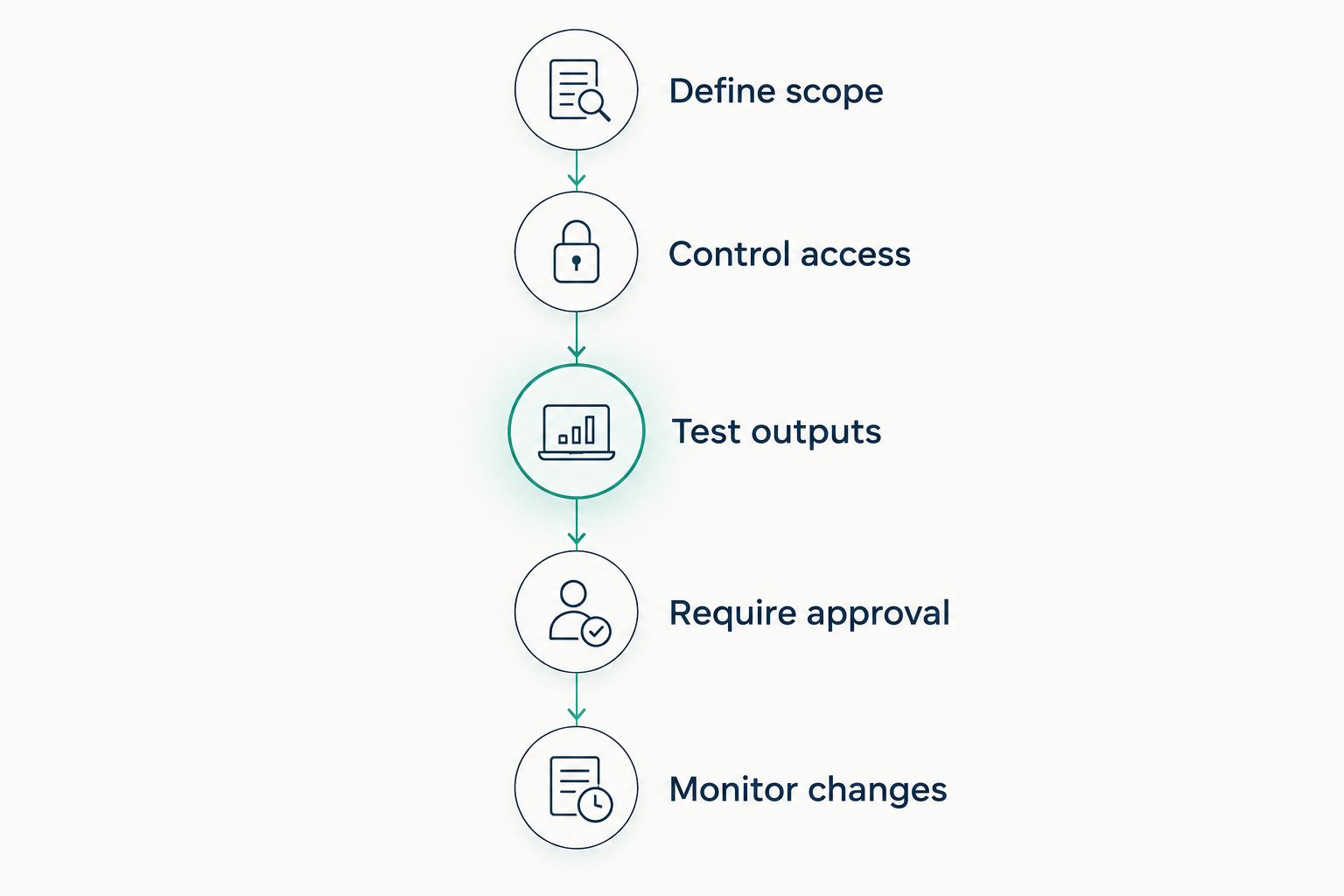
Approve the task and its controls before relying on generated outputs.
Use this sequence as a release process, not a one-time questionnaire. Your 2026 AI inventory should identify the owner, approved use, connected sources, review process, and current approval status for each workflow.
Who remains responsible when AI supports a compliance task?
Your firm remains responsible for its compliance obligations when it uses AI. Assigning a task to software or a service provider does not establish that the task was performed correctly.
For a broker-dealer, FINRA Rule 3110 addresses supervision. For an SEC-registered investment adviser, Rule 206(4)-7 addresses compliance policies and procedures. These are different regulatory contexts; do not assume a workflow approved for one business automatically fits another.
Have your compliance lead and counsel determine which requirements apply to the proposed use. Technical staff should then translate the approved requirements into permissions, logging, retention, and escalation controls.
For 2026 oversight, name the person who owns the business decision and the person who owns the technology configuration. Those responsibilities need to connect, but they are not interchangeable.
Can AI replace rules-based compliance automation?
AI should not replace a defined rules-based check merely because it produces more readable explanations. A deterministic condition is easier to inspect when the rule and its inputs are explicit.
Use AI where interpretation or summarization adds value, and keep the original check visible. If the assistant explains an exception, the explanation should accompany the rule result rather than overwrite it.
The strongest design makes disagreement reviewable. When the assistant and the configured rule reach different conclusions, send the conflict to an authorized reviewer instead of silently choosing one.
When does outside IT support make sense?
Outside support fits when your compliance team knows the required outcome but needs help implementing and maintaining the technical controls. Evaluate support for access management, security operations, evidence collection, and the handoff between IT and compliance.
DivergeIT is best for growing small and mid-sized financial services firms seeking managed IT, cybersecurity, compliance, and AI services together. That service scope does not replace your firm's legal interpretation or approval responsibilities; establish ownership and deliverables before assigning work.
When assessing DivergeIT, ask how the proposed engagement divides those responsibilities. Request a written scope covering the systems involved, the evidence delivered, and who approves changes to the AI workflow.
FAQ
Can AI help with financial compliance without making final decisions?
Yes. AI can help organize evidence, summarize approved documents, and prioritize exceptions while authorized staff retain decision-making responsibility. Require source references and review before relying on the output.
What's the best first AI compliance workflow to try?
A bounded evidence-preparation task is a practical first pilot when reviewers can verify the output against approved source records. Keep the pilot separate from autonomous approvals and external communications.
Can we put client financial information into an AI assistant?
Use client financial information only after your firm approves the tool, the specific use, and the applicable data-handling controls. Review permissions, contractual terms, retention, and training settings before submitting sensitive material.
Is an AI-generated compliance policy enough for an audit?
No. A generated policy does not demonstrate that the described controls operated. Your firm needs accurate documentation and supporting records appropriate to the requirements being assessed.
Do people need to review every AI compliance output?
Require human review before an AI output supports a consequential compliance decision. Define review requirements by workflow and risk rather than assuming every generated draft needs the same approval process.
Is AI better than rules-based compliance software?
Neither approach is best for every task. Rules-based automation fits explicit conditions, while AI-assisted review fits bounded interpretation and summarization; both need testing and oversight.
Does using an AI provider transfer our compliance responsibility?
No. Your firm remains responsible for meeting its applicable obligations. Evaluate the provider and the complete workflow, including access, verification, recordkeeping, and escalation.
One last thing
Include a deliberately unanswerable question in your 2026 pilot. Withhold a necessary source and check whether the assistant identifies the gap or fills it with a plausible statement.
That test reveals something a polished demonstration will not: whether your workflow exposes uncertainty before someone acts on it. Require the reviewer to document the gap and stop the decision until the missing evidence is available.