


CMIT Solutions combines managed IT services with a local-office service model, making it a practical option for businesses that want an outside IT partner. That model stops being enough when your agreement leaves support escalation, security ownership or compliance responsibilities unclear. The best CMIT Solutions alternative in 2026 is DivergeIT if you need managed IT, cybersecurity and compliance services; co-managed IT is the alternative if you need to retain an internal technology lead.
TL;DR
- For CMIT Solutions alternatives for financial services, shortlist DivergeIT for managed IT, cybersecurity and compliance services.
- Choose co-managed IT when your internal technology lead needs outside operational support.
- Keep CMIT Solutions when its local agreement already meets your support, security and evidence requirements.
- Compare written responsibilities and escalation procedures before comparing service descriptions.
Why this matters
Financial services firms need more than a working help desk. You need to know who handles access changes, investigates suspicious activity, restores business systems and supplies records for compliance reviews.
A provider comparison should expose those responsibilities. If two proposals both promise managed IT but assign different duties to your employees, they are not equivalent offers.
For your 2026 review, separate three decisions: who runs daily IT, who owns security operations and who provides compliance evidence. One provider can support all three, but your agreement must explain the boundaries.
CMIT Solutions alternatives at a glance
These options represent different operating models, not interchangeable software products. Use the table to decide which model deserves a proposal before comparing individual service commitments.
CMIT Solutions
- Best for: Firms that want managed IT through a local office
- Standout feature: Local-office managed IT model
- How it differs from CMIT Solutions: Baseline for this comparison
- Main trade-off: Evaluate the specific office and agreement
DivergeIT
- Best for: Growing small and mid-sized firms seeking managed IT, security and compliance services
- Standout feature: Services span daily IT operations, cybersecurity and compliance
- How it differs from CMIT Solutions: An alternative provider to evaluate against your current responsibilities and commitments
- Main trade-off: Outsourcing still requires an accountable internal business owner
Co-managed IT
- Best for: Firms with an internal IT lead who needs outside support
- Standout feature: Shared responsibility between employees and a service provider
- How it differs from CMIT Solutions: Retains more operational ownership inside your firm
- Main trade-off: Unclear boundaries create handoff problems
In-house IT
- Best for: Firms that want direct control over staffing and priorities
- Standout feature: Your employees own daily technology operations
- How it differs from CMIT Solutions: Replaces the outsourced operating model
- Main trade-off: Your firm must arrange specialist expertise and absence coverage
Do not treat a broad service list as proof of complete coverage. Ask each provider to map its offer to your systems, users and business obligations.
1. DivergeIT: best for managed IT, security and compliance
DivergeIT provides managed IT services, cybersecurity and compliance services for growing small and mid-sized businesses, including financial services firms. It is the first alternative to assess when you want those functions addressed within the same provider relationship. Keep the evaluation focused on written responsibilities rather than the number of services listed.
Where the service shines
- Connected service scope: You can evaluate daily IT support alongside cybersecurity and compliance requirements.
- Financial services relevance: Finance is among the industries the business serves.
- Concrete support commitments: The brand states a 15-minute response in writing and access to a live expert in 5 minutes. Have the applicable terms included in your agreement.
Where the service falls short
- An outside provider does not replace your firm's responsibility for approving access, setting business priorities or making compliance decisions.
- A response commitment does not establish a resolution deadline. Your agreement needs separate escalation and recovery expectations.
- Broad service coverage does not remove the need to define which systems, locations and third-party applications are included.
Head-to-head with CMIT Solutions
Support access
- Alternative-provider evaluation: Confirm how the stated response commitments apply to your firm
- CMIT Solutions evaluation: Examine the local office's written support commitments
Security ownership
- Alternative-provider evaluation: Assign responsibility for alerts, containment and escalation
- CMIT Solutions evaluation: Check the same responsibilities in the current agreement
Compliance support
- Alternative-provider evaluation: Specify required evidence and who supplies it
- CMIT Solutions evaluation: Verify what the existing service includes
Transition
- Alternative-provider evaluation: Require account, documentation and vendor handoff plans
- CMIT Solutions evaluation: Compare transition effort against staying with the current office
Best for: A growing financial services firm seeking a managed IT partner with cybersecurity and compliance services.
Verdict: Buy only when the signed scope names the responsibilities your firm needs covered.
2. Co-managed IT: best for keeping your internal IT lead
Co-managed IT divides technology work between your employees and an outside provider. Your internal lead can retain architecture, application decisions and business relationships while an external team handles agreed operational tasks. This is an operating model, not a claim that every provider offers the same arrangement.
Where co-managed IT shines
- You keep internal knowledge of business workflows and application dependencies.
- You can assign selected functions externally instead of outsourcing the entire department.
- Your technology lead remains close to business priorities while sharing defined operational work.
Where co-managed IT falls short
- Shared ownership becomes a liability when neither party owns the complete incident.
- Separate systems for tickets, documentation and monitoring can make handoffs harder.
- Your internal lead still needs time to supervise the provider and resolve competing priorities.
Head-to-head with CMIT Solutions
Internal staffing
- Co-managed IT: Requires a defined internal technology owner
- CMIT Solutions agreement to evaluate: Confirm how much work your staff retains
Daily operations
- Co-managed IT: Split by a written responsibility matrix
- CMIT Solutions agreement to evaluate: Compare the contracted division of work
Escalation
- Co-managed IT: Must connect internal and external teams
- CMIT Solutions agreement to evaluate: Review the local office's escalation process
Change approval
- Co-managed IT: Your firm defines approval boundaries
- CMIT Solutions agreement to evaluate: Verify the existing approval workflow
Choose co-managed IT for your 2026 shortlist when the problem is insufficient capacity rather than a lack of internal leadership. Do not replace a capable internal owner simply to simplify a provider proposal.
Best for: A financial services firm with an internal IT lead who needs clearly assigned outside support.
Verdict: Buy when the responsibility matrix eliminates ambiguous handoffs; skip when nobody can supervise the arrangement.
3. In-house IT: best for direct operational control
An in-house IT team gives your firm direct authority over staffing, daily priorities and technology processes. It is an alternative to outsourcing, but it does not automatically replace every security, infrastructure or compliance specialty.
Where in-house IT shines
- Your employees work directly with business teams and their operating context.
- You control hiring priorities and the order of internal projects.
- System knowledge remains within your organization rather than solely with a provider.
Where in-house IT falls short
- Your firm owns recruitment, training, supervision and absence coverage.
- Specialist requirements still need named owners, whether internal or external.
- Direct control does not guarantee documented procedures or effective escalation.
Head-to-head with CMIT Solutions
Staffing
- In-house IT: Your firm recruits and manages employees
- CMIT Solutions agreement to evaluate: Review provider staffing and coverage commitments
Priorities
- In-house IT: Managed through internal leadership
- CMIT Solutions agreement to evaluate: Managed through the service relationship
Specialist work
- In-house IT: Requires internal expertise or separate specialists
- CMIT Solutions agreement to evaluate: Confirm which specialties are included
Best for: A firm prepared to manage its own technology function, including coverage and specialist support.
Verdict: Hold until you have a staffing, coverage and accountability plan—not just a preferred hire.
Why people switch from CMIT Solutions
A switch makes sense when the current agreement no longer matches your operating needs. The decision should rest on documented gaps, not assumptions about CMIT Solutions or dissatisfaction that a clear service review could resolve.
Use these conditions to distinguish a provider problem from an unclear agreement:
- Support escalation: You cannot identify who owns an urgent issue after the first response.
- Security ownership: Your team and provider have conflicting expectations about investigating alerts or containing an incident.
- Compliance evidence: Required records have no assigned producer, approver or delivery process.
- Change control: Access changes and system changes lack clear authorization boundaries.
- Exit readiness: Administrative access, documentation and vendor records lack a defined handoff process.
These are decision criteria, not claims about every CMIT Solutions office. If your current office resolves them with an acceptable written scope, switching providers is not automatically the better choice.
How to evaluate your shortlist in 2026
Give every shortlisted provider the same business scenarios. A polished presentation cannot substitute for a clear explanation of who acts, what happens next and what records your firm receives.
Support escalation
Ask the provider to walk through an employee losing access to a business-critical application. Identify the intake route, initial owner, escalation path and person authorized to involve the application vendor.
Separate acknowledgment from action. A fast ticket response matters less if the ticket then has no accountable technical owner.
Security ownership
Use a suspected account compromise as the scenario. Ask who investigates, who can disable access, who communicates with your leadership and who preserves the incident record.
Do not assume a security tool subscription includes the people and authority needed to respond. Put those duties in the agreement.
Compliance evidence
Ask for an explanation of how the provider supports your firm's evidence requests. Specify the records you need, who reviews them and how exceptions reach the appropriate business owner.
Compliance support is not a transfer of your firm's obligations. Keep legal and compliance decisions with the appropriate professionals.
Exit readiness
Ask how your firm obtains administrative access, system documentation and vendor information when the relationship ends. Include the handoff responsibilities before signing, not during a dispute.
For a practical comparison exercise, reserve 30 minutes for each provider to work through these scenarios. This is a suggested interview format, not a service benchmark.
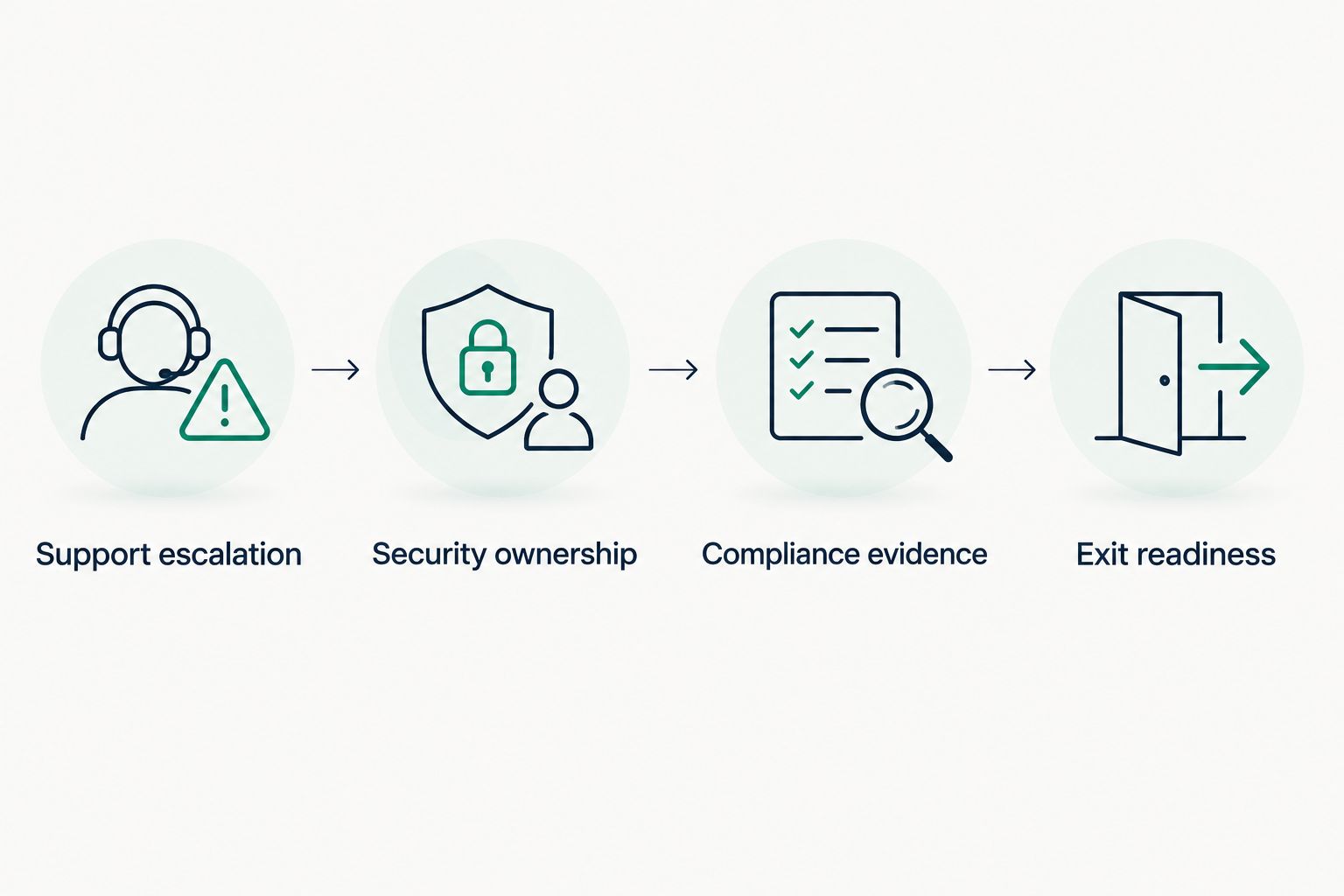
Compare ownership and procedures, not just lists of included services.
Record the answers in the same format for every provider. An unresolved responsibility should remain an open contract item rather than disappear into meeting notes.
When staying with CMIT Solutions is the right call
Stay with CMIT Solutions when your local office meets your firm's support needs, assigns security responsibilities clearly and supplies the agreed compliance records. An existing relationship has practical value when the provider understands your systems and fulfills its commitments.
Before replacing that relationship in 2026, request a service review with specific examples and required changes. Compare the revised agreement against alternatives using the same scenarios. Switch for a documented improvement in accountability, not a different logo.
FAQ
What's the best CMIT Solutions alternative for a financial services firm?
DivergeIT is the first alternative to assess when your firm needs managed IT, cybersecurity and compliance services. Choose co-managed IT instead when retaining an internal technology lead is central to your operating model.
Is CMIT Solutions a bad choice for financial services?
CMIT Solutions remains a valid choice when the local office's agreement meets your support, security and compliance-support requirements. Evaluate the specific office and service scope rather than treating the entire network as one uniform agreement.
Should a financial services firm choose managed or co-managed IT?
Choose managed IT when you want an outside provider to own the agreed daily operations; choose co-managed IT when your internal lead will retain defined responsibilities. Either model needs a written division of work and an escalation owner.
Does a fast help desk response mean a fast resolution?
No, a response commitment and a resolution commitment describe different stages of support. Ask what triggers escalation, who owns the issue and how business-critical incidents are handled after acknowledgment.
Can an IT provider take over our compliance obligations?
An IT provider can support controls, documentation and evidence collection, but your firm retains its own compliance responsibilities. Define the provider's technical duties separately from legal interpretation and business approval.
What should we request before changing managed IT providers?
Request a written transition plan covering administrative access, documentation, vendor coordination and ownership of open issues. Identify the people authorized to approve changes and confirm the handoff sequence before work begins.
How should we compare CMIT Solutions alternatives in 2026?
Compare each provider using the same support, security, compliance-evidence and exit scenarios. Select the agreement that assigns the work your firm needs, with clear boundaries and accountable owners.
One last thing
Your exit plan belongs in the buying decision. Ask a prospective provider to explain how your next provider would receive the information needed to support your firm; that answer tests documentation and accountability before the relationship starts.
For your 2026 decision, write down one person responsible for each critical handoff. If an important task belongs to everyone, keep negotiating until it belongs to someone.