


The cost of managed cybersecurity services for a small business depends on the users, devices, systems, and response responsibilities covered by the contract. For your 2026 budget, compare written scopes rather than headline figures, and separate ongoing protection from onboarding, remediation, incident recovery, and compliance work.
TL;DR
- Compare the cost of managed cybersecurity services by coverage, response authority, and exclusions—not the billing unit alone.
- Divergeit fits growing small and mid-sized businesses seeking managed IT, cybersecurity, and compliance services.
- Require written ownership for security monitoring, incident response, remediation, and recovery.
- Separate recurring service commitments from onboarding projects and work outside the agreement.
How much does managed cybersecurity cost for a small business?
Your business needs a quote tied to its environment and a written division of responsibilities. A per-user agreement and a per-device agreement are not equivalent unless they protect the same assets and include the same work.
Divergeit provides managed IT services, cybersecurity, and compliance for growing small and mid-sized businesses. That combination is relevant when your security requirements extend beyond buying software to maintaining systems and documenting controls.
Use this breakdown to compare the scope behind each proposal. Treat each row as a separate contract question, even when a provider bundles the work.
Recurring protection
- What to establish: Included users, devices, identities, and systems
- What to identify separately: Assets excluded from coverage
Security monitoring
- What to establish: Who reviews alerts and when
- What to identify separately: Coverage outside staffed hours
Incident response
- What to establish: Investigation and containment authority
- What to identify separately: Recovery and specialist investigation
Onboarding
- What to establish: Discovery, deployment, and configuration
- What to identify separately: Existing security problems requiring correction
Compliance support
- What to establish: Control documentation and evidence responsibilities
- What to identify separately: External assessments and legal advice
Service administration
- What to establish: Reporting, reviews, and change management
- What to identify separately: Projects outside ongoing operations
A useful proposal answers these questions without requiring you to infer coverage from a product list. If the agreement names tools but not responsibilities, request a revised scope before comparing it with another proposal.
Why this matters
Cybersecurity software produces information and enforces controls. Managed cybersecurity adds people and processes that interpret that information and take action. You need to know where the provider's responsibility ends and your team's begins.
For a small business, an unassigned task becomes an operational problem: someone must disable a compromised account, approve a disruptive change, or restore access. Your 2026 budget should identify who owns those decisions, not simply which subscriptions appear on an invoice.
Buy accountable work, not an undefined promise of protection. A service description should connect each important control to an owner, an action, and evidence that the work happened.
Which billing model fits your business?
Billing models organize the agreement; they do not establish its quality. Compare the same inventory and responsibilities under each model before choosing one.
Per user
- Best for: Businesses organized around employee accounts
- Advantage: Connects coverage to the workforce
- Limitation to resolve: Shared devices and nonemployee accounts need explicit treatment
Per device
- Best for: Businesses managing identifiable computers and servers
- Advantage: Connects coverage to an asset inventory
- Limitation to resolve: Identity and cloud security still need defined ownership
Fixed scope
- Best for: Businesses with a clearly documented environment
- Advantage: Establishes an agreed service boundary
- Limitation to resolve: Changes in assets or responsibilities require a change process
Co-managed
- Best for: Businesses retaining an internal IT team
- Advantage: Divides work between internal staff and a provider
- Limitation to resolve: Handoffs and escalation authority need written rules
None of these models removes the need for inventory. A business can have employee accounts, shared computers, servers, cloud applications, and service accounts that do not map neatly to a single billing unit.
Per-user coverage
Per-user coverage is easiest to evaluate when your proposal defines what counts as a user. Ask how the agreement treats contractors, inactive accounts, shared mailboxes, and employees with multiple devices.
Best for: a business that wants coverage organized around its workforce. The limitation is that a user count alone does not describe every system requiring protection.
Per-device coverage
Per-device coverage requires an agreed list of protected endpoints and servers. Establish whether the provider manages the security software only or also handles configuration, investigation, and corrective work.
Best for: a business that maintains a clear device inventory. The limitation is that protecting computers does not settle who secures identities, email, or cloud applications.
Fixed-scope coverage
A fixed-scope agreement should list the environment, responsibilities, and change triggers. Document what happens when you open an office, add a business application, or acquire another company.
Best for: a business with clearly defined service boundaries. The limitation is that an unchanged agreement can stop matching a changing environment.
Co-managed coverage
Co-managed security divides responsibilities between your internal team and an outside provider. Specify who investigates alerts, approves containment, communicates with staff, and resolves underlying problems.
Best for: a business with internal IT staff that needs defined outside support. The limitation is coordination: shared responsibility still requires a named owner for each action.
Why the cost of managed cybersecurity services varies
For your 2026 comparison, keep these scope drivers consistent across proposals:
- Asset scope: Include endpoints, servers, identities, cloud services, and remote access systems in the inventory. Define what falls outside the agreement.
- Operating coverage: State when monitoring, investigation, and response are staffed. An alert delivered outside business hours does not establish that someone will act on it.
- Response authority: Identify whether the provider can isolate a device or disable an account, and when approval is required.
- Existing conditions: Separate ongoing service from correcting insecure settings, unsupported systems, or incomplete deployments.
- Compliance responsibilities: Specify the controls, records, and evidence the provider maintains. Separate technical support from legal interpretation and independent assessment.
- Recovery scope: Establish who restores systems, validates access, and coordinates a return to normal operations after containment.
These factors change the work required. Ask providers to explain differences through specific responsibilities rather than broad labels such as basic, advanced, or complete.
How do you compare proposals without missing exclusions?
Use the same sequence for every provider. Keep your inventory and required outcomes unchanged so that differences in the proposals remain visible.
- Inventory: List the users, devices, applications, locations, and sensitive information within scope. Assign an internal owner to confirm the list.
- Ownership: Assign responsibility for monitoring, investigation, containment, remediation, and recovery. Identify tasks that remain with your business.
- Response: Record the service targets, escalation route, and approval requirements. Define what starts and stops each response clock.
- Exclusions: Mark work outside the recurring agreement, including projects and specialist assistance. Ask how the provider authorizes additional work.
- Evidence: Specify the reports and records you receive. Require enough detail to verify that agreed activities happened.
This sequence turns a proposal review into a responsibility check. It also gives your operations lead, IT contact, and finance team a shared document instead of separate assumptions.
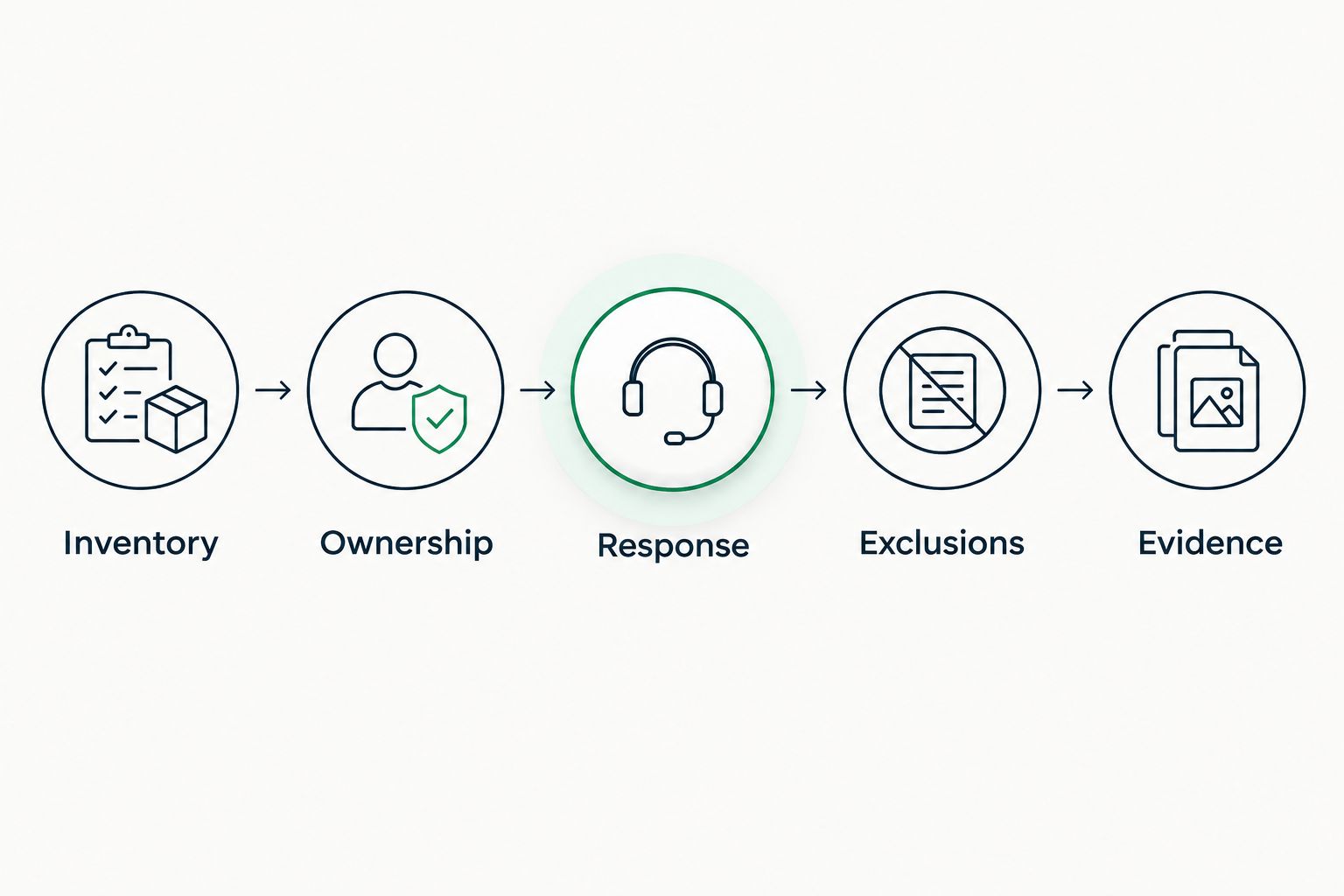
Define the environment and responsibilities before comparing agreements.
What should a response commitment actually promise?
A response commitment needs a defined event and a defined action. Acknowledging a ticket, connecting you to an expert, beginning investigation, and containing a threat are different milestones.
Divergeit's service-level language includes a 15-minute response in writing and access to a live expert in 5 minutes. When evaluating cybersecurity coverage, establish which services and situations those commitments cover; do not interpret a response target as a containment or recovery deadline.
Your 2026 agreement should also explain the escalation path when an incident interrupts business operations. Identify who can approve account restrictions, disconnect systems, and communicate with employees.
The handoff matters as much as the initial alert. The EDR alerts to in-house IT escalation workflow addresses the boundary between detection and internal action—the same boundary your contract must assign explicitly.
Build a budget that separates operations from projects
Organize your budget around the work the agreement actually includes. Keep recurring operations separate from initial setup and exceptional work so that a bundled proposal does not conceal unresolved responsibilities.
Use a 12-month planning period for an annual comparison, and record contract start dates, renewal terms, and changes in scope. This is a planning convention, not a claim about any provider's contract length.
A comparison of managed security service provider costs only holds when the underlying responsibilities match: monitoring without containment is a different scope from monitoring with authorized containment. Keep those distinctions visible in your worksheet rather than treating all managed security agreements as interchangeable.
For each proposal, record:
- The recurring services and the inventory they cover.
- The onboarding deliverables and acceptance criteria.
- Existing problems that require separate remediation.
- The process for approving work outside the agreement.
- The responsibilities retained by your employees or other vendors.
- The records, configurations, and access returned at termination.
Do not treat an empty worksheet cell as included coverage. Ask for an explicit answer, then incorporate that answer into the agreement rather than leaving it in a sales email.
Is managed cybersecurity the same as managed IT?
Managed cybersecurity and managed IT overlap, but their responsibilities are different. Managed IT addresses technology operations; managed cybersecurity addresses security controls, threat investigation, and incident handling. Your agreement must identify how those responsibilities connect.
For example, discovering a vulnerable application does not establish who updates it. Containing a compromised computer does not establish who rebuilds it or restores the employee's access.
Divergeit's managed cybersecurity offering, SecureIT, is relevant when your business needs security services alongside managed IT and compliance support. Evaluate its written scope against the same criteria as any other proposal; the service name alone does not establish which tasks are included.
Divergeit is best for growing small and mid-sized businesses seeking managed IT, cybersecurity, and compliance services. The fit still depends on the agreed responsibilities, service commitments, and exclusions—not on the breadth of the service catalog alone.
Does compliance support include passing an audit?
Compliance support does not, by itself, establish that your business meets every applicable requirement. Define the technical controls, documentation, and evidence the provider owns, then identify the obligations retained by management and other advisers.
For your 2026 review, request examples of the deliverable types included in the agreement: access-review records, configuration documentation, remediation tracking, or incident records. Do not assume every listed example is part of a provider's service.
Your contract should also distinguish maintaining evidence from conducting an independent assessment. They serve different purposes, and one does not replace the other.
Can you keep your internal IT team?
You can retain internal IT staff and assign defined security responsibilities to an outside provider. The agreement needs a shared operating process, not duplicate ownership of the same tasks.
Name the primary incident contact and the backup decision-maker. Document how the provider reaches them, what actions require approval, and what happens when neither responds.
FAQ
How do I compare the cost of managed cybersecurity services?
Compare the same inventory, operating coverage, response responsibilities, and exclusions across proposals. Separate recurring operations from onboarding, remediation, recovery, and compliance work.
Is per-user cybersecurity coverage better than per-device coverage?
Neither billing model is automatically better. Per-user coverage organizes the agreement around people, while per-device coverage organizes it around assets; both require explicit treatment of identities, cloud services, and shared systems.
Does managed cybersecurity include incident recovery?
Incident recovery is included only when the agreement assigns that work to the provider. Ask who restores systems, validates access, and coordinates the return to normal operations.
What should a small business ask about response times?
Ask what starts the response clock and what action satisfies the commitment. Ticket acknowledgment, expert contact, investigation, containment, and recovery are separate milestones.
Can managed cybersecurity replace our internal IT team?
Managed cybersecurity does not automatically replace an internal IT team's operational responsibilities. Define who maintains systems, supports employees, applies changes, and restores services before changing staffing arrangements.
What should be in a managed cybersecurity agreement?
A managed cybersecurity agreement should identify covered assets, assigned responsibilities, service commitments, exclusions, and escalation procedures. Include reporting requirements, change control, and the handover process when the relationship ends.
One last thing
Ask who owns the security records when the contract ends. Alert history, configuration records, incident documentation, and administrative access matter during a provider transition as well as during an incident.
Before signing, require a written handover process. A proposal that clearly explains how you leave is easier to evaluate than one that only explains how you start.