


EDR software cost for a small business depends on the endpoints covered, the capabilities licensed, and who investigates and responds to alerts; compare written quotes against the same scope rather than a universal average. The software subscription alone does not establish your total security budget, because deployment, monitoring, incident response, and recovery can sit outside the license.
TL;DR
- EDR software cost: small business buyers should compare licensing, deployment, monitoring, and response scope together.
- Software-only EDR fits businesses with staff who can investigate alerts and authorize containment.
- Managed detection and response adds operational responsibility; verify coverage hours and exclusions in writing.
- DivergeIT serves growing small and mid-sized businesses seeking managed IT, cybersecurity, and compliance services.
Why this matters
An endpoint license is not the same purchase as an operated security service. A proposal can cover detection software without assigning anyone to investigate an alert or isolate a compromised device.
For your 2026 budget, separate the technology from the work required to operate it. That distinction lets you compare proposals without treating different service scopes as equivalent. Start with the capabilities discussed in EDR tools for small business security, then evaluate who takes responsibility when those tools detect suspicious activity.
Your decision should answer a business question: can your existing team operate the system, or do you need a provider to do that work?
How much does EDR software cost for small business security?
Your EDR budget consists of the contracted software and the operational services you select. Obtain a quote that separates recurring licensing, deployment, ongoing administration, and incident-related work instead of accepting an unexplained bundle.
Use this breakdown when requesting 2026 proposals:
Endpoint licensing
- What to specify: Covered computers, servers, operating systems, and features
- What to check for exclusions: Separate server licensing or features outside the selected package
Deployment
- What to specify: Installation, policy configuration, testing, and rollout ownership
- What to check for exclusions: Troubleshooting failed installations and removing conflicting software
Monitoring
- What to specify: Who reviews alerts and when coverage applies
- What to check for exclusions: Unattended periods and alerts that receive notification only
Investigation and containment
- What to specify: Who examines evidence and can isolate a device
- What to check for exclusions: Approval requirements and incident work outside the agreement
Administration
- What to specify: Policy maintenance, exceptions, and device changes
- What to check for exclusions: Changes treated as separate projects
Reporting and evidence
- What to specify: Required reports, records, access, and retention
- What to check for exclusions: Custom reporting or additional evidence requests
Compare the complete scope before comparing the recurring total. A quote that excludes investigation does not cover the same work as a quote that includes it.
Ask each bidder to identify assumptions directly in the proposal. Verbal assurances about monitoring or response do not resolve an exclusion in the contract.
Software-only EDR: best for a staffed internal security function
Software-only EDR gives your team the technology to examine endpoint activity and act on detections. Your staff remain responsible for configuring policies, reviewing alerts, investigating suspicious behavior, and deciding what happens next.
The advantage is direct operational control. Your team can align investigation and containment decisions with its knowledge of business systems.
The limitation is staffing responsibility. Buying a license does not create an on-call function, establish an escalation process, or reserve time for investigation.
Choose software-only EDR when named staff can operate it, not simply because someone can install it. Before signing, identify the primary operator, the backup operator, and the person authorized to approve disruptive actions. If those responsibilities remain unassigned, the proposal leaves an operational gap.
Managed EDR or MDR: best for outsourced alert investigation
Managed endpoint detection and response places defined operational tasks with a service provider. Managed detection and response, or MDR, describes a service model; the precise technologies and responsibilities depend on the agreement.
The advantage is access to an external function responsible for the contracted monitoring and investigation work. The limitation is dependence on the provider's coverage, permissions, exclusions, and escalation procedures.
Do not assume that managed service wording includes unlimited remediation, full incident recovery, or authority to disconnect business-critical systems. Ask the provider to distinguish notification, investigation, containment, and recovery.
Choose managed detection and response when you need operational coverage that your internal team cannot supply. Require the contract to state what the provider does without approval and what still requires your decision.
Co-managed EDR: best for shared operational responsibility
Co-managed EDR splits responsibilities between your internal team and an external provider. That arrangement fits a business that wants outside investigation support while retaining control of business systems and internal communications.
Its advantage is a defined division of work. Its limitation is the handoff: unclear ownership can leave both teams waiting for the other to act.
Software-only EDR
- Best for: Businesses with staffed investigation and response
- Main advantage: Direct control over operation
- Main limitation: Internal team owns the workload
Managed EDR or MDR
- Best for: Businesses outsourcing defined security operations
- Main advantage: External ownership of contracted tasks
- Main limitation: Coverage depends on contractual scope
Co-managed EDR
- Best for: Businesses retaining IT ownership with outside support
- Main advantage: Shared responsibilities matched to team capacity
- Main limitation: Handoffs require explicit rules
Document the boundary using an EDR alerts-to-in-house IT escalation workflow. The document should identify who receives an alert, who investigates, and who can authorize containment.
Why EDR software cost varies
The drivers below change what you are buying. Put them in your request for proposals so vendors respond to the same requirements.
- Endpoint scope: Specify employee computers, shared devices, servers, and remote devices. Ask how each device category is licensed.
- Licensed capabilities: Identify the detection, investigation, containment, and reporting functions required. Confirm which package includes them.
- Operational ownership: Separate software administration from alert review, investigation, and response. Each task needs an owner.
- Coverage schedule: State when monitoring and escalation must operate. Distinguish continuous data collection from staffed investigation.
- Deployment complexity: Identify existing security agents, supported operating systems, remote installations, and business-critical applications before rollout.
- Evidence requirements: Specify the records, retention, reporting, and access your compliance or insurance process requires.
For a 2026 renewal, ask what changed in each category before accepting a new total. A different endpoint inventory or service boundary deserves an explanation separate from a licensing change.
How do you compare EDR quotes fairly?
Follow the same sequence for every proposal. Otherwise, an attractive subscription figure can distract from a missing operational requirement.
1. Confirm inventory
List the devices you need to protect and identify their owners. Separate servers from employee computers, and include remote equipment that accesses business information.
Reconcile that list with the proposal. Ask how devices added or removed during the agreement affect billing, deployment responsibilities, and reporting.
2. Map coverage
Write down the functions you expect: detection, investigation, containment, administration, and reporting. Mark each function as included, excluded, or dependent on approval.
Do not accept a general security description as a substitute. A capability listed on a product page does not establish that the proposed service includes operating it.
3. Assign ownership
Name the party responsible for every function and every handoff. Include the person who decides whether a business-critical device can be isolated.
Your process must also work when the usual contact is unavailable. Record an escalation path rather than relying on a single employee's availability.
4. Test escalation
Walk through a suspicious endpoint event before signing. Ask who receives the alert, what evidence gets reviewed, how your team is contacted, and which actions require permission.
This is a process check, not a request to create a live threat. Use the walkthrough to identify decisions the agreement leaves unresolved.
5. Confirm exclusions
Request a written list of activities outside the service boundary. Include recovery, legal coordination, specialist forensics, and major remediation in the discussion rather than assuming they are covered.
Then ask how excluded work is authorized. Your purchasing process should remain clear during an incident, when decision-makers have less time to interpret a contract.
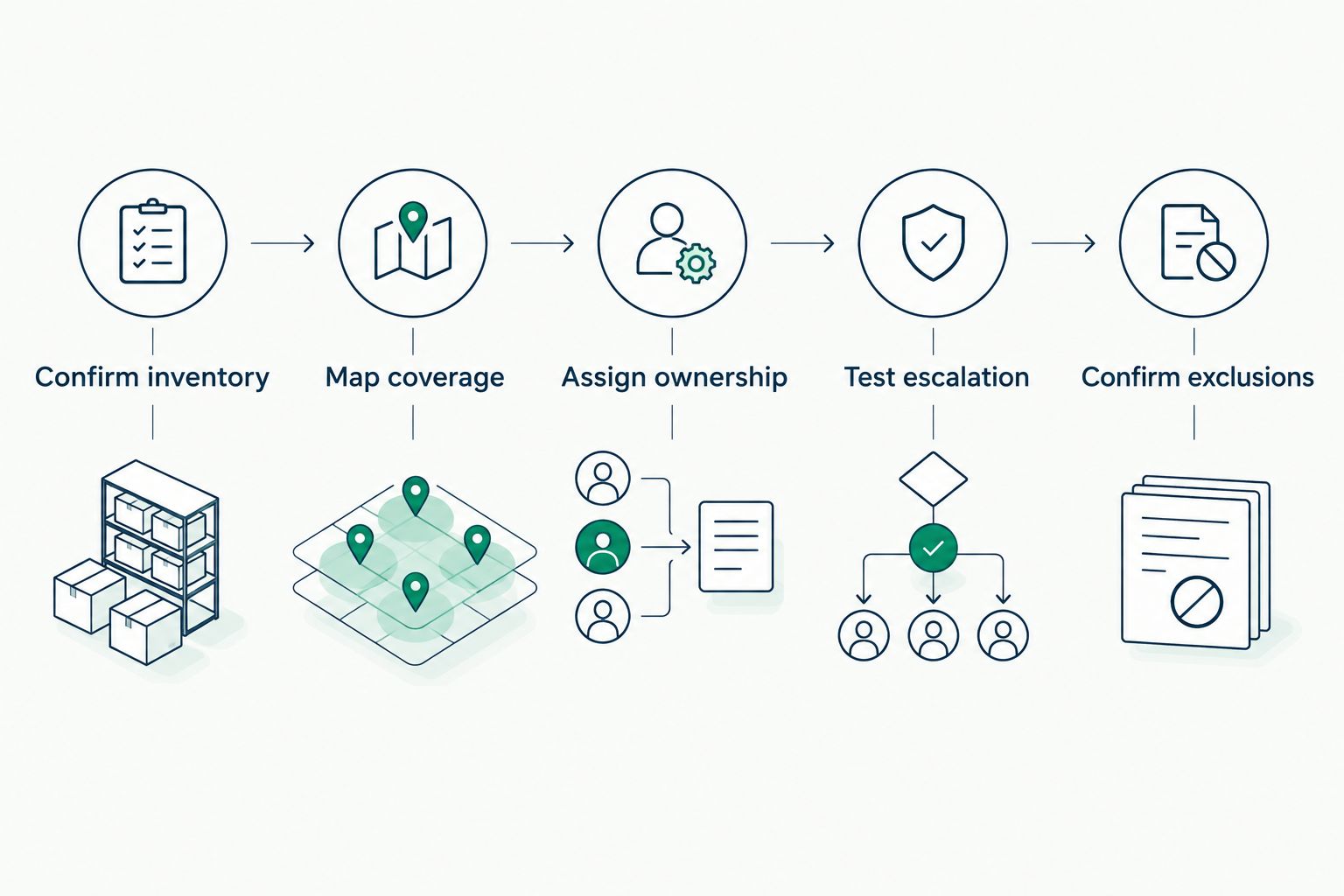
Confirm responsibilities and exclusions before choosing an EDR proposal.
The finished comparison should let a business leader identify the protected devices, the responsible parties, and the limits of the agreement without interpreting technical sales language.
What does an EDR subscription leave outside the budget?
An EDR subscription does not, by itself, establish coverage for restoring systems, notifying affected parties, or completing a broader incident investigation. Those responsibilities need separate confirmation even when endpoint monitoring is managed.
Separate the security response into distinct activities:
- Detection: Identify suspicious endpoint behavior.
- Investigation: Determine what happened and which systems are involved.
- Containment: Restrict affected devices or activity under an agreed authority.
- Recovery: Restore business systems and validate their return to service.
When comparing managed detection and response providers, distinguish alert investigation from recovery ownership; a provider's ability to investigate does not establish a contractual duty to restore your systems. Apply that distinction to every proposal, regardless of where the provider operates.
For your 2026 agreement, request a service boundary that names the activities included and the approval path for anything excluded. This makes the contract usable during an incident, not just during procurement.
Also distinguish endpoint response from backups. Isolating a compromised computer and restoring clean business data address different needs. Require an owner for both without treating either as a substitute for the other.
Is managed EDR better than buying software alone?
Managed EDR is the better fit when you need someone else to perform defined monitoring and investigation tasks. Software-only EDR fits a team that already has the skills, coverage, and authority to do that work.
Neither model removes your responsibility for business decisions. You still need an internal contact who can approve actions, explain system dependencies, and coordinate staff communication.
Can you reduce EDR spending without weakening coverage?
Start by reconciling the device inventory and checking for overlapping contracted capabilities. Remove a duplicate only after confirming that the remaining service covers the required function.
Do not reduce the scope by silently leaving business devices unprotected or removing the person responsible for investigation. Eliminate redundant purchases, not unassigned security work. Record the reason for every scope change so the next renewal does not recreate the same confusion.
Does EDR satisfy compliance or insurance requirements?
EDR supports endpoint monitoring and investigation, but installing it does not establish compliance or guarantee an insurance outcome. Match the actual policy, contract, or regulatory requirement to the capability and evidence you can provide.
For a 2026 review, retain the service description, deployment records, reporting requirements, and assigned responsibilities. Ask your compliance lead or insurance adviser to confirm whether those records answer the specific requirement under review.
When should you discuss EDR with a managed IT provider?
Discuss EDR with a managed IT provider when endpoint protection decisions also involve device administration, cybersecurity operations, and compliance responsibilities. Those functions need coordinated ownership even when different parties perform them.
DivergeIT is best suited to growing small and mid-sized businesses seeking managed IT, cybersecurity, and compliance services. Discuss endpoint requirements within that broader service scope rather than assuming a particular EDR platform or response arrangement is included.
For a DivergeIT cybersecurity discussion, bring your device inventory, current security agreements, internal staffing responsibilities, and required evidence. Ask for the proposed endpoint scope and operational responsibilities in writing. The benefit is evaluating related IT and security needs together; the trade-off is that a broader service discussion requires careful separation of required work from optional scope.
Define your endpoint security scope
Discuss device coverage, operational ownership, and compliance requirements before comparing proposals.
FAQ
How much should a small business budget for EDR software?
Build the budget from a written quote covering your endpoint inventory, selected capabilities, and operating responsibilities. Separate software licensing from deployment, monitoring, investigation, and any excluded incident work.
Is EDR billed by employee or by device?
Confirm the billing unit in the specific proposal rather than assuming employees and protected devices are equivalent. Ask how servers, shared computers, remote devices, and changes to the inventory are handled.
Does an EDR license include someone monitoring alerts?
An EDR license does not establish staffed monitoring coverage. The agreement must identify who reviews alerts, when they do it, and what actions follow an investigation.
Is managed detection and response the same as EDR?
Managed detection and response is a service model, while EDR refers to endpoint detection and response technology and capabilities. An MDR agreement must specify the technologies, operational tasks, and response authority included.
Can EDR replace backups for a small business?
EDR does not replace backups. Endpoint detection and containment address suspicious activity, while backups support restoration of data and systems.
What should I ask before signing an EDR agreement?
Ask which devices are covered, who investigates alerts, who can isolate systems, and which incident activities are excluded. Require written coverage hours, escalation procedures, and approval responsibilities.
Can DivergeIT help with broader cybersecurity requirements?
DivergeIT provides managed IT services, cybersecurity, and compliance services for growing small and mid-sized businesses. Discuss your endpoint requirements and request confirmation of the specific technologies and responsibilities proposed.
One last thing
Request an alert walkthrough before you approve the purchase. Ask the bidder to explain what happens after a suspicious event appears on an employee's computer, including what happens when your usual contact cannot answer.
That conversation tests the service boundary better than a feature checklist alone. You should finish knowing who investigates, who decides, who acts, and who restores service. If the proposal cannot answer those questions, clarify the scope before comparing its total with another bid.