


Strategic IT consulting is worth it for growing businesses when it turns expansion plans, security requirements, and technology spending into an executable roadmap. In 2026, the deciding caveat is implementation: advice alone does not resolve support tickets, change access permissions, or prove that recovery procedures work.
TL;DR
- Strategic IT consulting is worth it when business growth requires coordinated technology decisions, not just faster ticket resolution.
- DivergeIT serves growing small and mid-sized businesses needing managed IT, cybersecurity, and compliance services.
- Require a prioritized roadmap, accountable owners, and acceptance criteria before approving a consulting engagement.
- Choose consulting for planning gaps; choose operational support when daily execution is the immediate problem.
Is strategic IT consulting worth it for growing businesses?
Yes—when you face decisions that affect several business functions and nobody owns the technology consequences. Opening another office, changing critical applications, and tightening client-data controls require more than separate purchasing decisions.
Buy a decision-making process, not a presentation. The engagement should identify what needs to change, explain the trade-offs, and assign responsibility for delivery. If your immediate gap is shared responsibility with an existing IT team, compare that requirement with co-managed IT for an in-house team before choosing a consulting scope.
Use this comparison to match your 2026 requirement to the right engagement:
Strategic IT consulting
- Best for: Leadership teams facing connected technology decisions
- Main advantage: Connects business priorities to architecture, risk, and delivery
- Main limitation: Implementation requires an explicit scope and owner
Managed IT services
- Best for: Businesses needing ongoing IT operations
- Main advantage: Assigns responsibility for recurring support and administration
- Main limitation: Strategic planning must be defined rather than assumed
Co-managed IT services
- Best for: Businesses with an internal IT team and specific capacity gaps
- Main advantage: Shares work without replacing internal ownership
- Main limitation: Unclear boundaries create duplicated or missed tasks
Internal-led planning
- Best for: Businesses with available technical leadership
- Main advantage: Keeps decision authority and business context inside the company
- Main limitation: Planning competes with operational responsibilities
None replaces executive accountability. Your business still decides which risks to accept, which projects to approve, and which outcomes matter.
Why this matters
Growth changes the consequences of an IT decision. A workflow that depends on someone manually creating accounts becomes a management problem when hiring expands across departments or locations.
Your 2026 technology plan should connect those dependencies before individual teams commit to separate solutions. Consulting earns its place by making the choices explicit: what must happen first, what can wait, and what the business accepts by delaying it.
For a founder, the useful output is not a longer technical inventory. It is a clear answer to whether the current environment supports the next business move—and what must change if it does not.
When consulting is worth buying—and when to wait
Best for connected growth decisions
Strategic IT consulting fits when a business decision crosses systems, people, and controls. A new location, for example, creates questions about connectivity, identity, endpoint management, application access, and support responsibility.
The advantage is coordinated planning. The limitation is that coordination takes input from business owners as well as technical staff; an external adviser cannot decide your operating priorities without them.
Proceed when the engagement resolves a defined business decision and produces an actionable plan. Avoid a scope built only around discovering unspecified opportunities.
Best for execution gaps: operational support
If employees cannot get routine issues resolved, focus first on support ownership, escalation, and recurring administration. A roadmap does not substitute for someone handling those tasks.
Operational support addresses execution; its limitation is that resolving tickets does not automatically establish a business technology strategy. Ask separately who owns planning and how proposed changes reach leadership.
Choose operational support first when daily service failures are the immediate constraint. Add consulting when the underlying decisions extend beyond support delivery.
Best for a bounded decision: a focused assessment
A focused assessment fits when you need to answer a specific question, such as whether an application migration is ready to proceed. Define the decision, the systems involved, and the evidence required before work starts.
The advantage is a clear boundary. The limitation is that a narrow assessment does not establish a wider technology roadmap or ongoing operational ownership.
Use a focused scope when the question is narrow; do not purchase a business-wide strategy to answer a contained technical question.
What should a strategic IT consulting engagement deliver?
A useful engagement leaves behind documents your team can execute without depending on the original presenter. Ask for these deliverables in the statement of work, not after the assessment finishes.
- Business priorities. Record the growth plans, operating constraints, and leadership decisions the technology plan must support. Translate each priority into a requirement that someone can verify.
- Current-state evidence. Document relevant systems, ownership, dependencies, and known control gaps. Separate verified findings from assumptions that require further investigation.
- Decision options. Compare viable approaches, including keeping the current environment where appropriate. Explain operational advantages, limitations, and dependencies rather than declaring one option universally better.
- Delivery roadmap. Sequence approved changes, name accountable owners, and identify prerequisite work. Distinguish recommendations from work that the provider is contracted to perform.
- Acceptance checks. Define the evidence that demonstrates completion. A configured backup job and a documented recovery test answer different questions.
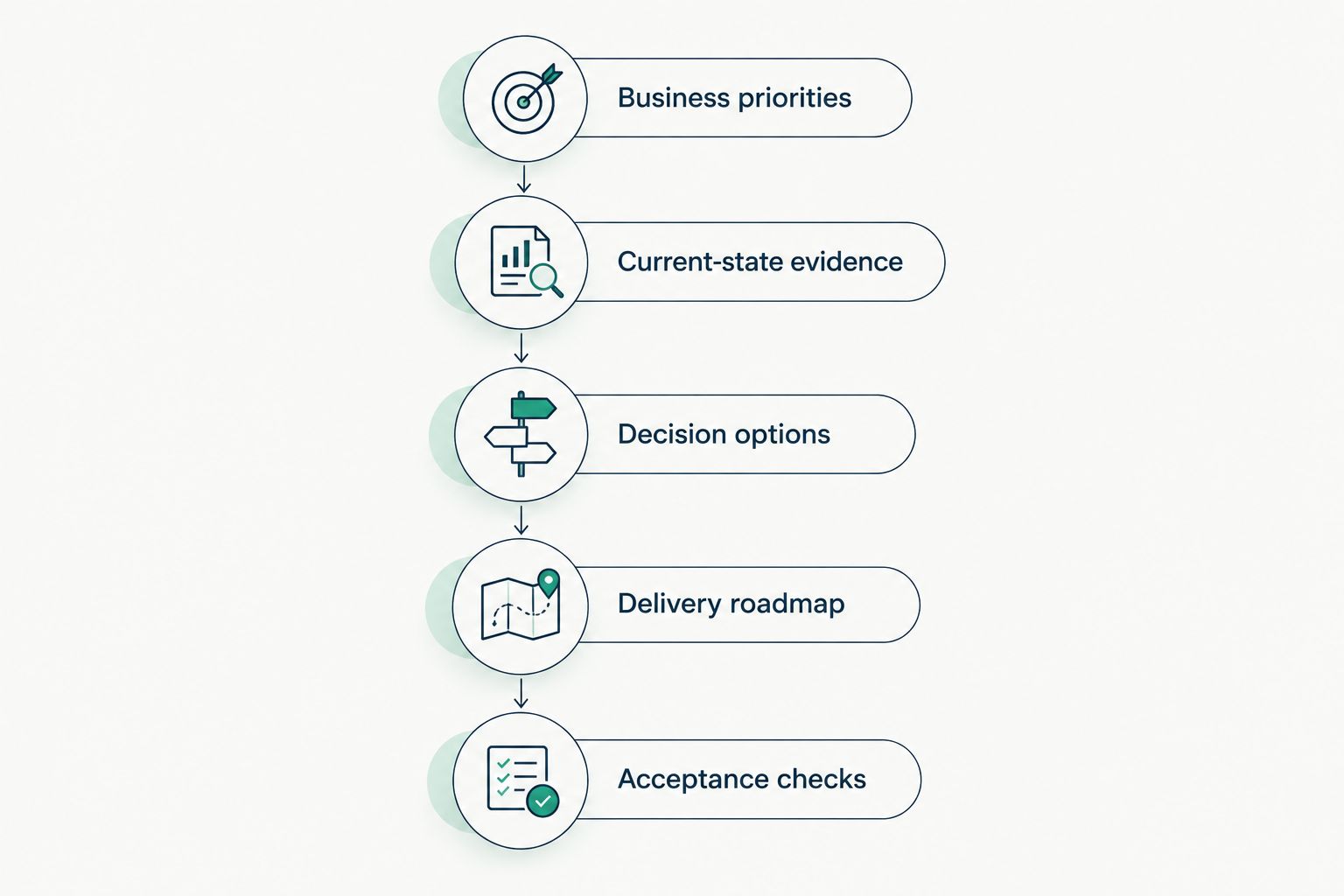
Each recommendation needs an owner and a way to verify completion.
These deliverables make proposals comparable. Without them, two providers can use the same consulting label while offering substantially different work.
Why the value of strategic IT consulting varies
The value depends on the decisions you need to make and your ability to act on the result. Assess these factors before approving the scope:
- Decision complexity. A change spanning identity, applications, and data needs coordination across those dependencies.
- Internal ownership. Name the person who can approve priorities and resolve disagreements between departments.
- Evidence quality. Incomplete inventories and undocumented access arrangements leave questions that discovery must resolve.
- Implementation responsibility. Establish whether delivery belongs to your team, the adviser, another provider, or a defined combination.
- Compliance requirements. Identify the obligations and contractual requirements that apply to your business rather than requesting generic compliance advice.
- Change capacity. Check whether staff can participate in discovery, testing, training, and handover alongside their regular work.
A detailed roadmap has limited operational value if nobody has authority or capacity to execute it. Resolve that ownership problem before expanding the assessment.
How should you evaluate a consulting proposal?
Ask each provider to work from the same business brief. Describe the decision, the affected operations, and the outcome leadership needs; do not start with a preferred product and ask for justification.
Require decision-ready findings
A finding should explain the condition, the business consequence, and the proposed response. A list of technical observations without priorities leaves you responsible for reconstructing the strategy.
Ask what evidence supports each recommendation. For your 2026 priorities, require the provider to distinguish urgent dependencies from improvements that can wait without blocking the business objective.
Separate advice from delivery
Identify who configures systems, manages migration work, communicates with employees, and verifies completion. Those responsibilities should appear in the agreement rather than remain implied by the word consulting.
Also ask how recommendations involving the provider's other services will be evaluated. You need a clear explanation of alternatives and selection criteria, not an assumption that every finding requires another service.
Define handover and access
Specify which diagrams, inventories, decision records, and operating instructions your business receives. Establish how administrative access and documentation transfer when an engagement ends.
Your company should retain the information needed to operate and change its environment. A strategy that cannot be handed over creates another dependency instead of clarifying ownership.
Keep cybersecurity governance inside the scope
A technology roadmap should identify who owns security decisions, not simply list security products. Business leadership must understand which risks remain, who accepts them, and which changes require approval.
When the gap is security leadership rather than general technology planning, the scope question becomes whether vCISO services for small businesses address the governance work you need. Keep that question separate from who monitors alerts, administers tools, or responds to incidents.
For healthcare, financial, and legal businesses, bring the relevant compliance and business owners into discovery. Ask the adviser to map proposed controls to your applicable requirements and identify where specialist legal or compliance review remains necessary.
Do not treat a consulting report as proof of compliance. Require evidence of the controls your organization actually operates, with responsibility for maintaining that evidence after the project ends.
Turn the roadmap into a measurable operating plan
Start with a 90-day implementation plan as a planning requirement, not a promise that every recommendation can be completed in that period. Put approved priorities, owners, dependencies, and acceptance checks in the same working document.
For longer-term decisions, request a 12-month roadmap that distinguishes committed projects from items awaiting approval. That separation prevents an exploratory recommendation from becoming an assumed delivery commitment.
Use a 30-day review cycle to examine completed work, unresolved decisions, and changes to business priorities. These are suggested planning intervals; adjust them to the project rather than treating them as service guarantees.
Track outcomes with records you already maintain. Examples include whether new employees receive approved access before starting work, whether recovery testing meets the business's stated requirements, and whether project owners complete agreed acceptance checks.
For the rest of 2026, keep the same outcome definitions unless leadership deliberately changes them. Changing the measurement every time a project slips makes progress harder to judge.
Where does DivergeIT fit?
DivergeIT is best for growing small and mid-sized businesses seeking managed IT, cybersecurity, and compliance services. Its stated service scope also includes consulting and covers businesses in finance, healthcare, legal, and entertainment.
Discuss strategic IT consulting through ConsultIT when the requirement is business technology planning. The relevant advantage is the stated breadth of services; the boundary to establish is which assessment, implementation, and ongoing operating responsibilities your agreement includes.
Ask DivergeIT to define deliverables, ownership, and acceptance criteria against your business brief. Do not assume that access to several service categories means every activity belongs in the same engagement.
You can discuss your consulting requirements once you have identified the decision, executive owner, and implementation constraints.
Can strategic IT consulting replace an internal IT leader?
Strategic IT consulting provides external planning and decision support; it does not remove the need for internal business authority. Someone inside your company must approve priorities, coordinate department owners, and accept operational trade-offs.
If an internal IT leader already owns those decisions, define the external role around specialist expertise or a bounded project. Avoid creating parallel decision channels with conflicting instructions.
How do you know when to stop a consulting engagement?
Stop or rescope the engagement when it no longer supports a defined decision or produces executable work. Additional discovery should answer a specific unresolved question, not indefinitely postpone recommendations.
Use acceptance criteria established at the start. Once the agreed findings, decisions, roadmap, and handover are complete, evaluate implementation or ongoing advisory work as a separate requirement.
FAQ
Is strategic IT consulting worth it for a small business?
Strategic IT consulting is worth it when a small business needs coordinated decisions about growth, systems, security, or implementation. For a contained support problem, a narrower operational engagement is the better starting point.
What's the difference between IT consulting and managed IT services?
IT consulting addresses defined planning and decision-making work, while managed IT services address agreed ongoing operations. Check the contract because neither label establishes the exact responsibilities included.
What should I receive from a strategic IT consultant?
You should receive business priorities, current-state evidence, decision options, a delivery roadmap, and acceptance checks. Each approved recommendation needs an accountable owner and a clear implementation boundary.
Can I use a consultant if I already have an IT team?
Yes, an external consultant can support an existing IT team with a defined planning question or specialist requirement. Keep internal decision authority and delivery responsibilities explicit.
Will IT consulting make my business compliant?
IT consulting alone does not establish compliance. Your organization must implement applicable controls, maintain evidence, and obtain appropriate specialist review where required.
Does DivergeIT offer services beyond IT consulting?
DivergeIT provides managed IT services, cybersecurity, and compliance services alongside consulting. Confirm which responsibilities and deliverables belong in your specific agreement.
One last thing
Before approving a consulting proposal, ask the provider to describe the decision you will be able to make when the work ends. If the answer names only a report, ask again.
The deliverable is not the decision. For your 2026 plan, require both: evidence that explains the choices and an accountable owner who can act on them.