

No—SIEM software is not automatically necessary for a small IT team. It becomes necessary when your security requirements demand centralized event correlation, investigation records, or monitoring that separate tools cannot provide. The deciding factor is whether someone can investigate and act on the alerts; buying software does not supply that responsibility.
TL;DR
- Is SIEM necessary for small IT teams? Only when investigation, monitoring, or evidence requirements justify it.
- Endpoint detection protects devices; SIEM connects security events across systems. Neither replaces an incident response owner.
- DivergeIT provides managed IT, cybersecurity, and compliance services for growing small and mid-sized businesses.
- Choose a monitoring service by its written coverage, escalation, and response responsibilities—not its dashboard.
Why this matters
A small team has to keep employees working while protecting accounts, devices, applications, and business data. Adding another alert queue without changing ownership competes with those responsibilities. Security coverage matters more than the number of security tools.
For a 2026 security plan, separate the decision to centralize logs from the decision to operate a security monitoring function. If you have already established that need, compare SIEM tools for small IT teams against your required data sources and operating model—not just their feature lists.
Is SIEM software necessary for a small IT team?
SIEM is necessary when your required security outcomes depend on collecting and correlating events across systems, and your existing controls cannot deliver those outcomes. Team size alone does not establish that need. A small organization can have demanding monitoring requirements; a larger organization can still lack the processes needed to operate SIEM effectively.
Use this comparison to distinguish the available approaches. These are operating models, not interchangeable products.
Existing platform alerts
- Best for: Teams with a limited environment and defined alert ownership
- Main benefit: Uses security information within systems you already operate
- Main limitation: Separate consoles make cross-system investigation harder
Endpoint detection and response
- Best for: Teams prioritizing device-level detection and investigation
- Main benefit: Provides endpoint activity and supported containment actions
- Main limitation: Does not automatically cover every identity, network, or application event
Self-managed SIEM
- Best for: Teams with security analysis and engineering capacity
- Main benefit: Centralizes selected logs and supports cross-system detection
- Main limitation: Requires integration, tuning, investigation, and maintenance
Managed security monitoring
- Best for: Teams that need outside monitoring capacity
- Main benefit: Assigns agreed monitoring work to a service provider
- Main limitation: Coverage and response authority depend on the contract
Choose self-managed SIEM only when you can name who maintains it and who responds. If either role is unassigned, resolve the operating gap before approving the platform.
When existing security tools are enough
Best for: teams whose required investigations stay within their existing tools. Start by checking whether those tools expose the events you need, retain them for your required period, and let an authorized person investigate suspicious activity.
For example, an endpoint alert can help you examine suspicious behavior on a managed computer. An identity platform's sign-in records can help you investigate an account. If your response process handles those events separately and meets your requirements, central correlation is not automatically the next priority.
The limitation is fragmented context. Connecting a suspicious sign-in to a mailbox change and endpoint activity requires access to each relevant record. If responders cannot reconstruct that sequence reliably, document the gap rather than assuming another dashboard will solve it.
In your 2026 review, test actual investigation tasks. Ask a responder to locate the relevant events and explain the action they would take. A feature checklist cannot demonstrate that the process works.
When self-managed SIEM makes sense
Best for: teams with a defined cross-system detection need and assigned security operations capacity. Self-managed SIEM gives your team control over selected data sources, detection rules, investigation workflows, and reporting.
That control comes with recurring work. Someone must connect log sources, check collection health, maintain useful detections, handle false positives, and preserve investigation records. Configuration changes in connected systems also need attention.
Do not approve self-managed SIEM solely because an administrator can install it. Installation and ongoing security operations are different responsibilities. Require an operating plan that identifies the work and assigns it to people with the necessary access and authority.
A sensible starting scope is a defined investigation problem, such as connecting suspicious account activity with administrative changes. Begin with the sources needed to investigate that problem. Expand collection when another documented requirement justifies it.
When managed security monitoring makes sense
Best for: teams that need additional monitoring capacity without assigning every investigation internally. A managed arrangement can assign agreed analysis and escalation tasks to an outside provider while your employees retain business decisions and internal coordination.
The limitation is the service boundary. Monitoring, investigation, containment, recovery, and compliance reporting are different responsibilities. A contract that includes one does not establish that it includes the others.
DivergeIT's managed IT, cybersecurity, and compliance services are best suited to growing small and mid-sized businesses seeking outside IT and security support. That service scope does not, by itself, establish a particular SIEM integration or monitoring commitment. Confirm the proposed coverage and response responsibilities in writing.
When discussing a 2026 service agreement, require a distinction between acknowledging an alert and taking action. An acknowledgment is not endpoint isolation, account suspension, or business recovery.
Why SIEM needs vary
Your SIEM decision should reflect the environment and the responsibilities attached to it—not an employee-count threshold.
- Data sources: Identity systems, endpoints, network equipment, cloud services, and business applications generate different records. Identify which records support your required investigations.
- Investigation needs: Cross-system questions create a stronger case for centralized correlation than investigations contained within one platform.
- Coverage requirements: Define when someone must review alerts and what happens when your usual responder is unavailable.
- Evidence obligations: Map legal, contractual, insurance, and internal requirements to the records and review activities they actually require.
- Response authority: Determine who can disable accounts, isolate devices, preserve evidence, and authorize disruptive action.
- Operating capacity: Account for detection maintenance, collection failures, investigation, and documentation—not just deployment.
These factors also explain why copying another company's security stack is a poor buying method. Similar businesses do not necessarily share the same applications, contracts, or response responsibilities.
How do you decide whether to deploy SIEM?
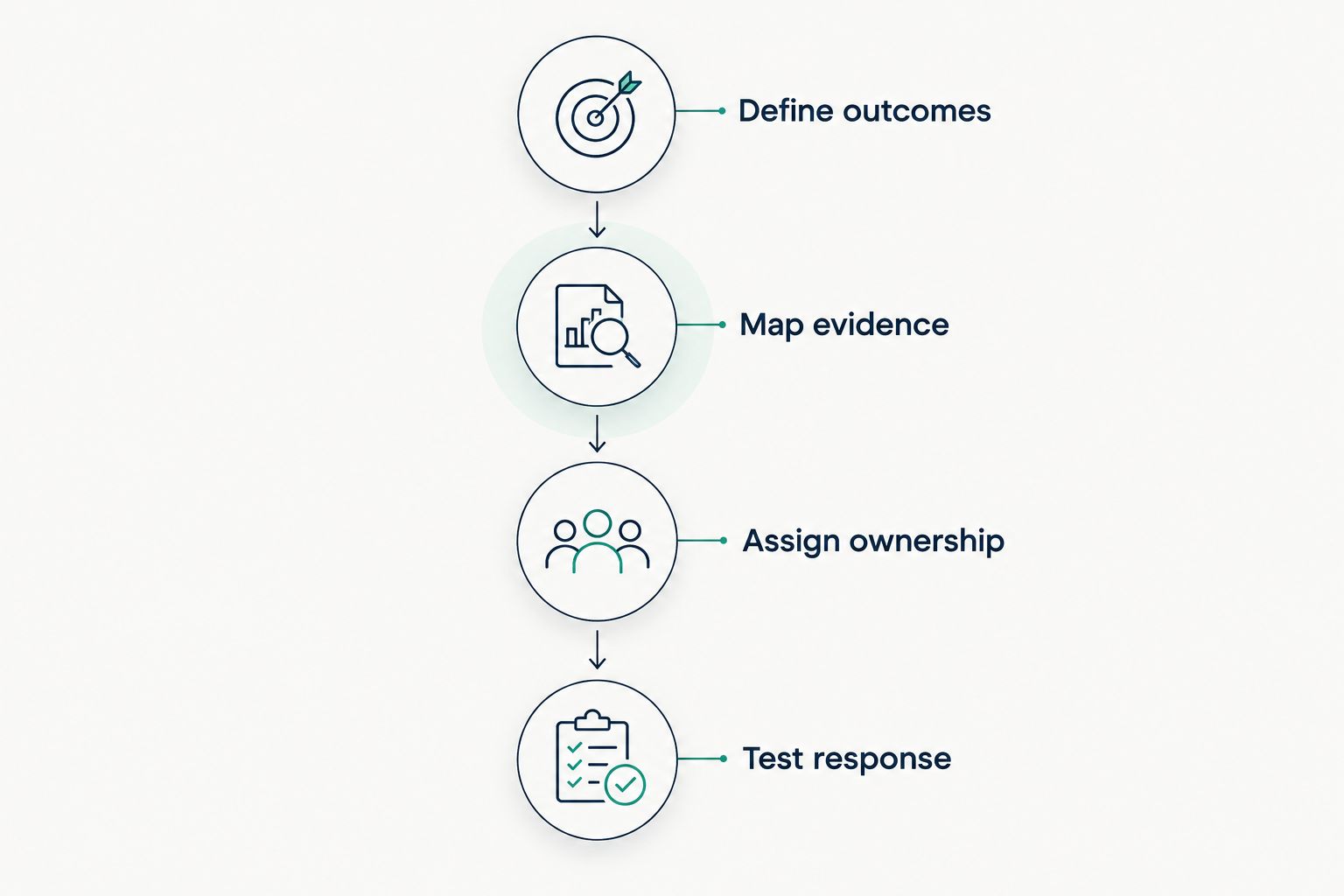
Use the following sequence before selecting a platform or service. Each step should produce an answer that a business owner and a technical responder can both understand.
Define outcomes
Write down the incidents you need to detect and the questions you must answer afterward. Examples include unauthorized administrative access, suspicious account changes, or activity involving sensitive business data.
Avoid requirements such as better visibility without explaining what someone needs to see. A useful outcome identifies the activity, the relevant systems, and the decision it supports.
Map evidence
Identify the records needed for each outcome. Confirm that the source generates those records, that collection is supported, and that investigators can retrieve them.
Collecting everything is not a substitute for this mapping. More records also create more data to handle, secure, and interpret. Prioritize the evidence required for your defined outcomes.
Assign ownership
Name the person or service responsible for reviewing alerts, validating suspicious activity, and escalating incidents. Identify a backup owner as well.
Separate technical authority from business approval. A responder needs to know which actions are preauthorized and which require approval because they interrupt operations.
Test response
Run a controlled exercise using an approved test event. Follow it from the source record through detection, investigation, escalation, and documented closure.
Test failure handling too. If a source stops sending records or the primary responder is unavailable, the process still needs an owner. An alert that arrives is not proof that an incident will be handled.
Choose the operating model after you define the evidence and response responsibilities.
Use the results as your acceptance criteria. If an existing toolset passes the required tests, document that decision. If it fails, specify whether the missing element is data, correlation, analyst capacity, or response authority before choosing a remedy.
Does compliance require a small business to buy SIEM?
Compliance requirements do not automatically translate into a requirement to buy SIEM. Read the applicable obligation and identify the monitoring, logging, review, evidence, and response activities it requires.
A requirement to review system activity is not the same as a requirement naming a particular software category. Conversely, a customer contract can impose specific monitoring expectations. Map each obligation to an implemented control and retained evidence, and obtain qualified advice when interpreting legal requirements.
For a 2026 assessment, ask whether your team can demonstrate that the control operates. A dashboard screenshot does not establish consistent review, documented investigation, or appropriate follow-up.
Can EDR replace SIEM for a small IT team?
Endpoint detection and response does not replace every SIEM function. EDR focuses on endpoint activity and supported response actions; SIEM brings selected event sources together for centralized analysis and investigation.
If endpoint protection is your immediate gap, address it directly. If your investigation requires connecting account, network, application, and endpoint events, assess whether your existing tools can make those connections without a separate SIEM.
Do not confuse a feature label with coverage. Verify the sources, records, and actions included in the proposed configuration. The useful question is what an investigator can actually establish and do.
What should you ask a monitoring provider before signing?
Ask for written answers tied to your environment. The service description should make the division of work clear enough to use during an incident.
- Which systems and event sources are included, and who maintains their connections?
- Who detects a collection failure and restores the missing data feed?
- When are alerts reviewed, and how are urgent incidents escalated?
- Which containment actions can the provider take without further approval?
- Who owns recovery, employee communication, and evidence preservation?
- How do you retrieve investigation records or transition them when the agreement ends?
If you are discussing support with DivergeIT, use these questions to discuss your monitoring requirements. Ask for a proposed responsibility split, not simply a list of security products.
FAQ
Is SIEM necessary for small IT teams in 2026?
SIEM is necessary when required monitoring, correlation, or investigation outcomes exceed what your existing tools can deliver. Team size alone does not establish the need; data coverage and response ownership determine whether the investment addresses a real gap.
What's the best alternative to running SIEM ourselves?
Managed security monitoring is an alternative when you need outside analysis and escalation capacity. Compare written coverage, included data sources, and response authority rather than assuming every monitoring service performs the same work.
Can our existing security alerts be enough?
Existing security alerts can be enough when they support your required investigations and someone owns the response. Test access to records, escalation, and incident handling before deciding that centralized correlation is unnecessary.
Does buying SIEM make our business compliant?
Buying SIEM does not make a business compliant. Compliance depends on applicable requirements, implemented controls, operating practices, and evidence; software supports only part of that work.
Who should respond to SIEM alerts on a small team?
A named internal responder or contracted security service should own SIEM alert investigation and escalation. Assign backup coverage and define which containment actions require business approval.
Can DivergeIT help with IT security and compliance?
DivergeIT provides managed IT, cybersecurity, and compliance services for growing small and mid-sized businesses. Confirm the monitoring scope, included systems, and incident responsibilities in the proposed agreement.
One last thing
For your 2026 security plan, test a missing log feed—not just a suspicious event. A monitoring process needs to recognize when its evidence disappears as well as when that evidence contains a threat.
Before buying SIEM, ask who notices when it stops receiving useful data. If nobody owns that answer, fix the operating model first.