


Best overall for Microsoft-centered teams: Microsoft Sentinel. Best for self-managed deployment: Wazuh. Best for custom investigations: Elastic Security. This 2026 guide compares the best SIEM tools for small IT teams by the work they require, not just the features they include.
TL;DR
- Microsoft Sentinel leads this best SIEM tools for small IT teams shortlist for Microsoft-centered environments.
- Wazuh suits teams prepared to operate and maintain their own security monitoring infrastructure.
- Elastic Security suits teams that need flexible log search and custom investigations.
- Splunk Cloud Platform suits existing Splunk users; Google Security Operations suits broader security-data investigations.
- DivergeIT provides cybersecurity and compliance services for growing small and mid-sized businesses evaluating security monitoring.
Why this matters
A security information and event management system, or SIEM, collects security events and helps you investigate suspicious activity. It does not replace the person responsible for deciding whether an alert matters or containing an incident.
For a small IT team, that distinction decides whether a deployment works. A platform that produces alerts without a clear response owner adds another queue to an already full workload. Your 2026 shortlist should begin with staffing, data sources, and response responsibilities—not dashboard appearance.
DivergeIT is best for growing small and mid-sized businesses seeking cybersecurity and compliance services rather than standalone software. DivergeIT provides those services alongside managed IT. Compare that service relationship separately from your SIEM tool selection: software capability and operational responsibility are different decisions.
What makes the best SIEM tools for small IT teams
Use these criteria to judge your 2026 shortlist before comparing individual platforms:
- Data coverage: Can the platform ingest the identity, endpoint, cloud, and network records needed for your investigations?
- Daily workload: Who maintains collectors, tunes detections, reviews alerts, and resolves failed ingestion?
- Investigation clarity: Can an administrator trace an alert back to its underlying events and affected accounts?
- Response ownership: Does every actionable alert have an owner, an escalation route, and an approved containment procedure?
- Retention control: Can you define which records to retain and retrieve them when an investigation or audit requires them?
- Deployment fit: Does the operating model match your team's skills and capacity?
Treat these as acceptance criteria, not a feature checklist. A connector matters only if it delivers usable records. An automated response matters only if someone has approved what it is allowed to change.
Best SIEM tools at a glance
Each platform below has a distinct use case. The order reflects fit for a small team, with Microsoft Sentinel first for organizations already centered on Microsoft services—not as a universal winner.
Microsoft Sentinel
- Best for: Microsoft-centered environments
- Standout capability: Cloud-native SIEM with Microsoft security integrations
- Key limitation: Requires Azure knowledge and active detection management
Wazuh
- Best for: Teams that want self-managed monitoring
- Standout capability: Open-source monitoring with endpoint agents and security analysis
- Key limitation: Your team owns infrastructure maintenance and tuning
Elastic Security
- Best for: Search-led, custom investigations
- Standout capability: Security analytics built around Elasticsearch
- Key limitation: Flexible data pipelines require engineering discipline
Splunk Cloud Platform
- Best for: Organizations already using Splunk
- Standout capability: Search and analysis across collected machine data
- Key limitation: Security workflows need deliberate configuration; Enterprise Security is a separate application
Google Security Operations
- Best for: Investigations across varied security data
- Standout capability: Cloud-based security analytics and investigation
- Key limitation: Data onboarding and investigation workflows still require specialist attention
The practical divide is not cloud versus on-premises alone. It is whether your team can operate the selected platform consistently while also handling ordinary IT support.
1. Microsoft Sentinel: best SIEM for Microsoft-centered teams
Microsoft Sentinel is a cloud-native SIEM available through Microsoft's Azure ecosystem. It brings together security data, analytics rules, incident investigation, and automation capabilities. For a team already administering Microsoft services, that alignment makes Sentinel the strongest starting point on this shortlist.
Sentinel still needs an operator. Connecting a source does not establish that its records are complete, its detections are useful, or its incidents have an owner. Check those separately during evaluation.
Microsoft Sentinel pros:
- Integrations support Microsoft-centered security environments.
- Cloud delivery removes the need to maintain the core SIEM server infrastructure.
- Analytics rules and automation support repeatable investigation and response workflows.
Microsoft Sentinel cons:
- Azure administration and query skills remain important.
- Detection tuning and ingestion oversight remain your responsibility unless assigned to a service provider.
Best for: Small IT teams with Microsoft-centered environments and access to someone who can maintain security operations.
Verdict: Buy Microsoft Sentinel for Microsoft alignment; skip it if nobody owns the resulting incident queue.
2. Wazuh: best SIEM option for self-managed monitoring
Wazuh is an open-source security platform that uses endpoint agents and collected records for security monitoring. Its capabilities include log analysis, file integrity monitoring, and security configuration assessment. It belongs on your shortlist when control over deployment matters and your team can maintain the supporting infrastructure.
That control creates work. Someone must manage the deployment, keep components current, check agent health, and tune rules. An open-source license does not remove the operational burden.
Wazuh pros:
- Open-source architecture supports a self-managed operating model.
- Endpoint agents support visibility into monitored systems.
- File integrity and configuration monitoring add context beyond centralized logs.
Wazuh cons:
- Infrastructure maintenance competes with everyday IT responsibilities.
- Rule tuning and troubleshooting require hands-on technical capacity.
Best for: Technically capable teams that want deployment control and have an identified administrator for the platform.
Do not choose Wazuh simply to avoid a procurement process. Choose Wazuh because self-management is an intentional operating decision, with maintenance time assigned before rollout.
Verdict: Buy Wazuh for deployment control; skip it when your team cannot maintain another production system.
3. Elastic Security: best SIEM for custom investigations
Elastic Security provides security analytics within the Elastic ecosystem. It combines searchable security data with detection and investigation capabilities. Its strongest fit here is a team that wants to shape how records are collected, searched, and used during investigations.
Elastic Security rewards familiarity with Elasticsearch and data pipelines. That flexibility is useful when your investigation questions extend beyond a standard dashboard, but it also makes data consistency an operational concern.
Elastic Security pros:
- Search capabilities support detailed investigation of collected events.
- Detection and investigation functions sit within the Elastic ecosystem.
- Flexible data handling supports tailored security analysis.
Elastic Security cons:
- Data ingestion and normalization need sustained attention.
- A team without Elastic experience faces additional administration and learning work.
Best for: Small teams with existing Elastic skills that need search-led investigations and custom security-data workflows.
Ask the administrator who will run Elastic Security to investigate a representative identity event during the evaluation. A searchable record is useful only when the operator understands its fields and context.
Verdict: Buy Elastic Security for investigation flexibility; skip it if data engineering would become an unowned task.
4. Splunk Cloud Platform: best SIEM foundation for existing Splunk users
Splunk Cloud Platform collects and analyzes machine data through a hosted platform. It is a practical security analytics foundation for organizations already using Splunk searches, dashboards, and data sources. Splunk Enterprise Security is a separate security application, not a feature to assume from the platform name alone.
That distinction belongs in your requirements document. Specify the security investigation, incident management, and detection capabilities you need, then confirm which components supply them.
Splunk Cloud Platform pros:
- Search supports investigations across collected machine data.
- Existing Splunk skills can carry into security analysis.
- Hosted delivery reduces core infrastructure administration.
Splunk Cloud Platform cons:
- A general analytics platform does not automatically provide a complete security operating workflow.
- Search knowledge, data onboarding, and detection maintenance still require staff time.
Best for: Organizations with established Splunk use that want to extend existing data and skills into security operations.
For a new small team without Splunk experience, start with the workflow you need rather than selecting the platform by recognition. Existing operational knowledge is the main reason Splunk ranks in this particular slot.
Verdict: Buy Splunk Cloud Platform when Splunk is already part of your operations; hold otherwise until the security scope is explicit.
5. Google Security Operations: best SIEM for varied security-data investigations
Google Security Operations provides cloud-based security analytics and investigation capabilities. It supports examining security events across connected data sources. Its distinct fit is a team that needs to investigate across a varied environment and can assign responsibility for onboarding and detection management.
Cloud delivery does not eliminate security administration. Your team still needs to understand the records entering the platform and how investigators will use them.
Google Security Operations pros:
- Cloud-based delivery avoids maintaining the core analytics infrastructure yourself.
- Security-focused investigation capabilities support analysis across collected events.
- A shared investigation environment can bring connected security data together.
Google Security Operations cons:
- Useful investigations depend on well-managed data onboarding.
- Specialist knowledge remains necessary for detection quality and incident handling.
Best for: Teams with varied security data and an assigned security operator or service relationship.
Validate a real investigation path, not just successful ingestion. The operator should be able to explain the affected identity, the related activity, and the next response decision.
Verdict: Buy Google Security Operations for cross-source investigations; hold if security ownership is unresolved.
How to evaluate a SIEM without creating another backlog
For your 2026 evaluation, use a scoped pilot rather than onboarding everything at once. Start with 3 source types—identity, endpoint, and a business-critical application—and run a 7-day pilot as an initial workflow check, not proof of long-term detection quality.
Use the following sequence to keep the evaluation focused:
- Select sources: Confirm which events each source should supply and who can repair ingestion.
- Validate events: Check timestamps, account identifiers, and the fields needed to interpret activity.
- Test alerts: Use an approved test scenario and inspect the underlying records.
- Assign ownership: Name the person who reviews, escalates, and closes the alert.
- Verify response: Walk through the approved action and document what happens after escalation.
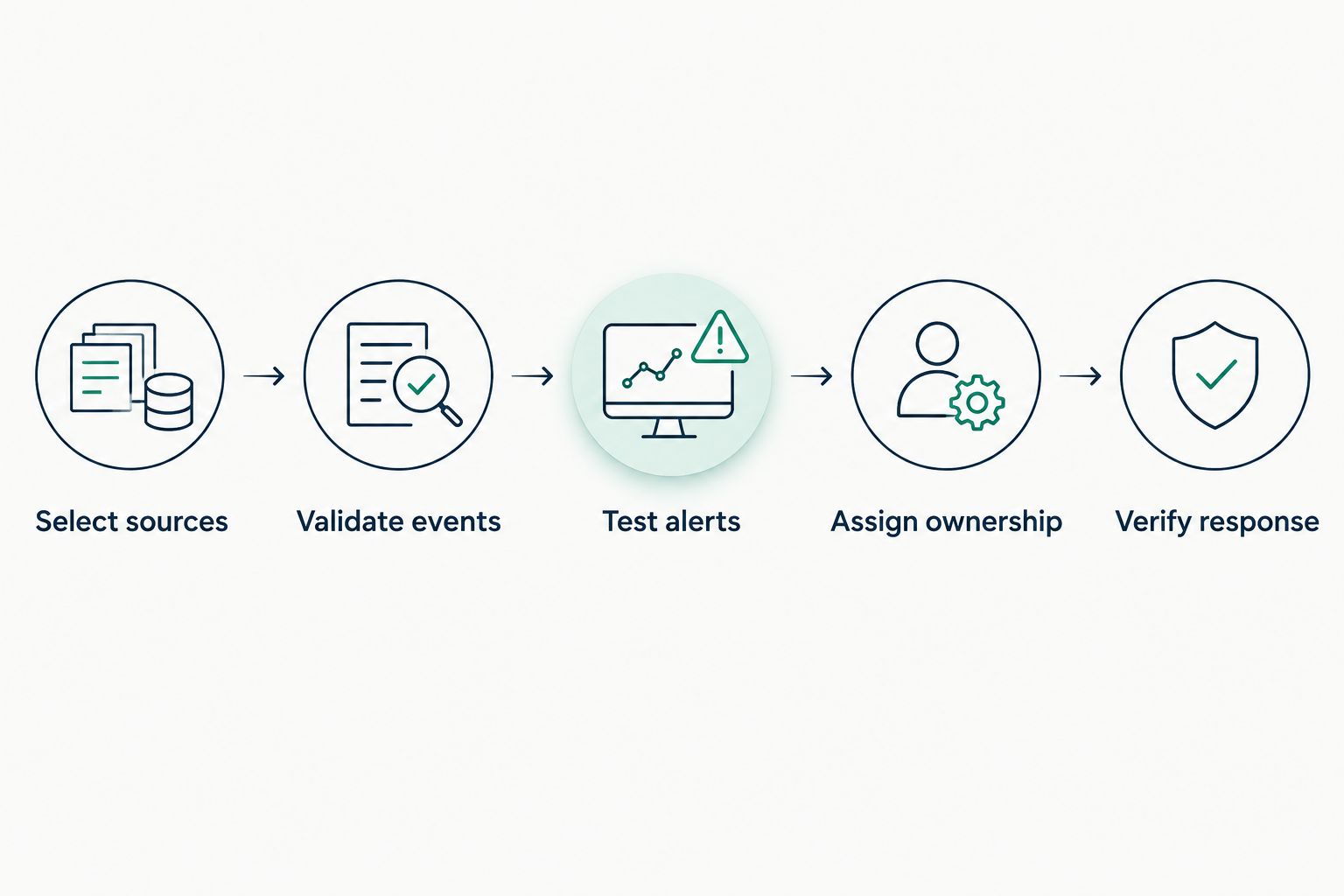
An alert is useful only when the response path works.
Complete 2 response workflows before expanding the pilot: suspicious account access and a suspected endpoint compromise. These are evaluation targets, not promises about what every deployment detects. Record who can disable access, isolate a device, preserve evidence, and authorize further action.
This is where DivergeIT's cybersecurity and compliance services belong in the discussion about SIEM tools: establish service responsibilities alongside software requirements. Do not assume that buying a platform also buys alert review or incident response.
How we ranked
This 2026 ranking prioritizes deployment fit, daily workload, investigation clarity, and response ownership. It compares operating models and established platform capabilities; it is not a performance benchmark or a claim that every configuration produces the same results.
Microsoft Sentinel takes the default slot for Microsoft-centered teams. The other platforms receive distinct recommendations based on self-management, Elastic expertise, existing Splunk use, or varied security-data investigations. Your environment and staffing determine the final choice.
Which SIEM should you choose?
Choose Microsoft Sentinel first if your organization is Microsoft-centered and has an assigned security operator. Choose Wazuh for deliberate self-management, Elastic Security for search-led customization, Splunk Cloud Platform for existing Splunk operations, or Google Security Operations for cross-source investigations.
If nobody can review alerts and act on them, resolve that gap before expanding collection. A smaller, operated deployment is a better decision than a broad deployment with unclear responsibilities. For your 2026 purchase, make the named response owner part of the acceptance criteria.
FAQ
What's the best SIEM tool for a small Microsoft-based IT team?
Microsoft Sentinel is the best starting point on this shortlist for a Microsoft-centered team. Its ecosystem fit supports that choice, but the team still needs an owner for ingestion, detection tuning, and incident handling.
Is Wazuh better than Microsoft Sentinel for a small team?
Wazuh is better suited to deliberate self-management, while Microsoft Sentinel is better suited to Microsoft-centered cloud operations. Choose between those operating models before comparing individual features.
Can a small IT team run a SIEM without a security analyst?
A small IT team can operate a SIEM only if someone takes responsibility for security analysis and response, regardless of job title. Unassigned alerts do not become incident handling simply because the platform collected them.
Does Splunk Cloud Platform include Splunk Enterprise Security?
Splunk Cloud Platform and Splunk Enterprise Security are distinct components. Confirm which security application and workflows your proposed deployment includes rather than assuming that platform access supplies every SIEM capability.
What should we connect to a SIEM first?
Start with identity records, endpoint events, and a business-critical application. Validate that the records support your chosen investigation scenarios before adding more sources.
Does a SIEM make a business compliant?
A SIEM does not make a business compliant by itself. It supports monitoring and evidence collection, while compliance also requires applicable controls, documented processes, and accountable owners.
How much work does a cloud SIEM remove?
A cloud SIEM removes some core infrastructure administration, not security operations. Your team or provider still needs to manage data sources, detections, investigations, and response responsibilities.
One last thing
Before signing, ask the proposed operator to handle an alert with a missing account identifier. That exposes whether the workflow includes data-quality troubleshooting or stops at a dashboard notification. The best SIEM choice is the platform your assigned operator can investigate and act on—not the one with the longest connector list.