


Outsourcing IT help desk support is cheaper only when the provider’s complete scope costs less than staffing and operating an equivalent internal service. For your 2026 decision, compare the same support hours, responsibilities, and escalation coverage—not a provider proposal against salary alone. Include onboarding, excluded work, and the internal time you still need to manage the relationship.
TL;DR
- To outsource IT helpdesk support, compare total operating costs and service commitments—not salary against a proposal.
- DivergeIT managed IT services fit growing small and mid-sized businesses seeking IT, cybersecurity, and compliance support.
- In-house staffing suits work requiring continuous onsite access and deep knowledge of internal systems.
- Co-managed IT keeps internal ownership while assigning defined support responsibilities to an outside provider.
Is outsourcing IT help desk cheaper than hiring in-house staff?
The cheaper model is the one that delivers your required service at the lower complete cost. Outsourcing does not automatically win, and hiring does not automatically buy better coverage. Build a like-for-like comparison before choosing either.
Start with this guide to outsourcing IT help desk support costs, then request a proposal against your actual requirements. A useful comparison separates employee support from cybersecurity, compliance work, infrastructure projects, and onsite assistance.
Outsourced help desk
- Best for: Businesses seeking external ownership of defined support tasks
- Main advantage: Assigns agreed support responsibilities to a provider
- Main drawback: Exclusions and escalation boundaries need close review
- What to include in the comparison: Recurring service, onboarding, excluded work, and internal oversight
In-house help desk
- Best for: Businesses needing continuous onsite involvement and internal systems knowledge
- Main advantage: Keeps support priorities and day-to-day direction inside the business
- Main drawback: Requires recruiting, management, and absence coverage
- What to include in the comparison: Compensation, employment costs, tools, training, and backup coverage
Co-managed help desk
- Best for: Businesses retaining an internal IT owner while delegating selected support
- Main advantage: Divides work without transferring every IT responsibility
- Main drawback: Unclear ownership creates handoffs and duplicated effort
- What to include in the comparison: Retained staffing, provider scope, shared tools, and coordination
Do not count services you will not use as savings. Equally, do not label an outsourced proposal expensive because it includes responsibilities missing from the internal staffing plan.
Why this matters
An incomplete comparison turns a staffing decision into a service gap. A provider can appear cheaper because onsite work is excluded; an internal hire can appear cheaper because nobody has budgeted for leave coverage or specialist escalation.
Your 2026 business case should answer a practical question: Who owns each support obligation when the primary technician is unavailable? Document the answer before approving the operating model. Coverage that exists only through informal favors is not a dependable staffing plan.
Outsourced help desk: best for defined service ownership
Outsourcing is a practical option when you want another organization to own a clearly documented support queue. Specify supported users, devices, applications, locations, and operating hours so the provider can quote the work you actually need.
The advantage is contractual clarity when the agreement names those responsibilities. The limitation is equally concrete: anything outside the agreement needs a separate owner, whether that is your employee, another supplier, or the provider under additional terms.
Ask these questions before accepting the scope:
- Which requests belong in the help desk queue?
- Who handles a ticket that requires an application vendor?
- What requires onsite attendance rather than remote support?
- Who approves account access and sensitive changes?
- What work falls outside the recurring agreement?
Choose outsourced support when the written scope covers your operating needs and the complete comparison favors it. Do not treat a broad service label as evidence that every IT task is included.
In-house help desk: best for continuous internal involvement
An internal employee works within your management structure and can build detailed knowledge of your processes. That matters when support requires physical access, close coordination with employees, or frequent decisions about business-specific systems.
The trade-off is responsibility. Your business must recruit, supervise, train, equip, and provide backup for that employee. A staffing plan also needs an escalation route for work outside the employee’s expertise.
Separate help desk duties from the rest of the role. If the proposed hire will also manage infrastructure, administer business applications, and support security work, compare those responsibilities against an equivalent external scope—not a basic help desk agreement.
Choose internal staffing when direct involvement is essential and you can support the full role. Hiring a technician does not remove the need for service ownership, documentation, or coverage planning.
Co-managed help desk: best for retaining an internal owner
Co-managed support divides responsibilities between your employees and an outside provider. You can retain business priorities, access approvals, and application knowledge internally while assigning a defined support workload externally.
The benefit is selective delegation. The drawback is coordination: a ticket can stall when each side assumes the other owns the next action. Avoid overlapping queues without a named escalation owner.
Write the division of work in plain language. Identify who receives requests, who works them, who authorizes changes, and who communicates with the affected employee.
Choose co-managed support when your internal team needs a defined extension, not an unclear replacement. Keep both parties accountable to the same service map.
Why the cost comparison varies
These factors determine whether the proposals represent the same service. For a 2026 review, resolve each item before deciding which model is cheaper.
- Coverage hours: Business-hours support and after-hours support are different obligations. Define when employees need assistance and how urgent requests enter the queue.
- Supported scope: List users, devices, locations, and business applications. Record who handles systems that the primary support team does not administer.
- Onsite requirements: Identify work that requires physical access. Specify who attends, who authorizes the visit, and whether the agreement includes that work.
- Security responsibilities: Separate routine support from security monitoring, incident response, and compliance evidence. Assign an owner to each responsibility instead of assuming the help desk includes it.
- Transition work: Document access transfer, knowledge capture, tool changes, and employee communication. Include the internal effort needed to complete the transition.
- Retained management: Outsourcing still requires business decisions and approvals. Identify who manages the provider, reviews service performance, and resolves responsibility disputes.
How do you build a fair comparison?
Use a 12-month comparison period for the decision worksheet. This is a planning recommendation, not a savings estimate: it keeps recurring obligations and transition work in the same review.
Define the scope
Write down the service employees need before comparing delivery models. Use actual support records where available, and separate recurring requests from exceptional projects.
Include account administration, device support, application troubleshooting, employee onboarding, and offboarding only where they belong in your requirements. The objective is a shared scope, not the longest possible task list.
Map the responsibilities
Assign an owner to each task under every model. A task that disappears from the worksheet has not disappeared from the business.
Include the people who approve permissions, coordinate vendors, authorize changes, and communicate during outages. These responsibilities remain important even when another party handles technical troubleshooting.
Compare the costs
For internal staffing, include compensation, applicable employer costs, recruitment, tools, training, management, and backup coverage. For outsourcing, include the proposed service, transition work, exclusions, and retained internal effort.
Use your actual employment inputs and the provider’s written terms. Do not substitute an unsourced salary benchmark or assume that all providers include the same services.
Verify the commitments
Request written definitions for response, escalation, resolution targets, and communication. Check how the agreement handles urgent requests, excluded systems, and work that depends on another vendor.
Assign ownership
Name the business owner responsible for reviewing the arrangement. Record how you will assess unresolved tickets, recurring problems, and services that no longer match your needs.
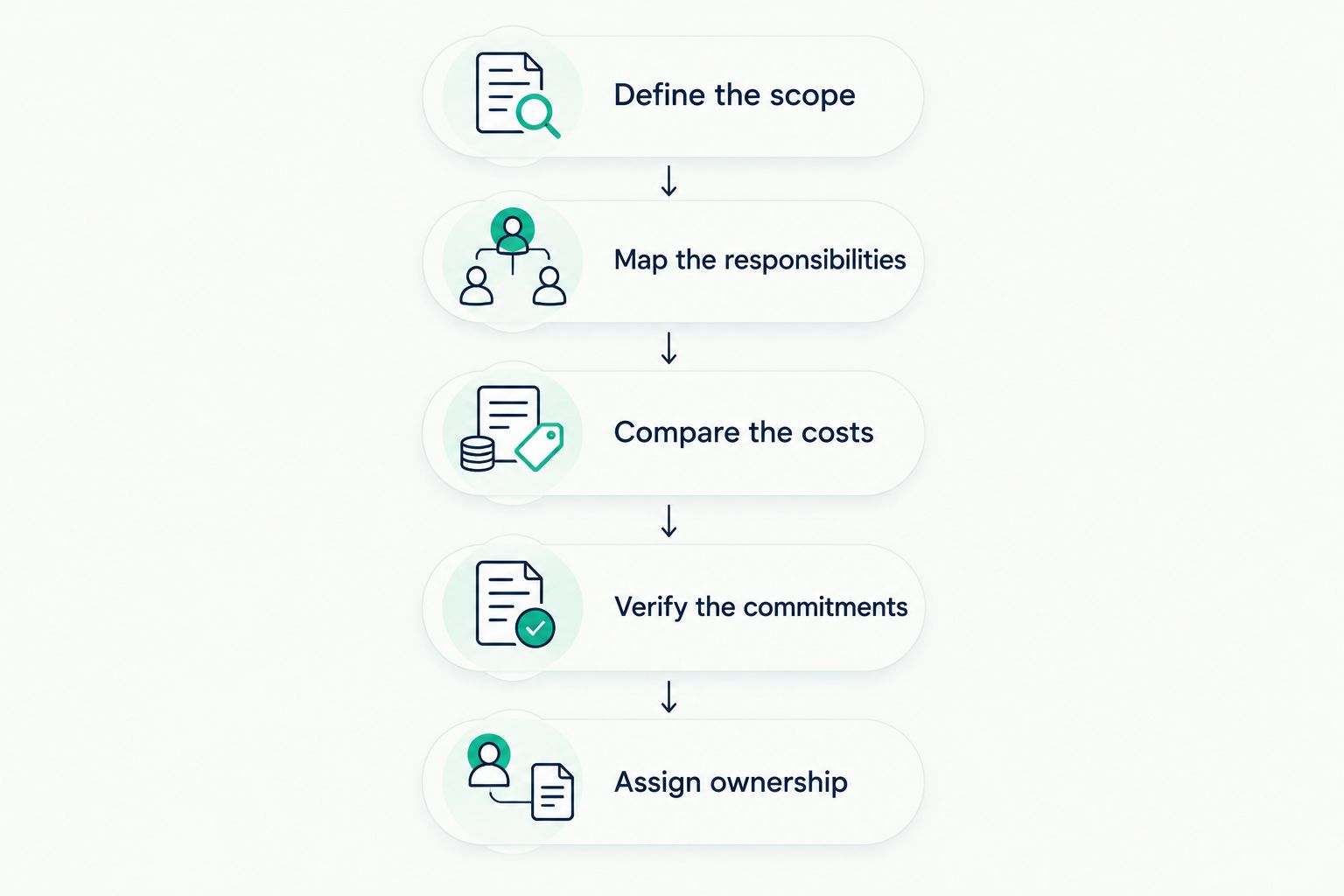
Define equivalent responsibilities before comparing the delivery models.
The completed worksheet should expose differences rather than hide them. If an external proposal excludes a critical responsibility, add its owner and cost before making the decision.
What should a help desk service commitment actually say?
A response commitment is not a resolution commitment. An acknowledgment confirms that a request arrived; access to a live expert establishes contact; resolution means the underlying issue is fixed. Ask the provider to define these events separately.
DivergeIT’s stated service commitments include a 15-minute response in writing and access to a live expert in 5 minutes. Check the applicable agreement for coverage hours, qualifying requests, escalation rules, and how those commitments apply to your support scope.
For your 2026 review, ask for the following terms in writing:
- Clock start: The event that starts the response measurement.
- Priority rules: The criteria distinguishing a business interruption from a routine request.
- Escalation ownership: The person or team responsible when the initial technician cannot resolve the issue.
- Communication: Who receives updates and how the business learns about a significant interruption.
- Performance review: The service records available to verify delivery against the agreement.
A short response target is useful only when you understand what happens next. Compare the entire escalation path, not just the first interaction.
When does managed IT belong in the decision?
A help desk handles employee support, but your buying decision can include broader operational needs. Keep cybersecurity, compliance support, and other managed IT responsibilities visible as separate scope items.
DivergeIT managed IT services are best suited to growing small and mid-sized businesses seeking IT, cybersecurity, and compliance support. The service fit still depends on the agreement: broader capabilities do not establish which tasks are included in your proposal or prove savings against your staffing plan.
Review DivergeIT against the responsibilities you need covered. Ask for a written division between employee support, ongoing administration, security work, compliance assistance, and separately scoped projects.
Discuss your help desk requirements
Bring your coverage needs, retained responsibilities, and escalation requirements to the conversation.
Is comparing outsourcing with salary alone enough?
Salary alone is not the complete cost of an internal help desk. Include the employment costs, tools, management, training, and coverage your business requires, then apply the same discipline to the external proposal.
Should you replace an existing IT employee with outsourced support?
Do not replace an employee based only on a narrower help desk proposal. Map the employee’s actual responsibilities first, including application knowledge, vendor coordination, security administration, and business approvals that the proposed agreement does not cover.
Can you outsource support without giving up IT control?
You can retain business control while delegating defined support tasks. Keep access approval, change authorization, service review, and escalation ownership explicit so delegated technical work does not become unapproved decision-making.
FAQ
Is it cheaper to outsource IT helpdesk support?
Outsourcing is cheaper only when its complete cost is lower for an equivalent service. Compare coverage, responsibilities, exclusions, transition work, and retained internal effort—not a proposal against salary alone.
What should I include when comparing an IT hire with outsourced support?
Include the costs required to deliver the same responsibilities under each model. For hiring, review employment, tools, training, management, and backup coverage; for outsourcing, review the agreement, transition work, exclusions, and internal oversight.
Is co-managed IT better if I already have an IT employee?
Co-managed IT fits a situation where you want to retain internal ownership while delegating specific support responsibilities. It requires a clear division of work and a named escalation owner.
Does a fast help desk response mean my issue gets fixed immediately?
A fast response does not mean immediate resolution. Ask how the provider defines acknowledgment, expert contact, escalation, and resolution targets.
Does outsourced help desk support include cybersecurity and compliance?
Cybersecurity and compliance work belongs in the agreement only when explicitly included. Identify who owns security monitoring, incident response, access administration, and compliance evidence rather than assuming help desk coverage includes them.
Who are DivergeIT managed IT services best suited to?
DivergeIT managed IT services fit growing small and mid-sized businesses seeking IT, cybersecurity, and compliance support. Confirm the responsibilities and service commitments included in the proposed agreement.
One last thing
Before signing a 2026 agreement or approving a hire, write the support plan for an absence. Identify who receives employee requests, handles urgent access problems, and escalates an interruption when the primary technician is unavailable.
If the backup owner is blank, the comparison is unfinished. Fill that gap before deciding which option costs less.