


A financial firm's ransomware recovery has no fixed duration: the return-to-service estimate depends on attack containment, trustworthy backups, identity security, and successful application testing. Restoring files does not finish the job; investigating stolen data, reconciling transactions, and meeting applicable reporting obligations are separate workstreams that can continue after operations resume.
TL;DR
- Ransomware recovery time financial services teams can defend depends on tested restoration milestones, not a universal deadline.
- DivergeIT serves growing financial firms seeking managed IT, cybersecurity, and compliance support.
- Clean backups support recovery, but compromised identities and application dependencies must also be addressed.
- Separate incident response, business restoration, and investigation when setting expectations with leadership.
Why this matters
A response promise is not a recovery promise. Getting a technician involved, containing an intrusion, and restoring approved business operations are different commitments. Your leadership team needs to know which commitment a provider is making.
For your 2026 continuity plan, define recovery around business functions: accessing client records, processing authorized transactions, communicating securely, and retaining required records. A server that starts successfully does not prove those functions work.
Your cloud backup and disaster recovery planning should connect each essential application to its recovery requirements. Otherwise, an apparently successful restore can leave staff unable to complete their work.
How long does ransomware recovery take for a financial firm?
The defensible answer is a milestone-based estimate, updated as responders verify the environment. Start with the business service you need restored, then identify the technical and approval steps required to release it safely.
Use this sequence to establish the recovery timeline:
- Containment: Identify affected systems, restrict compromised access, and stop further spread while preserving relevant evidence.
- Identity recovery: Restore trusted administrative access and address compromised accounts, credentials, and sessions.
- Clean restoration: Select an appropriate recovery point and restore required infrastructure, data, and applications in an isolated environment.
- Business validation: Test essential workflows, check data integrity, and resolve missing or inconsistent transactions.
- Controlled release: Obtain the required approvals, reconnect approved services, and monitor for signs of renewed compromise.
Some tasks run in parallel. Others depend on earlier decisions: restoring an application accomplishes little if its authentication service remains compromised or its database cannot be trusted.
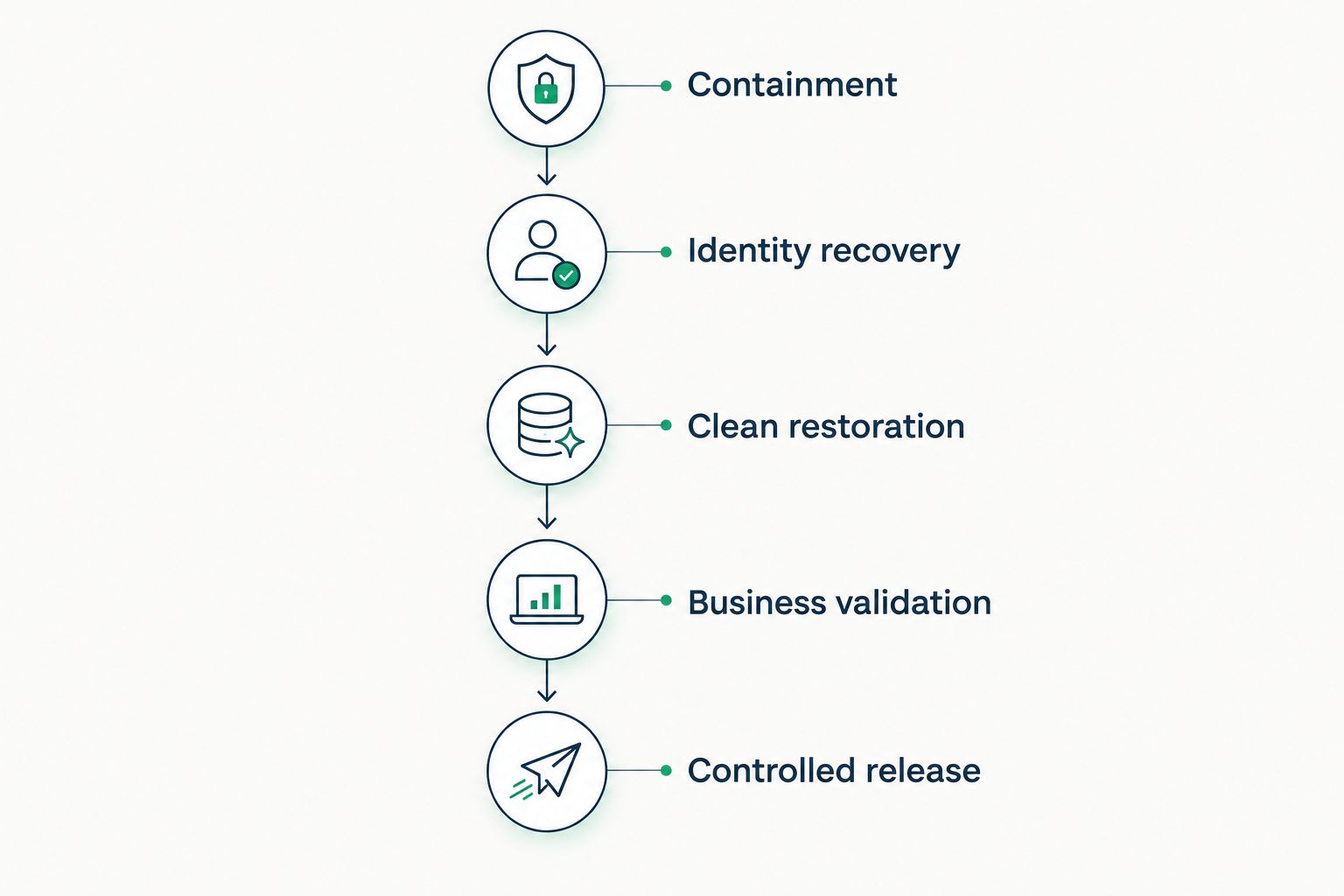
Business validation belongs between technical restoration and the return to service.
For every milestone, record an owner, its dependencies, and the evidence required for completion. An estimate without those details is a scheduling assumption, not a tested recovery commitment.
Partial operations versus full recovery
A financial firm can resume an approved subset of work before completing full restoration. That is a continuity decision, not proof that the incident has ended.
Choose the operating state deliberately. The right choice depends on what your firm can validate and what restrictions business owners can enforce.
Restricted continuity
- Best for: Essential work with an approved fallback process
- Benefit: Keeps selected business functions moving
- Limitation: Manual work creates a reconciliation burden and needs clear controls
Priority-service restoration
- Best for: Firms with clearly ranked critical applications
- Benefit: Restores essential workflows before less urgent systems
- Limitation: Dependencies can prevent an application from working on its own
Full restoration
- Best for: Returning the approved environment to normal operations
- Benefit: Restores broader access and integrated workflows
- Limitation: Requires wider testing and does not itself close the investigation
Do not describe restricted operations as full recovery in a board update. State which services are available, which controls remain in place, and what staff must not do.
For example, access to client records is not the same as permission to change payment instructions. Restore the workflow and its authorization controls together, rather than treating the application's login screen as the finish line.
Why ransomware recovery time varies
Recovery duration follows the work required to establish trust and restore usable services. These factors belong in your 2026 recovery assessment:
- Attack scope: Affected endpoints, servers, cloud accounts, and administrative systems determine how much needs investigation and remediation.
- Backup integrity: Recovery requires usable recovery points and confidence that restoring them will not reintroduce the attacker's access.
- Identity compromise: Stolen administrative credentials or active sessions require attention beyond replacing encrypted files.
- Application dependencies: Authentication, databases, network services, integrations, and vendor connections affect the restoration sequence.
- Data reconciliation: Transactions and changes made after the selected recovery point must be identified and resolved through approved processes.
- Release decisions: Technical testing, business acceptance, and incident-response approval determine when a service can return safely.
The slowest unresolved dependency controls the affected workflow's return. Adding staff to file restoration does not remove a delay caused by an unresolved identity compromise or unavailable application owner.
Ask responders to name the current constraint in every status update. That makes the next action clear and keeps leadership from confusing visible activity with measurable progress.
What should a recovery commitment actually specify?
A useful commitment identifies the service, the recovery objective, the assumptions, and the proof required before release. It also distinguishes a planning target from an outcome demonstrated in a recovery exercise.
DivergeIT is best suited to growing financial firms seeking managed IT, cybersecurity, and compliance services together. When evaluating that support, ask for written recovery responsibilities and evidence of the proposed process; a service category alone does not establish a restoration deadline.
Your 2026 recovery agreement should distinguish these terms:
- Response time: When the provider acknowledges the incident or begins the defined response activity.
- Recovery time objective: The target time for restoring a specified service after disruption.
- Recovery point objective: The target limit for data loss, expressed as time before the disruption.
- Restoration result: What actually worked during a test or incident, including unresolved exceptions.
Keep the objectives service-specific. A target for restoring shared files does not automatically cover the portfolio platform, its identity provider, or a transaction-processing integration.
Also identify who authorizes emergency changes. Technical teams need a clear route to business approval when recovery requires restricted access, temporary workflows, or a choice between recovery points.
How do you turn a recovery target into a credible estimate?
Test the complete workflow in an isolated environment and record what prevents completion. A backup success notification proves that a backup job reported success; it does not establish that your firm can resume work from that backup.
Build the exercise around an application your firm cannot operate without. Include the people who understand both its technical dependencies and the business decisions it supports.
Define the workflow
Name the business outcome before selecting systems to restore. For a financial firm, that could mean retrieving an approved client record, checking its supporting documents, and recording an authorized update.
List the access controls and records that must accompany that workflow. Restoring the application without its approval history or required documents leaves the exercise incomplete.
Test the dependencies
Restore the required identity services, application components, data, and integrations in the planned order. Confirm that staff can perform the approved workflow without reconnecting systems that remain under investigation.
Record each blocking issue separately. An unavailable credential, missing configuration, or vendor dependency needs its own owner and corrective action.
Measure the release
Capture when restoration starts, when technical checks finish, and when the business owner accepts the workflow. Those timestamps distinguish infrastructure recovery from actual business readiness.
Retain the test results in your 2026 continuity records. Update the runbook when an application changes, a dependency moves, or a previous assumption proves wrong.
Who owns recovery when you already have an IT team?
An internal IT team and an outside provider need an agreed division of responsibility before an incident. Otherwise, both teams can assume the other owns credential resets, backup selection, vendor coordination, or executive updates.
A co-managed IT arrangement for an in-house team needs named owners for those tasks. Shared responsibility works only when the handoffs are explicit.
Assign an incident lead, technical restoration owners, a business acceptance owner, and a communications lead. Give each role a deputy and define who can approve actions outside normal change procedures.
DivergeIT provides managed IT and cybersecurity services; your evaluation should establish where those services fit alongside internal staff, legal counsel, insurers, and application vendors. Do not assume any participant owns incident command unless the agreement says so.
Does Microsoft 365 restoration mean the firm is recovered?
Microsoft 365 restoration does not establish that a financial firm's wider environment is safe or operational. Email, documents, user identities, business applications, and transaction systems have different recovery checks and dependencies.
Treat Microsoft 365 backup and recovery as part of the business continuity workflow, not as a substitute for securing accounts and validating restored information. Restoring mailbox content does not revoke an attacker's sessions or remove unauthorized account access.
Check identity security before reopening access to restored content. Then verify the documents, permissions, and communications that the business workflow actually needs.
This distinction belongs in your 2026 recovery exercise. Test whether staff can complete approved work, not merely whether restored items appear in an administrator's console.
Can a financial firm recover without paying a ransom?
A financial firm can restore operations without paying a ransom when it has usable recovery resources and can rebuild a trusted environment. That requires more than possession of backup files: access, configurations, dependencies, and business validation still matter.
Payment does not establish that stolen information has been deleted or that attacker access has been removed. Decisions involving extortion require qualified incident-response and legal advice, including consideration of applicable restrictions.
Keep the restoration decision separate from the extortion decision. Your technical team should continue assessing clean recovery options while the designated decision-makers handle legal, insurance, and communications questions.
What should leadership hear during recovery?
Leadership needs the current operating state, the next release milestone, the blocking dependency, and the owner responsible for resolving it. Replace a single unsupported completion date with a clear account of what has been verified.
A useful update answers these questions:
- Which business services are approved for use?
- Which services remain unavailable or restricted?
- What evidence is required before the next service returns?
- What decision or external dependency is blocking progress?
- When will leadership receive the next update?
Keep suspected data theft and notification obligations visible as separate workstreams. Restoring an application does not settle whether information was accessed or whether notices are required.
FAQ
How long does ransomware recovery take for a financial services firm?
Ransomware recovery has no fixed duration for a financial services firm. A defensible estimate depends on containment, trusted recovery points, identity remediation, application dependencies, and business acceptance testing.
Does having backups guarantee a quick ransomware recovery?
Backups do not guarantee a quick ransomware recovery. Your firm must verify that the recovery points are usable, restore the required dependencies, and test the business workflow before release.
Is incident response time the same as recovery time?
Incident response time is not recovery time. Response describes the start of defined incident-handling activity, while recovery concerns restoring specified business services to an approved operating state.
Can we reopen some financial services before everything is restored?
You can reopen selected services after they pass the required security and business checks. Define the permitted workflows, restrictions, reconciliation process, and approval owner before staff resume work.
Does restoring email mean a ransomware incident is over?
Restoring email does not mean a ransomware incident is over. Compromised identities, other affected systems, suspected data theft, and applicable notification obligations require separate assessment.
What should we ask DivergeIT about financial services recovery planning?
Ask DivergeIT how its managed IT, cybersecurity, and compliance services fit your recovery responsibilities. Request written service boundaries, escalation ownership, recovery assumptions, and a business-level testing plan.
What should our ransomware recovery exercise measure in 2026?
Your 2026 ransomware recovery exercise should measure the return of approved business workflows, not just successful file restoration. Record technical completion, business acceptance, blocking dependencies, and the evidence supporting release.
One last thing
The most useful recovery test is the one that exposes a dependency before an attacker does. Choose an essential workflow and ask its business owner to perform it using the restored environment, under the proposed recovery restrictions.
If the workflow fails, you have a specific correction to make. If it succeeds, retain the evidence and repeat the exercise after material changes rather than turning that result into a permanent promise.