


Yes—outsourced help desk support can meet government compliance rules when the provider’s access, systems, staff and procedures satisfy the requirements that apply to your agency. Outsourcing does not transfer your agency’s accountability, and a provider’s general security credentials do not establish compliance for your particular environment. In 2026, evaluate the actual support workflow and contractual obligations—not a blanket claim of being government-compliant.
TL;DR
- An outsourced helpdesk for government agencies needs documented access controls, incident procedures and audit evidence—not blanket compliance claims.
- NIST guidance supports control selection; applicable laws, contracts and agency requirements determine your obligations.
- Keep agency approval over privileged access, sensitive changes and incident decisions.
- Require evidence covering ticketing systems, remote support tools, subcontractors and contract exit.
Why this matters
Help desk staff reset credentials, troubleshoot endpoints and handle screenshots or diagnostic files. Those activities create access paths into agency systems and additional copies of sensitive information. A secure endpoint does not compensate for an unrestricted support account or an attachment stored outside the approved environment.
You do not have to outsource every decision to outsource support. A co-managed help desk model separates outside execution from internal oversight. For a government agency, that division needs named owners, explicit approvals and records showing who did what.
Can outsourced help desk support meet government compliance rules?
Yes, provided the outsourced service meets the requirements applicable to the information and systems it touches. Start with your agency’s legal, procurement and security requirements, then map the proposed service against them. The provider should show how each relevant control operates and where the supporting evidence lives.
There is no single government help desk certification that settles every procurement. Federal, state and local environments have different obligations, and additional rules attach to particular information or services.
FISMA and agency security requirements
- When it matters: Federal information systems and applicable contractor-operated systems
- What to examine in support operations: Assigned controls, assessment evidence and the agency’s authorization boundary
NIST SP 800-53
- When it matters: When adopted as the control catalog for the environment
- What to examine in support operations: Access control, audit logging, personnel security and incident handling
NIST SP 800-171
- When it matters: Nonfederal systems handling controlled unclassified information under applicable requirements
- What to examine in support operations: Whether support tools, staff access and ticket contents fall within scope
CJIS Security Policy
- When it matters: When support accesses criminal justice information or relevant systems
- What to examine in support operations: Applicable access, personnel, authentication and handling requirements
FedRAMP
- When it matters: Cloud services used by federal agencies where authorization requirements apply
- What to examine in support operations: Whether the exact cloud service and offering have the required authorization
State and local requirements
- When it matters: Agency-specific procurement, privacy, records and security obligations
- What to examine in support operations: Contract terms, retention rules, approved locations and reporting duties
These sources serve different purposes. A NIST publication is not a vendor certification, and FedRAMP authorization for a cloud offering does not authorize every service a provider sells. In your 2026 procurement, identify the applicable versions and agency requirements explicitly rather than accepting a list of framework names.
Which support model gives your agency the right control?
Choose the operating model around the authority you need to retain. Broader outsourcing places more responsibility on contract oversight and evidence review; narrower outsourcing leaves more technical work with your internal team.
Agency-led support
- Best for: Agencies keeping support execution and privileged administration internal
- Main advantage: Direct control over staffing, access and procedures
- Main limitation: Your agency must maintain coverage, skills and operational documentation
Co-managed support
- Best for: Agencies retaining technical leadership while assigning defined support tasks externally
- Main advantage: Clear separation between external work and internal approval
- Main limitation: Handoffs fail when responsibilities or escalation paths are unclear
Outsourced support
- Best for: Agencies assigning a defined support operation to an external provider
- Main advantage: A single contracted operating scope
- Main limitation: Strong oversight remains necessary, particularly for privileged access and subcontractors
Choose co-managed support when your agency needs outside execution but must retain internal approval authority. Choose broader outsourcing only when the provider can demonstrate the required controls across the entire contracted scope. Neither model removes the agency’s responsibility to verify performance.
Why government help desk compliance requirements vary
The right contract depends on what support staff can see, change and export. These factors determine the scope of your review:
- Information type: Public documents, personal information, controlled unclassified information and criminal justice information require different handling decisions.
- System boundary: A technician’s access to a restricted application creates different obligations from support limited to public-facing resources.
- Service authority: Password resets, account creation, remote administration and security configuration changes require different approval controls.
- Data locations: Ticket storage, backups, diagnostic uploads and remote-access infrastructure all belong in the review.
- Personnel and subcontractors: Establish who performs support, what screening applies and whether another organization can access agency information.
- Agency obligations: Procurement terms, records schedules, incident procedures and oversight requirements shape the final service specification.
Do not treat a requirement from one government customer as proof that the same service fits yours. Ask the provider to map its controls to your agency’s documented scope.
How do you verify a provider before granting access?
Use a structured acceptance process before production access. Your 2026 review should follow information from the initial request through remote support, escalation, ticket closure and eventual deletion or transfer.
Define scope
List the supported systems, information categories, permitted tasks and prohibited activities. Include the help desk’s own tools: ticketing, remote access, chat, call recording, knowledge storage and diagnostic collection.
Identify where sensitive information can enter those tools. An attachment uploaded during troubleshooting needs the same scope review as information accessed directly on an agency device.
Assign ownership
Create a responsibility matrix for account approval, privileged changes, incident declaration, evidence preservation and records requests. Name an agency owner for each decision and a provider owner for each operational task.
Separate response from resolution. Acknowledging a ticket is not the same as restoring service, containing a suspected compromise or completing an authorized change. Write those distinctions into the service agreement.
Restrict access
Require named accounts, appropriate multifactor authentication and access limited to approved work. Define how elevated privileges are requested, authorized, used and removed.
Document emergency access separately. Emergency work still needs attribution and review; it should not become a standing exception that allows shared credentials or unexplained administrative sessions.
Test workflows
Run representative requests before accepting the service. Use synthetic information rather than live sensitive records, and check both the technician’s actions and the records those actions generate.
Include a password reset, an administrative change and a suspected security incident. Each exposes a different failure mode: weak identity verification, excessive authority or delayed escalation.
Retain evidence
Specify which logs, approvals, tickets and incident records your agency receives. Confirm that exported evidence remains readable and attributable without continued dependence on the provider’s portal.
Set retention and disposal rules from applicable requirements and agency policy. Do not let a tool’s default retention setting become your records policy by accident.
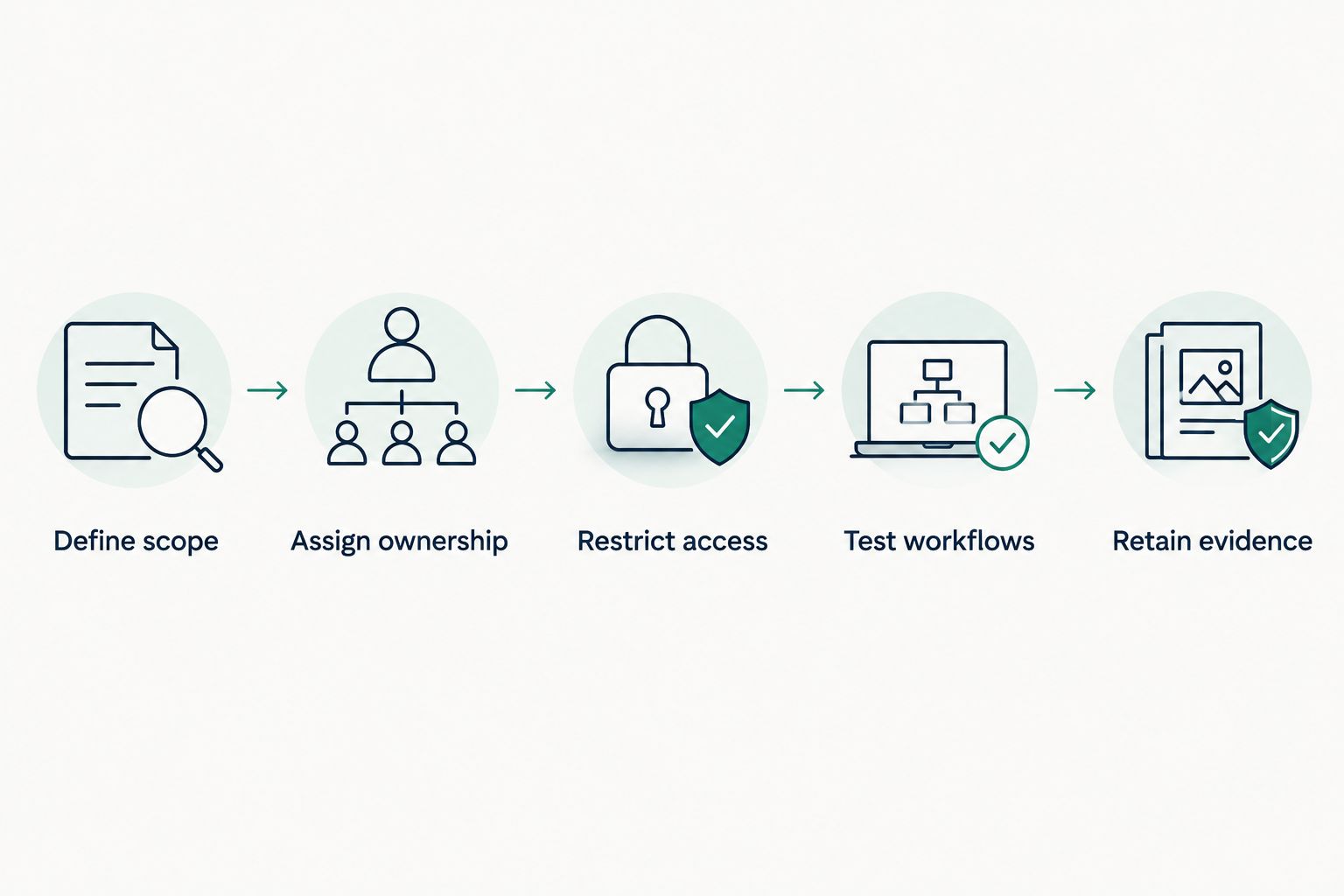
Verify the full support workflow before granting production access.
What should the contract require?
Translate security expectations into obligations you can inspect. A policy statement alone does not tell you whether the provider followed that policy on an agency ticket.
For a 2026 agreement, document these items before onboarding:
- Permitted access: Authorized systems, tasks, information categories and conditions for elevated privileges.
- Personnel requirements: Applicable screening, training, confidentiality obligations and access removal procedures.
- Tool boundaries: Approved support applications, storage locations and restrictions on uploading agency information elsewhere.
- Incident coordination: Notification triggers, agency contacts, evidence preservation and decision authority.
- Subcontractor controls: Disclosure, approval conditions and contractual requirements passed to other service providers.
- Verification and exit: Evidence access, remediation responsibilities, record transfer, account removal and confirmed disposal where required.
Require a change process when the provider introduces a new support platform, subcontractor or storage location. Otherwise, the service you assessed can change without a corresponding security review.
For municipal operations, cybersecurity for local governments must include the support channel itself: identity verification, remote access and incident escalation affect the systems that deliver public services. Put those responsibilities in the contract rather than leaving them in an informal onboarding conversation.
What evidence should you request?
Ask for evidence tied to the proposed service, not just the provider’s organization. A corporate security report has limited value if it excludes the tools, locations or subcontractors that will handle your agency’s requests.
Request a control mapping, relevant assessment material, sample access records and a demonstration of ticket export. Sensitive provider documents can be reviewed through an agreed confidentiality process; their confidentiality does not remove the need for verification.
A SOC 2 report can inform due diligence, but it does not certify compliance with every government requirement. Read its scope, reporting period, exceptions and customer responsibilities before deciding what it establishes.
Use an acceptance test with observable outcomes
As a practical starting point, require 3 test tickets: a credential reset, a privileged change and a suspected compromise. This is a recommended acceptance exercise, not a regulatory minimum.
For the privileged-change exercise, define 2 approval points: permission to grant elevated access and acceptance of the completed change. Assign 1 accountable agency owner to decide whether the overall test passes.
Check whether each ticket records the requester, verification method, technician, authorization, action and outcome. For the suspected compromise, confirm that escalation preserves evidence rather than treating the event as an ordinary troubleshooting request.
Is a fast help desk response enough to prove compliance?
No—response speed measures service performance, not compliance. Your 2026 acceptance criteria should assess both: whether a qualified person responds as agreed and whether the resulting work follows approved controls.
Ask what starts the response clock, which requests qualify and how after-hours escalation works. Then inspect identity verification, access authorization and ticket records independently. A fast unauthorized password reset is still a control failure.
Can an outsourced provider handle sensitive government information?
Yes, when the applicable requirements and agency approvals permit the proposed handling. Assess every place the information travels, including attachments, screen recordings, diagnostic files, backups and subcontractor systems.
Where a support task does not need sensitive content, prohibit its collection. Keeping unnecessary information out of tickets reduces the scope you must manage without preventing legitimate troubleshooting.
Where does DivergeIT fit in the evaluation?
DivergeIT is best suited to growing small and mid-sized businesses seeking managed IT services, cybersecurity and compliance support. That stated focus does not establish government authorization, contract eligibility or suitability for a restricted agency environment.
If your agency is evaluating DivergeIT managed IT services, use the same evidence requirements described here. Ask DivergeIT to address your exact information categories, access restrictions and contractual obligations before treating the service as a government fit.
The advantage of considering managed IT and cybersecurity together is that support actions can be assessed alongside security responsibilities. The limitation is equally important: DivergeIT cybersecurity and compliance services must still be evaluated against your agency’s requirements, not inferred from the service category.
FAQ
Can a government agency outsource its IT help desk?
Yes, when applicable procurement, security and information-handling requirements permit the arrangement. The agency must define the service scope, assign oversight and verify the provider’s controls.
Does outsourcing transfer compliance responsibility to the provider?
No. A provider can perform contracted controls, but the agency retains its own accountability and must establish who approves access, accepts risk and oversees performance.
Does a help desk provider need FedRAMP authorization?
FedRAMP requirements concern applicable cloud service offerings used by federal agencies, not a blanket authorization for every help desk provider. Assess the exact cloud tools and offerings used to store or process agency information.
Is a SOC 2 report enough for government help desk compliance?
No. A SOC 2 report is due-diligence evidence, not proof that every agency requirement is satisfied. Review its scope, exceptions and customer responsibilities against your proposed support environment.
Can outsourced technicians reset government employee passwords?
Yes, when agency policy authorizes the task and the support workflow meets applicable requirements. Require identity verification, approved privileges and an attributable record of the reset.
Can sensitive information appear in support tickets?
Only when the approved ticketing environment and handling procedures satisfy the applicable requirements. Avoid collecting sensitive content when troubleshooting does not require it.
What should happen when the help desk contract ends?
The agreed exit process should transfer required records, remove provider access and address retained copies under applicable rules. Include subcontractors and support tools rather than checking only the primary technician accounts.
One last thing
Test a denied request, not just a successful one. Ask an unapproved requester to seek a password reset or administrative change during your acceptance exercise. A help desk that stops the request, records the reason and follows the escalation procedure demonstrates a control that a response-time dashboard cannot show.